
Cellini Salt Cellar
Cellini Salt Cellar is a golden salt cellar made by Benvenuto Cellini, the Italian sculptor and goldsmith, between 1540 and 1543 for King Francis I of France. It symbolizes planet Earth through two seated figures, a man and a woman, whose interwoven legs represent Sea and Land; at their meeting point, salt is formed. The work is made of gold partly covered with enamel and stands on an oval ebony base. It measures 26 cm in height, 33.5 cm in length, and weighs about 5 kilograms. After passing from Charles IX to Archduke Ferdinand II, it was kept at Ambras Castle and later entered the Kunsthistorisches Museum in Vienna.
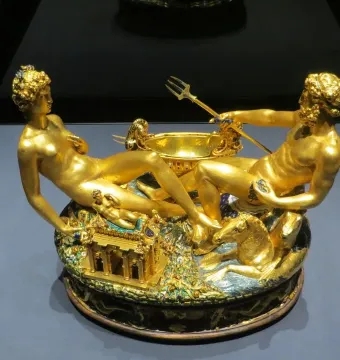
October 2016 © Jononmac46 · CC BY-SA 4.0
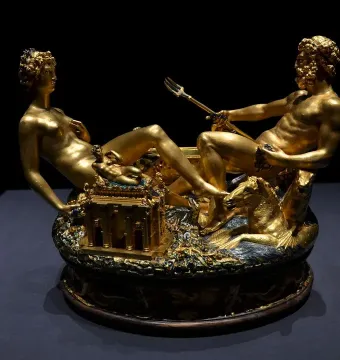
April 2013 © Vassil · CC0
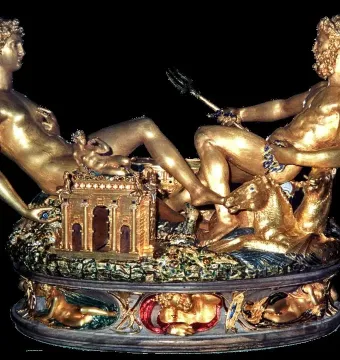
© Benvenuto Cellini · CC BY 3.0
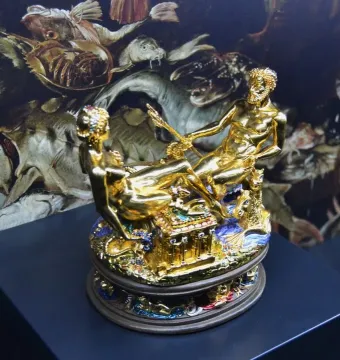
December 2013 © Joanbanjo · CC BY-SA 3.0
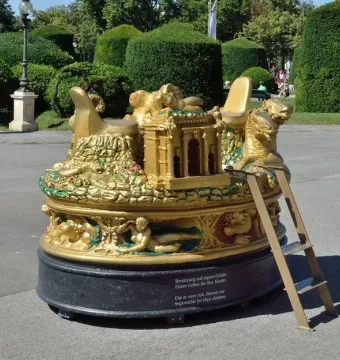
June 2018 © Herzi Pinki · CC BY-SA 4.0
Identification | |
| Title | Cellini Salt Cellar |
| Alternative names | Saliera; Salt Cellar of Francis I; Francis I Salt Cellar; La Saliera di Francesco I; La Salière de Cellini; Salero de Francisco I de Francia; "The Sculpture's Mona Lisa" |
| Type | Gold salt cellar |
Historical context | |
| Style / period | Mannerism; Italian Renaissance |
Creator | |
| Artist | Benvenuto Cellini |
| Artist's occupation | Italian sculptor, goldsmith, and writer |
| Artist's lifespan | c. 1500–1571 |
Creation | |
| Reported price | 1,000 scudi |
| Technique | Beaten from a wax model in gold sheet and partly enamelled |
| Assistance | Made with assistance from five other artists: two from Italy, two from France, and one from Germany |
| Advice on iconography | Luigi Alamanni and Gabriele Cesano |
| Original model | A wax model made earlier in Rome for Cardinal Ippolito d'Este |
| Commissioned by | Francis I of France; originally planned for Cardinal Ippolito d'Este |
| Place of creation | France, at the court of Francis I |
| Date of creation | 1540–1543 |
| Model subject | Two figures, identified as Ceres and Neptune |
Materials | |
| Materials | Gold, enamel, ebony, ivory balls; the model was wax |
Physical characteristics | |
| Dimensions | Height 26.3 cm; base width 33.5 cm; overall dimensions also given as 28.5 × 21.5 × 26.3 cm |
| Weight | About 5 kilograms |
| Base | Oval ebony base with gold decoration, divided into eight niches with allegories of the seasons and times of day |
| Support | Resting on four ivory balls embedded in the ebony base, allowing it to roll in all directions |
Appearance | |
| Additional iconography | A ship-shaped salt container carried by four horse-like sea creatures; land animals; a cornucopia overflowing with flowers and fruit; allegories of Dawn, Day, Dusk, and Night beneath the main figures |
| Central figures | Neptune and Tellus (or the Sea and the Land), seated opposite each other with intertwined legs |
| Tellus figure | Seated female figure beside a temple-like pepper container |
| Neptune figure | Reclining male figure with a trident |
Iconography and meaning | |
| Subject | An allegory of the union of sea and land, from which salt is born |
| Symbolism | Neptune represents the sea and salt; Tellus represents the earth and pepper; the work was also intended as a conversation piece about its meanings |
| Artist's explanation | Cellini said he made the two figures sitting opposite each other with crossed feet to show how the sea joins with the earth |
Location and ownership | |
| Original location | Ambras Castle, where Ferdinand kept his art collection |
| Entry to museum collection | In the 19th century |
| Museum collection | Decorative arts collection of the Kunsthistorisches Museum in Vienna |
| Current location | Kunsthistorisches Museum, Vienna, in the Kunstkammer permanent exhibition |
| Gift recipient | Archduke Ferdinand II of Tyrol |
| Gifted by | Charles IX of France |
| Patron at completion | Francis I of France |
| Original intended patron | Cardinal Ippolito d'Este |
History and restoration | |
| Theft | Stolen on the night of 10–11 May 2003 during renovation of the museum facade |
| Stolen by | Museum technician Robert Mang |
| Ransom demand | A ransom demand of about 10 million euro failed |
| Recovery | Recovered on 21–22 January 2006 in a forest near Zwettl, Austria, buried in a container |
| Thief's stated motive | He claimed he wanted to prove the ineffectiveness of the museum alarms, but the court did not believe this explanation |
| Sentence | 4 years in prison |
Significance | |
| Significance | Cellini's most famous work; the only extant gold sculpture by Benvenuto Cellini; one of the most famous surviving Renaissance gold sculptures; a masterpiece of goldsmithing and a major work of European Mannerism |