
Medal of John VIII Palaiologos
The Medal of John VIII Palaiologos is a portrait medal by the Italian Renaissance artist Pisanello, and it is generally considered the first portrait medal of the Renaissance. The obverse shows a profile portrait of the penultimate Byzantine emperor, John VIII Palaeologus, while the reverse depicts him on horseback before a wayside cross. The work was likely made during 1438 and 1439, when John was in Italy attending the Council of Ferrara, later moved to Florence. It is not known who commissioned the medal, though Leonello d’Este has been suggested as a likely candidate. The medal had a significant impact on later art and influenced sculpture and painting beyond numismatics.
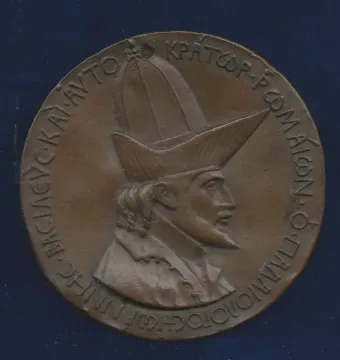
December 1439 © Berlin-George · Public domain
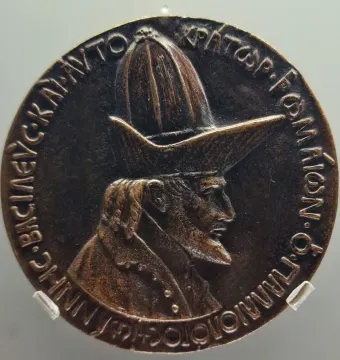
© historia · CC BY-SA 4.0
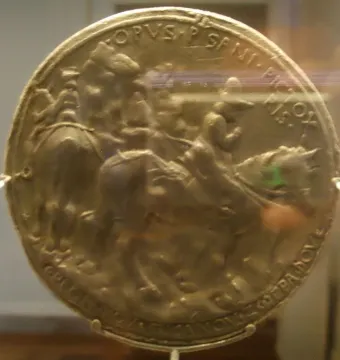
October 2007 © sailko · CC BY 2.5
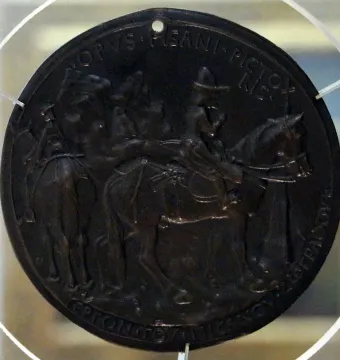
© Sailko · CC BY-SA 3.0
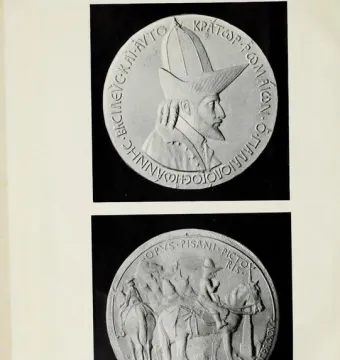
1904 © Fabriczy, Cornelius von, 1839-1910 · No restrictions
Identification | |
| Title | Medal of John VIII Palaiologos |
| Type | portrait medal |
Creator | |
| Artist | Pisanello |
Historical context | |
| Date | 1438–1439, probably |
| Context of creation | Made in connection with John VIII Palaiologos's visit to Italy for the Council of Ferrara, later moved to Florence, to discuss reunification of the Latin and Greek churches |
| Place of creation | Probably Ferrara; some historians propose Padua, while an unverified account reported by Vasari says Florence after the council moved there |
| Commissioner | Unknown; possibly John VIII Palaiologos or an Italian host. Leonello d'Este has been suggested as the most likely candidate |
| Dating basis | John VIII Palaiologos was in Italy in 1438–1439 for the council |
| Historical period | 15th century |
| Cultural context | Northern Italian court culture with growing appreciation of classical learning and ancient coins |
| Possible intellectual influences | Ancient Roman coins and medals; possibly the culture of chivalry and hunting imagery; possibly classical learning at Ferrara; possibly Byzantine enkolpia as models for prototype medals |
| Possible related project | The Ferrarese court may have intended to commission Pisanello to paint a series of frescoes celebrating the event, but the project was likely abandoned after the council moved to Florence |
Physical characteristics | |
| Example size | 10.3 cm diameter (British Museum example) |
| Known specimens | A number of specimens survive |
| Medium | medal |
Materials | |
| Primary materials of surviving specimens | Bronze or lead casts |
| Other materials used for Renaissance medals | Gold or silver |
| Example material | Bronze example in the British Museum |
Technique | |
| Technique | Cast |
Appearance | |
| Top inscription translation | The work of Pisano the painter |
| Top inscription | OPVS • PISANI • PICTORIS |
| Top inscription language | Latin |
| Reverse inscription translation | The work of Pisano the painter |
| Reverse inscription | ἜPΓON • TÔV • ΠICÁNOV • ZΩΓPÁΦOV |
| Reverse inscription language | Greek |
| Reverse scene interpretation | A hunting expedition interrupted by the emperor's encounter with a wayside cross |
| Reverse depiction details | The emperor wears his distinctive hat, carries a bow on his left side and a quiver of arrows above his right leg, and raises his right hand in acknowledgment of the cross; the horse has double reins and elaborate hindquarter straps |
| Reverse | John VIII Palaiologos on horseback in profile to the right, with a page or squire mounted behind him and a rocky landscape, approaching a wayside cross |
| Obverse inscription translation | John, emperor and autocrat of the Romans, the Palaeologus |
| Obverse inscription | +ἸΩÁΝΝΗC • BACIΛEV̀C • KAÌ • ἈVTOKPÁTΩP • ῬΩMÁIΩN • Ὁ • ΠAΛΑIOΛÓΓΟC |
| Obverse inscription language | Greek |
| Obverse hat | A large sharply peaked hat with a tall, domed, vertically ribbed crown and a jewel at the summit |
| Obverse depiction details | The emperor has corkscrew curls, a moustache and pointed beard, a slightly stooped posture, and a high-necked shirt with an open jacket and visible buttons |
| Obverse | Bust profile portrait of John VIII Palaiologos facing right |
Iconography and meaning | |
| Subject | John VIII Palaiologos, Byzantine emperor |
| Obverse significance | The profile bust echoes Roman imperial coin portraits and presents the emperor as a living likeness |
| Reverse significance | The reverse combines hunting imagery with a Christian emblem, possibly presenting John as a modern St Eustace |
| Cultural meaning | The medal's mixed Greek and Latin inscriptions and imagery were intended to underscore the reunion of the Eastern and Western churches and the link between East and West |
| Stylistic comparison | The medal was likely conceived to resemble ancient coins |
Location and ownership | |
| Related drawing locations | Paris and Chicago |
| Recipient | John VIII Palaiologos |
History and restoration | |
| Commission status | It is not known whether the emperor or his Italian hosts commissioned the medal |
| Associated drawings | Several drawings by Pisanello are closely associated with the medal, including sketches in the Vallardi Codex and sheets now in Paris and Chicago |
| Drawing evidence | The associated drawings document study of the emperor's likeness, clothing, court garments, and horses, and provide firm evidence of Pisanello's presence in Ferrara |
| Drawing interpretation | Scholars disagree about the circumstances of the Paris and Chicago sheets; one view links them to the opening session of the council on 8 October 1438, while another sees them as early composition studies for the medal |
| Probable intended related project | The color notes on the Paris sheet suggest Pisanello may have intended to paint the emperor |
| Later production and circulation | Multiple examples were struck and circulated in Italian courts, and Pisanello later made many more medals |
| Historical influence on later art | The emperor's portrait became a stock type for exotic or antique figures in Renaissance sculpture, painting, and illumination |
Significance | |
| Art-historical significance | Generally considered the first portrait medal of the Renaissance and the first true modern medal, with a portrait on the obverse and an emblematic reverse |
| Historical significance | Regarded as the first likeness of a living person issued on a medal since the Carolingian Empire, and before any coinage |
| Impact | The medal strongly influenced later medals and had wider influence on sculpture and painting |
| Later artistic influence | Piero della Francesca used the image in The Flagellation of Christ, the History of the True Cross frescoes in Arezzo, and the fresco of Constantine leading his troops into battle by the Milvian Bridge; it also influenced Filarete, Antonio Vivarini, Perugino, Vittore Carpaccio, Jean Fouquet, Hans Holbein the Elder, Urban Görtscher, Gozzoli, and other later artists |
| Artistic interpretation | The medal set a standard later medallists found difficult to equal |