
Monteleone Chariot
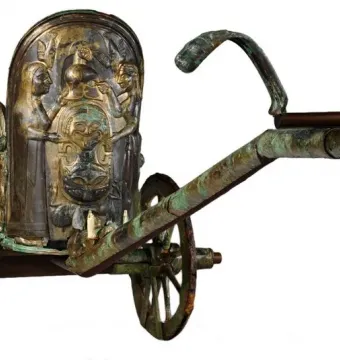
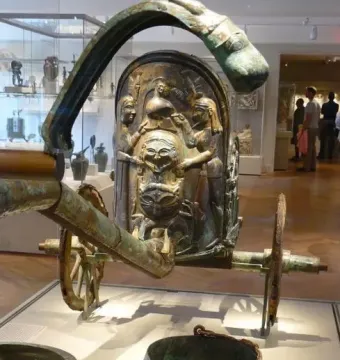
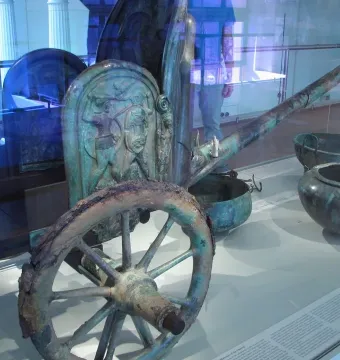
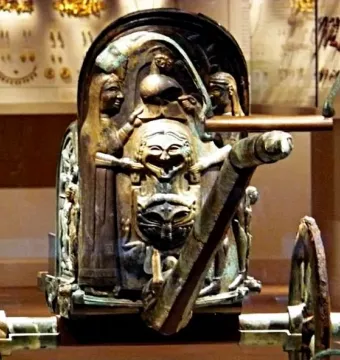
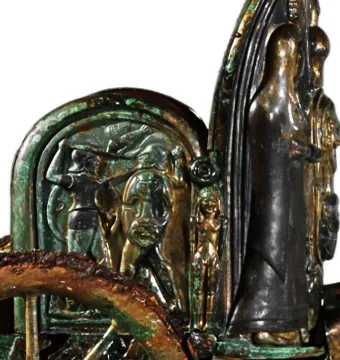
Monteleone Chariot is an Etruscan parade chariot dated to the 6th century BCE and made in Etruria. Built of bronze, iron, and walnut wood, it is decorated with repoussé work and ivory inlays. The chariot depicts Homeric mythology, showing Achilles in apotheosis with the goddess Thetis, along with shields, birds of prey, and a dead fawn. Discovered accidentally in 1902 by two farmers near Monteleone di Spoleto, it was part of a burial assemblage from a mound tomb. Since 1903, the original has been on display at the Metropolitan Museum of Art in New York, while a copy is kept in Monteleone.
© Unknown authorUnknown author · CC0
June 2007 © Mary Harrsch · CC BY 2.0
March 2010 © marcus nunes · CC BY-SA 2.0
© Unknown authorUnknown author · CC BY 2.5
© Unknown authorUnknown author · CC0
Identification | |
| Name | Monteleone Chariot |
| Type | Etruscan chariot |
| Alternative name | Etruscan chariot of Monteleone |
Historical context | |
| Date | c. 530 BC |
| Cultural attribution | Etruscan |
| Provenance date | 1902 |
Discovery and provenance | |
| Post-discovery history | Its early handling after discovery is disputed: one account says it was hidden and later sold to two Frenchmen in exchange for two cows; another says it was immediately sold as scrap and the proceeds were used to buy roof tiles |
| Acquisition date | 1903 |
| Later owner | John Pierpont Morgan |
| Discoverer | Isidoro Vannozzi, with Giuseppe Vannozzi |
| Discovery context | Accidentally unearthed in an underground tomb covered by a mound; the tomb was part of a burial and contained the remains of two human bodies and two drinking cups |
| Discovery location | Monteleone di Spoleto, Umbria, Italy |
Location and ownership | |
| Current location | The Metropolitan Museum of Art, New York City |
| Collection | Collection of the Metropolitan Museum of Art |
| Replica | A full-size copy is displayed in Monteleone |
| Repatriation campaign | In January 2005, the comune of Monteleone launched a campaign to recover the chariot from the Met; the Italian government did not support it |
Physical characteristics | |
| Length | 209 cm |
| Height | 131 cm |
| Wheel spokes | Nine spokes per wheel |
| Intended draught animals | Two horses |
Materials | |
| Construction materials | Wood, bronze, and ivory |
| Original additional materials | Likely included amber and other exotic materials that have not survived |
Technique | |
| Decoration technique | Hammered bronze plates with repoussé relief and ivory inlays |
Appearance | |
| Decorative style | Homeric mythological scenes in raised relief, with detailed animals and legendary creatures on the frame and plating |
Iconography and meaning | |
| Main subject | Scenes from the life of Achilles, especially his apotheosis and his receiving armor from Thetis |
| Depicted figures | Achilles and Thetis; the figures are separated by a bilobed shield with a Corinthian helmet and ram protome |
| Additional iconography | Two birds of prey flying over a slain fawn |
| Left side panel | Two warriors in combat, thought to be Achilles and Memnon |
| Right side panel | The apotheosis of Achilles, ascending in a chariot pulled by winged horses |
| Base scenes | Smaller scenes along the base may show Achilles as a youth with Chiron and Achilles as a lion felling a stag and a bull |
| Other ornamentation | The chariot pole has a boar protome and a bird head terminus; the yoke ends in snake heads; the hub ends in a lion head |
History and restoration | |
| Restoration findings | Evidence suggested the chariot had once been involved in a serious accident during its use |
| Use | Likely a parade chariot rather than a war chariot |
| Public reopening date | 20 April 2007 |
| Preservation status | Best preserved and most complete of the approximately 300 known surviving ancient chariots; only six are reasonably complete |
| Restoration | Reexamined and restored at the Metropolitan Museum from 1989 for five years under Italian archaeologist Adriana Emiliozzi |
| Original reconstruction | The chariot was first reconstructed in 1903, but museum curators later suspected that this reconstruction was not historically accurate and that the chariot had originally been assembled incorrectly |
| Curator assessment | Carlos Picón, curator of the Metropolitan Museum of Art's Greek and Roman department, called it the greatest piece of Etruscan bronze of the 6th century BC anywhere in the world |
| Significance | Described as one of the greatest archaeological discoveries in history and as the greatest piece of Etruscan bronze of the 6th century BC |
Other | |
| Comparative note | Its nine-spoke wheels contrast with classical Greek four-spoke wheels, Egyptian six-spoke wheels, Assyrian and Persian eight-spoke wheels, and Celtic chariot wheels of up to twelve spokes |
| Comparative reference | Reminiscent of the Gundestrup cauldron |