
Piraeus Apollo
Piraeus Apollo is one of the large bronze statues from the so-called Bronzes of Piraeus, discovered in 1959 during sewer works in Piraeus and now kept in the Piraeus Archaeological Museum. The hoard also included Athena, two statues of Artemis, two shields, a theatrical mask, two marble herms, and a marble statuette of Artemis. The Apollo stands 1.91 m tall, is nude, and has the general form of an archaic kouros, though several details differ from the usual model. Scholars have debated whether it belongs to a transitional phase or is a Hellenistic copy of an older original. The find was especially important because so few original ancient Greek bronze statues survive.
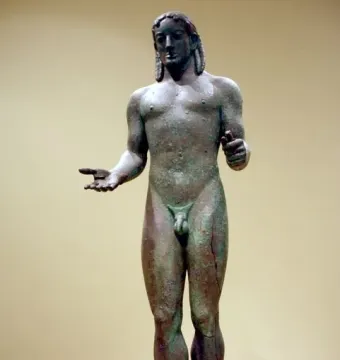
· Attribution
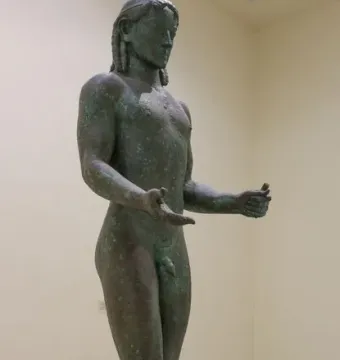
May 2022 © Ismoon · CC BY-SA 4.0
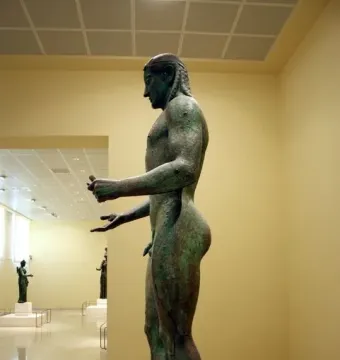
November 2009 © Giovanni Dall'Orto · Attribution
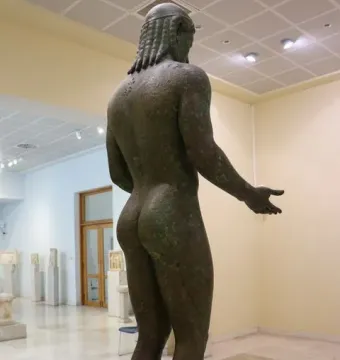
July 2018 © George E. Koronaios · CC BY-SA 4.0
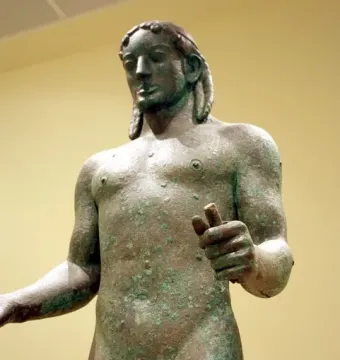
November 2009 © Giovanni Dall'Orto · Attribution
Identification | |
| Title | Piraeus Apollo |
| Type | bronze statue; kouros |
| Subject | Apollo |
| Alternative titles | El Apolo del Pireo; Apollo del Pireo; Apollon du Pirée |
Historical context | |
| Artistic period | Archaic Greek sculpture |
| Date | possibly 530–520 BC; some scholars place it in the late Archaic or early Classical period, while Claude Rolley argued for a Hellenistic imitation of an earlier 6th-century model |
| Dating difficulty | Bronze is difficult to date |
Creator | |
| Attribution | Unknown |
Discovery and provenance | |
| Find condition at discovery | The statues appear to have been packed for transport and were found in a burned warehouse |
| Possible original provenance | Piraeus or Delos; some scholars also suggest a local sanctuary in Piraeus |
| Possible original function and destination | The group may have been stored in a harbor stoa/portico and either evacuated for safety or prepared for shipment, possibly as Roman booty to Italy |
| Probable historical context of deposit | The warehouse likely burned around 86 BC, during the Roman capture of Piraeus by Sulla; a nearby coin dated to 87/86 BC bore the image of Mithridates VI |
| Associated finds | Found with Athena of Piraeus, two Artemis statues, a large bronze theatrical mask, and three marble sculpture fragments |
| Excavation director | Efthymios Mastrokostas |
| Discovery context | Found during sewer canalization / pipe-installation works, in or near a warehouse at the port of Piraeus |
| Discovery place | Piraeus, Greece |
| Discovery date | 1959, probably July |
Materials | |
| Primary material | Bronze |
| Additional materials | Iron armature; clay core; thin gold leaf |
Technique | |
| Manufacturing technique | Hollow casting, probably by the indirect lost-wax method |
Physical characteristics | |
| Facial features | Eyes fused with the head; face does not smile |
| Damage cause | Corrosion and oxidation, including moisture in the clay core and corrosion of the iron armature |
| Condition | Mostly intact, with slight corrosion, a crack in the left thigh, and a few fissures on the left leg |
| Surface finish | Refined |
| Height | 1.91–1.92 m |
| Arms and hands | Arms raised; the right hand probably held a phiale or cup, and the left hand probably held a bow |
| Hair | Short, rather naturalistic hair with spiral curls; originally described as golden and covered with thin gold leaf |
| Head position | Head slightly inclined forward and to the right |
| Pose | Nude figure with the right leg advanced |
Appearance | |
| Stylistic character | Archaizing kouros with several features departing from the usual archaic kouros model |
| Comparative style | The figure belongs to the latest or final phase of the kouros type and contrasts with works such as the Kroisos Kouros and the Kouros of Anavyssos |
Iconography and meaning | |
| Identification of figure | Generally interpreted as Apollo, though it may also be understood as a kouros form representing Apollo or a cult statue of Apollo |
| Interpretive background | Kouroi were often identified with Apollo in antiquity, and Apollo was associated with ideal order, balance, and libation offering |
| Action depicted | Offering a libation |
Location and ownership | |
| Current location | Piraeus Archaeological Museum, Athens |
| Collection status | Part of the museum's holdings |
History and restoration | |
| Publication status | Papadimitriou died in 1963 without publishing the find; his notes were lost |
Significance | |
| Historical significance | One of the few surviving original Greek bronze statues from antiquity |
| Technical significance | One of the earliest surviving examples of hollow-cast bronze sculpture, a technique invented around 550 BC |
| Scholarly significance | Attracted major scholarly attention, especially together with Athena of Piraeus |