
Mesha Stele
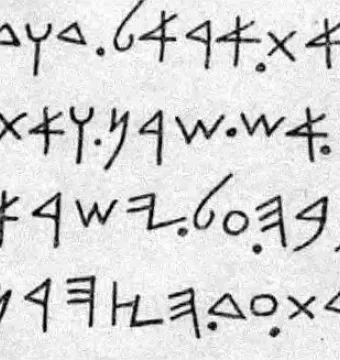
The Mesha Stele, also known as the Moabite Stone, is an inscribed stele dated around 840 BCE. It preserves a major Canaanite text in the name of King Mesha of Moab, written in a variant of the Phoenician alphabet closely related to Paleo-Hebrew. The inscription describes how Chemosh, the god of Moab, allowed the people to be subjugated by Israel, and how later he helped Mesha throw off Israel’s rule and restore Moab’s lands. It also records Mesha’s building projects. Discovered intact at Dibon in 1868, the stele was later broken into fragments, then reconstructed from the fragments and an earlier squeeze. It is now part of the Louvre Museum collection in Paris.
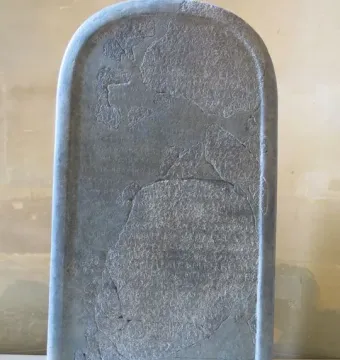
May 2018 © Tangopaso · Public domain
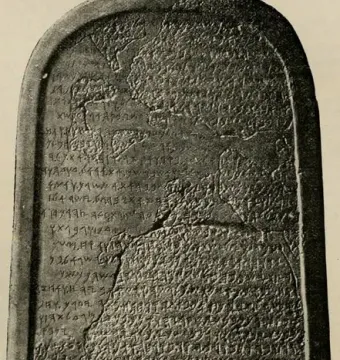
1896 © Internet Archive Book Images · No restrictions
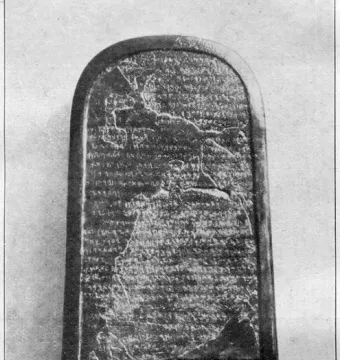
1925 © Albert Schramm · Public domain
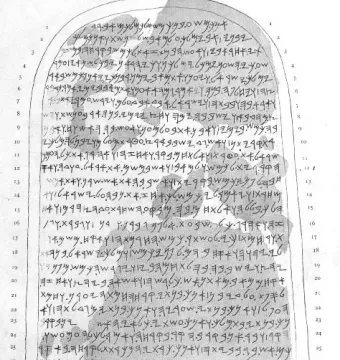
© Mark Lidzbarski · Public domain
July 2015 © PraeceptorIP · CC BY-SA 4.0
Identification | |
| Title | Mesha Stele |
| Type | Stele |
| Alternative name | Moabite Stone |
| Alternative title in Russian | Stele of King Mesha |
Historical context | |
| Date | around 840 BCE |
| Historical context | 9th century BCE Moab under King Mesha, during the conflict with the Kingdom of Israel after the death of Ahab |
Creator | |
| Creator / commissioner | Mesha, king of Moab |
| Associated ruler | King Mesha of Moab |
Physical characteristics | |
| Dimensions | 124 cm high, 71–79 cm wide, 36 cm thick |
| Shape | Rounded top with slightly tapered sides |
Materials | |
| Material | Black basalt |
Technique | |
| Inscription language | Moabite |
| Inscription extent | Probably more than 35 lines; 34 lines are commonly given |
| Inscription condition | The first 30 lines are well preserved, the following lines survive only in fragments, and at least the final two lines are lost |
| Inscription script | A Moabite alphabet, an early form of the Phoenician-type Semitic alphabet, closely related to Paleo-Hebrew |
Iconography and meaning | |
| Inscription subject | Mesha's victories and rebellion against the northern Kingdom of Israel, his dedication to Chemosh, and his building projects |
| Historical figures mentioned | King Omri of Israel; Ahab; Chemosh |
| Places conquered or mentioned | Medeba, Ataroth, Nebo, Jahaz, and territory associated with the tribe of Gad |
| Purpose | A memorial account of Mesha’s victories and revolt against Israel, and a thanksgiving dedication to Chemosh |
Discovery and provenance | |
| Documentation before destruction | Charles Simon Clermont-Ganneau obtained a papier-mâché squeeze before the stele was destroyed |
| Discoverer | Frederick Augustus Klein, an Anglican missionary |
| Discovery site | Ancient Dibon (modern Dhiban), Jordan |
| Discovery date | August 1868 |
History and restoration | |
| Destruction | It was smashed into fragments the year after its discovery by local Arabs, apparently in protest against Ottoman pressure to hand it over |
| Destroying group | The Bani Hamida tribe |
| Reconstruction | Clermont-Ganneau later recovered many fragments and reassembled the stele using the squeeze |
Location and ownership | |
| In collection since | 1873 |
| Return claim | Jordan has demanded the stone’s return since 2014 |
| Inventory number | AO5066 |
| Current location | Paris, France |
| Current collection | Louvre Museum |
Significance | |
| Historical significance | The first major epigraphic Canaanite inscription found in the Southern Levant; the longest Iron Age inscription ever found in the region; major evidence for the Moabite language; a cornerstone of Semitic epigraphy and history |
| Importance | The most extensive inscription referring to the kingdom of Israel ('the House of Omri'), and the earliest certain extrabiblical reference to YHWH |
| Scholarly status | Its authenticity has been disputed, but the vast majority of biblical archaeologists today regard the stele itself as genuine and historical |
| Biblical comparison | Its story parallels, with some differences, an episode in 2 Kings 3:4–27 and is broadly consistent with biblical accounts |
| Interpretive controversy | The disputed line 31 has prompted competing readings, including 'House of David' and alternatives such as Balak or Edomite-related reconstructions |
Other | |
| Original title in Russian | Stele of King Mesha |
| General scholarly conclusion | The stele is presented as confirming biblical data while also illustrating the partiality of historical narratives |
| Linguistic note | The inscription’s Moabite is closely related to early Hebrew, with dialectal and orthographic differences as well as many shared features |