
Monkey with a Skull
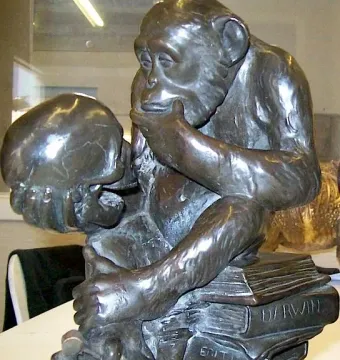
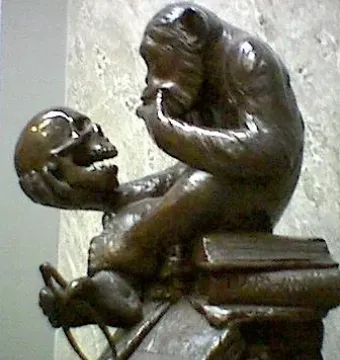
Monkey with a Skull is a 30 cm, all-around bronze sculpture by the German sculptor Hugo Rheinhold. It was created as the final work of his sculpture studies in 1892 and became his best-known work. The sculpture was first shown in 1893 at the Great Berlin Art Exhibition. Its composition includes a chimpanzee, a stack of books, a drawing compass, a Bible quotation, and a skull, elements that have led to interpretations linking it to science, Darwinism, religion, and the conflict between research and faith.
2008 © Derry, J.F. · CC BY-SA 4.0
2006 © 3DWiki · CC BY-SA 3.0
2008 © 3DWiki · CC BY-SA 3.0
2008 © 3DWiki · CC BY-SA 3.0

2008 © 3DWiki · CC BY-SA 3.0
Identification | |
| Title | Affe mit Schädel |
| Alternative title | Affe, einen Schädel betrachtend |
| English alternative title | Monkey Contemplating a Skull |
| Type | Bronze statuette |
| English title | Monkey with Skull |
Historical context | |
| Date | Late 19th century |
Creator | |
| Artist | Hugo Rheinhold |
| Artist nationality | German |
| Artist description | Late-19th-century German sculptor |
Discovery and provenance | |
| Foundry founder | Carl Gustav Hermann Gladenbeck |
| Foundry founding year | 1851 |
| Foundry that acquired reproduction rights | Hermann Gladenbeck & Sohn / Gladenbeck foundry |
| First exhibited | 1893 at the Große Berliner Kunstausstellung (Great Berlin Art Exhibition) |
History and restoration | |
| Original mold size | 30 cm |
| Original mold fate | Disappeared with the closure of the Gladenbeck foundry |
| Later mold size | 13 cm |
| Later mold catalog number | No. 1194 |
| Later mold source | Bildgießerei Seiler GmbH obtained a mold from Gladenbeck |
| Reproduction catalog entry | Reproduced in bronze in the Gladenbeck foundry catalogue |
| Popularity | Became popular for its originality |
| Gift to Lenin | 1922, given by Armand Hammer |
| Lenin display location | On Lenin's desk in the Kremlin; still visible there in 1991 |
Physical characteristics | |
| Additional object | A caliper held in the right foot |
| Pose | Seated on a pile of books and manuscripts, with one hand on its chin in a contemplative pose and the other holding a human skull |
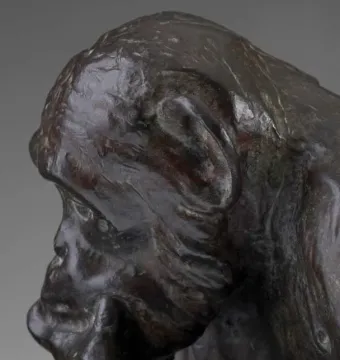
| Subject | A common chimpanzee (Pan troglodytes) studying a human skull |
| Height | 30 cm |
| Form | Three-dimensional, all-round-view sculpture |
Materials | |
| Material | Bronze |
Appearance | |
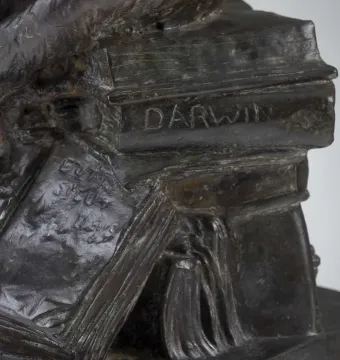
| Books detail | A closed book spine is inscribed 'Darwin' |
| Bible detail | An open Bible is shown toward the viewer with the quotation 'eritis sicut deus' |
| Bible page condition | The Bible page is torn in two halves; the lower half with the rest of the quotation is missing |
Iconography and meaning | |
| Rodin reference | Often compared with Auguste Rodin's The Thinker, though direct influence is uncertain |
| Related person interpretation | Carlos Bernardo González Pecotche interpreted the sculpture as a critique of a culture that reduces the human being to a skull and degrades him to the point that a monkey can try to understand him |
| Related literary context | The Genesis quotation is also associated with Goethe's Faust as a warning about the misuse of reason |
| Interpretive uncertainty | Motives and models for the sculpture are unclear |
| Possible intention | He may have intended an early warning about scientific ethics, but this is uncertain |
| Artist's view | Rheinhold was sympathetic to Darwinian ideas |
| Interpretive note | The work has been read as engaging with the theory of evolution and human intellectual dominance over other species |
| Other reference | Related comparison with Gabriel von Max's Monkey before Skeleton |
| Bible quotation meaning | 'You will be like God, knowing good and evil' |
| Hamlet reference | The skull recalls the graveyard scene in Shakespeare's Hamlet and Yorick's skull |
| Torn quotation interpretation | The missing second half of the quotation may suggest that good and evil cannot be fully distinguished |
| Bible quotation source | Genesis 3:5 |
| Symbolism of Bible quotation | The Bible quote symbolizes the Church and its conflicts with science |
| Symbolism of calipers | The calipers symbolize research and the scientific method, especially craniometry |
| Symbolism of books | The books represent accumulated human knowledge |
| Interpretation | Often interpreted as a warning against applying rationalism without morality |
| Themes | Science, Darwinism, evolution, and conflict with Christianity and the biblical creation story |
Significance | |
| Notability | Rheinhold's most famous work |