
Funerary Cone
Funerary cones were small clay cones used in ancient Egypt, almost exclusively in the Theban Necropolis. They were placed over the entrance of a tomb chapel. Early examples are known from the Eleventh Dynasty, and most were undecorated. During the New Kingdom, the cones became smaller and were often inscribed in hieroglyphs with the title and name of the tomb owner, sometimes with a short prayer. Their exact purpose remains uncertain, though they have been interpreted in various ways, including as passports, architectural features, or symbolic offerings. Fragments of seventeen terracotta cones were also found at al-Moghraqa in the Gaza Strip, where they may reflect a local adaptation of Theban funerary customs.
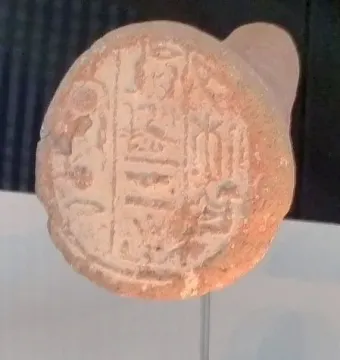
March 2021 © Derbrauni · CC BY-SA 4.0
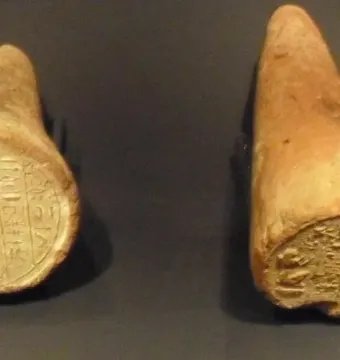
April 2010 © DORC · CC BY-SA 3.0
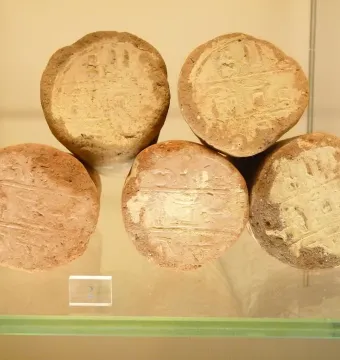
February 2014 © Khruner · CC BY-SA 3.0
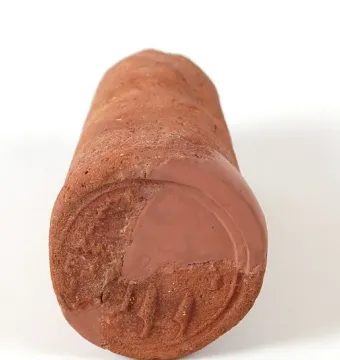
February 2008 © Biblioteca Museu Víctor Balaguer · CC BY-SA 4.0
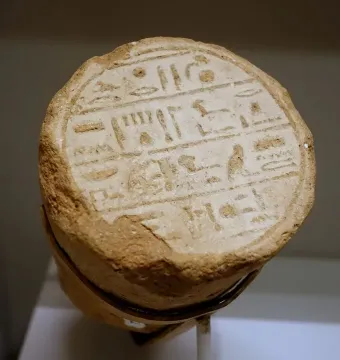
April 2016 © Daderot · Public domain
Identification | |
| Title | funerary cone |
| Object type | ancient Egyptian funerary cone |
Historical context | |
| Culture | ancient Egyptian |
| Period of use | 11th Dynasty to 26th Dynasty, especially the New Kingdom |
| Earliest examples | date to the 11th Dynasty |
| New Kingdom development | became smaller and inscribed |
Creator | |
| Scholarship on corpus | first organized into a corpus by Davies and Macadam (1957), supplemented by Vivó and Costa (1997), with more complete publications by Dibley and Lipkin (2009) and Zenihiro (2009); Theis (2017) added further examples for consideration |
Discovery and provenance | |
| Findspot | almost exclusively in the Theban Necropolis, especially West Thebes, including the areas of Asasif and Qurna |
| Related findspot | al-Moghraqa, Gaza Strip |
| Related find date | 2nd millennium BC |
| Related find description | fragments of seventeen terracotta cones |
| Interpretation of related find | suggested to be a local adaptation of Theban funerary customs and to have no parallels in the Levant |
Physical characteristics | |
| Surface | some examples preserve traces of paint |
| Size | up to about 50 cm long, though most are smaller |
| Shape | conical; usually circular at the base, though some examples are square, rectangular, flat, or triangular |
Materials | |
| Material | clay, sometimes terracotta; some examples were unfired clay |
Technique | |
| Manufacture/format | small clay cones, sometimes described as conical pottery nails |
Appearance | |
| Decoration | usually undecorated; early examples are uninscribed |
| Inscription | hieroglyphic inscriptions naming the tomb owner, often with a short prayer; some examples have multiple copies of the same inscription |
| Front face | flat |
| Inscription on earliest examples | the earliest examples from the 11th Dynasty are uninscribed |
Iconography and meaning | |
| Possible interpretations | variously interpreted as passports for access to the tomb, architectural elements, symbolic offerings, a solar symbol, models of wooden beams, or loaves/biscuits placed in the tomb |
| Alternative social interpretation | possibly placed by relatives as a sign of respect for the deceased, like stones left in some cultures |
| Seals | unlikely to have served as seals because they can be flat or triangular and some have several copies of the same inscription |
| Associated comparable object | a scented wax cone worn on the head in ancient Egypt |
Location and ownership | |
| Placement | placed over or above the entrance to a tomb chapel, often attached in large numbers side by side on the facade of tombs |
Other | |
| Purpose | unknown, disputed |
| Usage notes | used in ancient Egypt almost exclusively in the Theban Necropolis |
| Known types | about 400 types are known, of which about 80 can be assigned to a known tomb |