
Nuragic Bronze Statuettes
Nuragic bronze statuettes are small bronze figures from the Nuragic culture of Sardinia, most of them dated to between the 9th and 6th centuries BC, though some researchers believe they began earlier. About 500 examples, reaching up to 40 cm in height, have been found on the island, including 125 from the sanctuary sites of Santa Vittoria near Serri, Forraxi Nioi, and Abini near Teti. They have also been discovered in tombs, nuraghi, settlements, and workshops. Today, they are understood mainly as votive offerings, often deposited in sanctuaries with other bronze donations and sometimes fixed in natural rock crevices or drilled holes with lead.
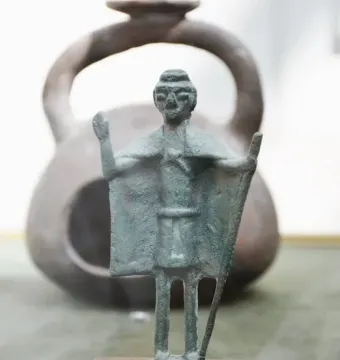
July 2023 © Silar · CC BY-SA 4.0
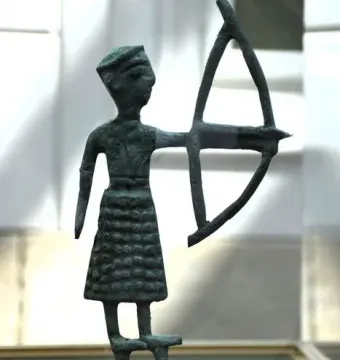
July 2023 © Silar · CC BY-SA 4.0
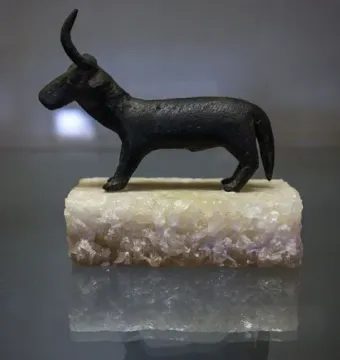
July 2013 © Giuliano Pisoni · CC BY-SA 3.0
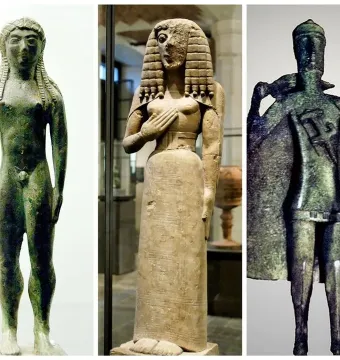
November 2012 © Shardan · CC BY-SA 3.0
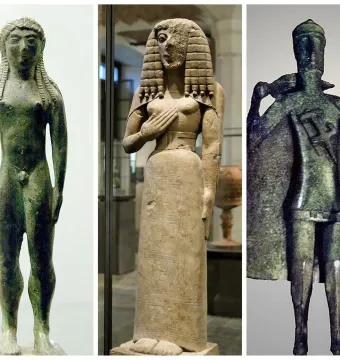
November 2012 © Shardan · CC BY-SA 3.0
Identification | |
| Title | Nuragic bronze statuettes |
| Type | Bronze statuettes / figurines |
| Original names | Italian: bronzetti (also bronzetto sardo or nuragico); Sardinian: brunzìtu sardu, brunzitu sardu nuragicu, nuraghesu, or nuraxesu |
Historical context | |
| Culture | Nuragic culture (Nuragic civilization) of Sardinia |
| Date | Generally dated to the final Bronze Age and early Iron Age, mostly the 9th–6th centuries BC; some scholars propose an earlier beginning, possibly as early as the 12th–11th centuries BC |
| Chronological uncertainty | Exact dating remains difficult; recent discoveries at Orroli and Ballao, including fragments dated to the 13th century BC, have called the traditional chronology into question |
Creator | |
| Stylistic attribution | Some descriptive figure names are due mainly to Giovanni Lilliu |
Discovery and provenance | |
| Origin | Sardinia, Italy |
| Known examples | More than 500 have been found on Sardinia |
| Findspots | Sacred wells and spring sanctuaries, tombs, nuraghes, settlements, workshops, and other cult sites such as holy wells and megara temples |
| Named findspots | Santa Vittoria near Serri; Forraxi Nioi; Abini near Teti; Monte Sallìa in Sulcis; Orroli; Ballao; Serra Niedda; Camposanto at Olmedo; Ittireddu |
| Examples found outside Sardinia | Several were found in Etruscan tomb excavations in central Italy, including Vulci |
| Specific sanctuary concentration | 125 examples come from the spring sanctuaries of Santa Vittoria near Serri, Forraxi Nioi, and Abini near Teti |
| Provenance of finds | Many pieces were recovered from old accidental finds or poorly documented excavations, so archaeological context is often uncertain |
Materials | |
| Local mineral resources | Sardinia was rich in copper, silver, and lead |
| Previous sourcing hypothesis | Copper had previously been thought to come from the Levant or Cyprus, but isotope analysis ruled this out |
| Material | Bronze |
| Tin source | Iberia |
| Copper source | Not from a single source; probable Sardinian supply from Sa Duchessa mine in the Iglesiente, with additional metal from the Iberian Peninsula (including the Alcudia Valley and the Linares district) |
| Alloy composition | Mostly copper with smaller amounts of tin and lead; some examples also contain silver and arsenic |
Technique | |
| Casting method | Lost-wax casting |
| Manufacturing process | Wax models were covered with clay, the bronze was poured in, and the wax melted out through the openings |
| Manufacturing uncertainty | How bronze-casting technology came to Sardinia is unclear |
Physical characteristics | |
| Size | Usually up to 35–40 cm high |
| Finish | Generally highly finished, with casting channels, sprues, pouring buttons, and vent channels removed and traces erased |
| Object groups | Anthropomorphic figures, zoomorphic figures, furniture and object miniatures, boat models, and nuraghe models |
Appearance | |
| Boat models | Bronze miniature ships with a hull body often ending in a protome; usually decorated with animal, bird, or nuraghe motifs |
| Nuraghe models | Miniature reproductions of simple and complex nuraghes, and sometimes small temples |
| Anthropomorphic subjects | Warriors, warriors with swords, spear-bearers, archers, tribal chiefs, notables, wrestlers, orants, offerers, pilgrims, musicians, draped women, mothers with children, and women holding reclining male figures |
| Object subjects | Bread chests, stools, coffers, dolia, tripods, baskets, carrying frames, axes, double axes, vases, miniature weapons, carts, and nuraghe models |
| Zoomorphic subjects | Domestic and wild animals, especially bulls, rams, deer, pigs, dogs, foxes, cattle, goats, mouflons, cocks, birds, boars, and weasels or ferrets |
Iconography and meaning | |
| Tribal chiefs / notables | Shown with straight tunics or cloaks, a dagger worn bandolier-style, a small cap, braided hair, a broad cloak, and a knotted staff; the right hand is raised in salute or holds a sword |
| Boat model interpretation | Likely miniature reproductions of real boats with symbolic and mythic associations, documenting naval carpentry, commercial exchange, and seafaring |
| Animal symbolism | Bull heads, rams, deer, dogs, and other animals also appear on boats and temple-related sculptures with propitiatory or symbolic meaning |
| Roast-king / shepherd-king | A unique warrior figure from Serra Niedda carrying a spear, wearing a horned helmet and greaves, with a shield on his back and a ram on a leash; the ram may be sacrificial or totemic |
| Lower-status female figures | Some women are shown in a simple tunic without a cloak, carrying an offering on the head supported by both hands |
| Female figures | Often shown with a conical hairstyle, long cloak, high collar, open downward-turned hand gesture, a small cup in the left hand, and sometimes a veil or cloth; some are seated on circular wooden stools |
| Offerings depicted | Flat cakes, cups, piglets, lamb skins, jugs, bags, and crutches |
| Warrior iconography | Some figures show warriors with swords, archers, and a four-eyed, four-armed hero interpreted as an amplification of warrior power; nine examples of this hero type are known, all from Abini |
| Social interpretation | The figures have been used to argue that Nuragic society may have lacked strongly aristocratic traits and that women may have had a relatively important role within families |
| Iconographic groups | Anthropomorphic, zoomorphic, furniture/object, and boat models |
| Interpretation | Their meaning is disputed, but they are often read as collective ritual offerings rather than individual votive gifts |
| Associated offerings | Often deposited together with talismans, weapons, and other bronze donations |
| Deposition context | Often placed in natural rock crevices or in holes made in stone blocks and fixed with lead |
| Primary function | Mainly votive offerings (ex voto) deposited in sanctuaries |
Location and ownership | |
| Current museum holdings | Examples are held in the National Archaeological Museum of Cagliari, the Archaeological and Ethnographic Museum G.A. Sanna in Sassari, museums in Nuoro and Oristano, the Museum of Prehistoric Statuary in Sardinia at Laconi, the National Museum of Prehistory and Ethnography Luigi Pigorini in Rome, the National Etruscan Museum of Villa Giulia, the Archaeological Museum of Crotone, the British Museum, and the Getty Museum |
| Other holdings | Many examples are in private collections and in Italian and foreign museums |
History and restoration | |
| Collection history | Giovanni Spano was the first to assemble and describe the finds; his material formed the core of the museum collections of Cagliari and Sassari; early finds also entered the Florentine grand-ducal collections and Athanasius Kircher's collection, later incorporated into the National Etruscan Museum of Prehistory and Ethnography Luigi Pigorini in Rome |
| Exhibition and publication history | The first exhibition of Sardinian bronzetti was organized in Venice in 1949; Giovanni Lilliu published Sculture della Sardegna Nuragica in 1956, the first corpus of the works |
Significance | |
| Historical significance | They underline Sardinia's role in Bronze Age trade networks and its connections with the eastern Mediterranean, especially Mycenaean Greece and Cyprus |
| Comparisons | Their dimensions and characteristics have been compared with stone sculptures, especially the Mont'e Prama stone giants |
| Art-historical context | The bronzetti genre originated in the Levant and later spread to Cyprus, Anatolia, Phoenician areas, the Etruscans, and Iberia |
| Scientific analysis | Isotope analysis of 48 bronzetti from three Nuragic sites suggested that the copper used was not from the Levant or Cyprus but from Sardinia and the Iberian Peninsula |