
Two Wrestlers
Two Wrestlers is a clay sculpture sketch, about forty centimeters high, attributed to Michelangelo and dated around 1525. It is preserved in the Casa Buonarroti in Florence. Among the small sketches attributed to the artist, it has received some of the most favorable critical opinions. The work was reconstructed in 1926 from fragments by Johannes Wilde, then working for the Giovanni Poggi Gallery. Its original purpose has long been debated. Suggestions have linked it to Hercules and Antaeus for the Piazza della Signoria, but this interpretation was rejected. Wilde later proposed a connection with the tomb of Julius II, probably as a pendant for a niche with the Genius of Victory, around 1527–1530, and this remains the most accepted hypothesis.
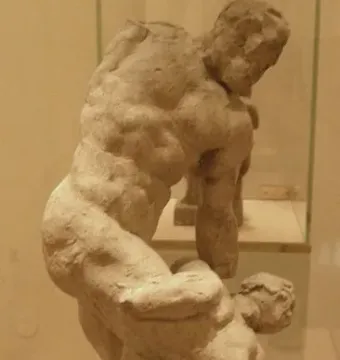
June 2009 © sailko · CC BY-SA 3.0
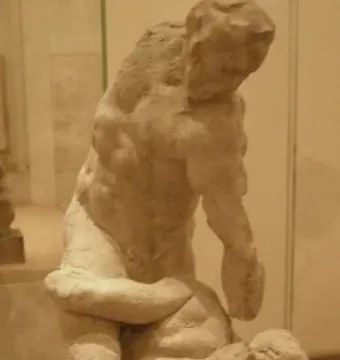
June 2009 © sailko · CC BY-SA 3.0
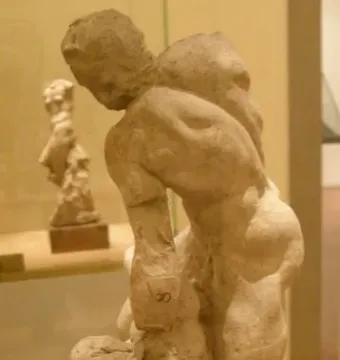
June 2009 © sailko · CC BY-SA 3.0
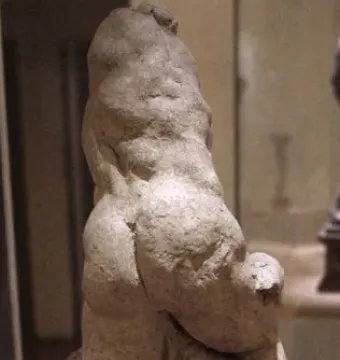
© Sailko · CC BY-SA 4.0
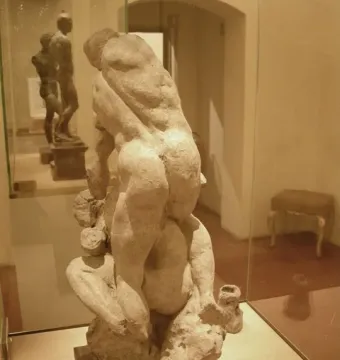
June 2009 © sailko · CC BY-SA 3.0
Identification | |
| Title | Two Wrestlers |
| Original title | I Due lottatori |
| Type | small-scale preparatory model (bozzetto) |
Creator | |
| Attribution | Attributed to Michelangelo; the attribution has received very favorable critical opinion |
Historical context | |
| Date of related work | around 1527–1530 |
| Related work in current hypothesis | Genius of Victory |
| Proposed function in Julius II tomb | Probably intended as a pendant in a niche with the Genius of Victory |
| Current scholarly hypothesis | A relationship with the Tomb of Julius II |
| Related finished sculpture date | 1535 |
| Related finished sculpture | Hercules and Cacus |
| Later allocation of related commission | The commission was eventually assigned to Baccio Bandinelli |
| Departure from Florence | After the fall of the Florentine Republic and the return of the Medici, Michelangelo left for Rome in 1534 and did not return to Florence |
| Later development of the commission | In 1528 Michelangelo was in Florence and accepted the commission; he then changed the subject to Samson and the Philistines, seen and commented on by Vasari |
| Historical interruption | The project was interrupted by the disorders related to the expulsion of the Medici |
| Alternative artist proposed | Baccio Bandinelli |
| Related early model | A model initially entrusted to Leone Leoni and later dispersed |
| Early proposed commission context | Commissioned from Michelangelo by Piero Soderini around 1508 to flank the David in front of Palazzo Vecchio, Florence |
| Early proposed subject | Hercules and Antaeus |
| Alternative proposed date | 1525 |
| Date | c. 1525 |
Materials | |
| Material | Clay |
Physical characteristics | |
| Height | about 40 centimeters |
Location and ownership | |
| Current location | Casa Buonarroti, Florence, Italy |
| Related finished sculpture location | Piazza della Signoria, Florence |
History and restoration | |
| State before reconstruction | The work survived in several fragments |
| Reconstruction | Reconstructed in 1926 from several fragments by Johannes Wilde under the supervision of Giovanni Poggi |
| Rejection of early interpretation | Rejected in 1928 after Johannes Wilde demonstrated that the wrestlers could not fit in the block used for Hercules and Cacus |
Discovery and provenance | |
| Initial scholarly status | The circumstances of the work's creation were unknown, so several hypotheses circulated |
Significance | |
| Later scholarly reception | Despite Wilde's objection, the Piazza della Signoria interpretation continued to circulate among scholars, with positive opinions from Charles de Tolnay, Hartt, and others |
| Current scholarly status | This tomb-related hypothesis is the most widely accepted |