
Juno Ludovisi
Juno Ludovisi, also known as Hera Ludovisi, is a colossal female head and neck carved in marble, now in the Altemps Palace, a branch of the National Roman Museum in Rome. The work is 114 cm high and the head is adorned with a tiara engraved with palms. It probably belonged to an acrolithic statue, in which only certain parts were made of stone and the body was wooden. Its origin is unknown, though it was probably found in Rome. First recorded in the collection of Cardinal Federico Cesi in the early 16th century, it passed to Cardinal Ludovico Ludovisi in 1622 and gained its nickname from the Villa Ludovisi. Long admired in Europe, it is now considered a Roman work of the 1st century BC, likely a portrait of Antonia Minor represented as Juno.
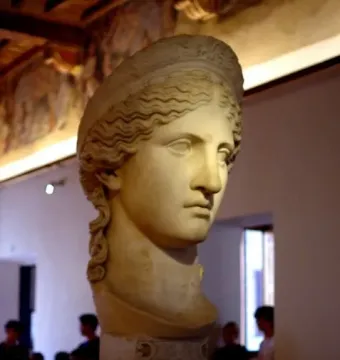
October 2023 © Paolo Villa · CC BY-SA 4.0
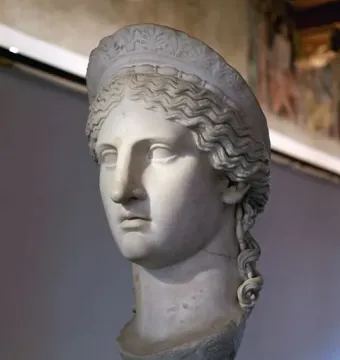
November 2024 © Fabrizio Garrisi · CC0
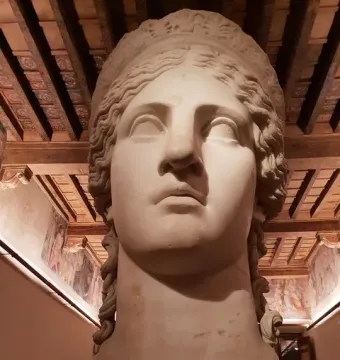
December 2018 © MumblerJamie · CC BY-SA 2.0
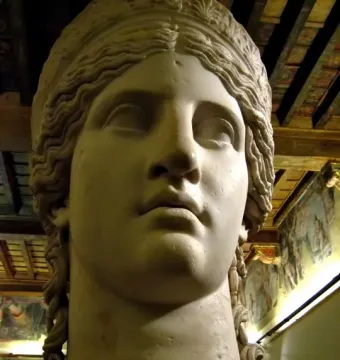
© Anthony Majanlahti · CC BY 2.0
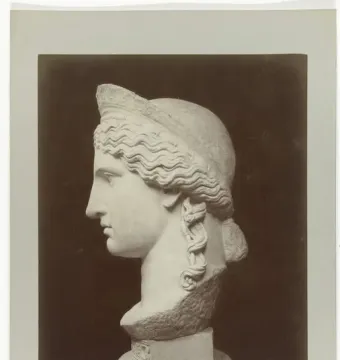
© Rijksmuseum · CC0
Identification | |
| Title | Juno Ludovisi |
| Alternative name | Hera Ludovisi |
| Type | colossal marble head |
| Subject | Traditionally Juno (Hera); now often identified as Antonia Minor represented as Juno |
Historical context | |
| Date | 1st century BC or 1st century AD; attribution remains debated |
| Original statue type | Acrolithic statue |
Creator | |
| Creator | Unknown |
Discovery and provenance | |
| Findspot | Probably Rome |
| Provenance | Unknown |
| Early recorded ownership | Collection of Cardinal Federico Cesi in the first half of the 16th century |
| Acquired by | Cardinal Ludovico Ludovisi |
| Acquired in | 1622 |
Location and ownership | |
| Surface condition implication | No typical wear from outdoor exposure, suggesting an indoor temple installation |
| Cast locations | Museum of Classical Archaeology, Cambridge; Bryn Mawr College, Pennsylvania; Goethe House in Weimar; George Mason University, Fairfax; University of Helsinki, Department of Art History; University of Tartu Art Museum; Montpellier Museum of Casts |
| Eponym | The name Ludovisi comes from Cardinal Ludovico Ludovisi and the Villa Ludovisi |
| Former location | Villa Ludovisi |
| Current location | Palazzo Altemps, Museo Nazionale Romano, Rome |
Physical characteristics | |
| Surviving parts | Head and neck |
| Facial features | Idealized, impersonal features with a frontal gaze |
| Hair | Hair tied back at the nape, with curls falling down the neck and onto the shoulders |
| Headgear | Diadem decorated with palmettes |
| Height | 114 cm |
| Scale | Colossal |
| Estimated original height | More than 5.5 m if the figure stood upright |
Materials | |
| Material | Marble, possibly Parian marble |
Technique | |
| Technique | Carved marble component of an acrolith; the body would have been made of wood |
Appearance | |
| Decorative feature | Tiara engraved with palms |
| Style | Classicizing, with formal austerity, expressive economy, and a balance between idealization and naturalism |
Iconography and meaning | |
| Religious association | Associated with the cult of the Divine Augustus |
| Possible original setting | Probably an unidentified temple; possibilities include the Temple of Antonia, the Temple of the Divine Augustus in the Roman Forum, or the Temple of Claudius on the Caelian Hill after his deification |
| Depicted figure | A youthful, idealized Antonia Minor as Juno |
History and restoration | |
| Later identification history | By the late 19th century the traditional identification as Juno was questioned |
| Current interpretation | Roman work of the 1st century BC or 1st century AD, usually interpreted as a portrait of Antonia Minor represented as Juno; the identification remains controversial |
| Early identification | Initially identified as a fragment of a cult statue of Juno or Hera |
Significance | |
| Reception | Highly admired from the 18th century onward, especially by German writers and artists, and regarded as one of the most beautiful creations of Classical Antiquity |
| Winckelmann's view | In 1764 Johann Joachim Winckelmann praised it as the most beautiful representation of Juno |
| Goethe's view | Goethe admired it intensely, called it his first Roman love, and had casts made for his Roman apartment and his house in Weimar |
| Schiller's view | Schiller regarded it as the embodiment of his aesthetic ideal and praised its beauty and stillness |
| Other admirers | Wilhelm von Humboldt; Johann Heinrich Füssli; Henry James |
| Art-historical significance | A landmark work for Weimar Classicism and a major representative of classicizing aesthetics |