
Bronze Head from Ife
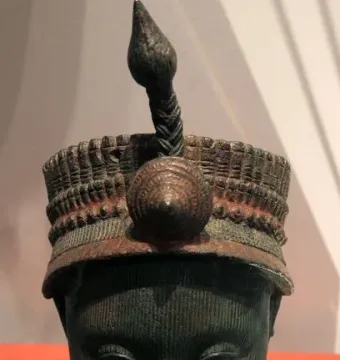
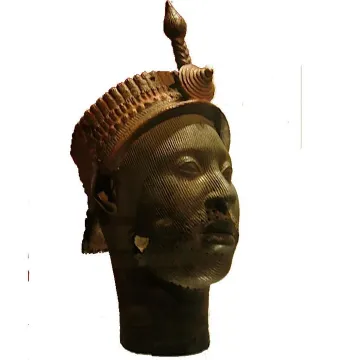
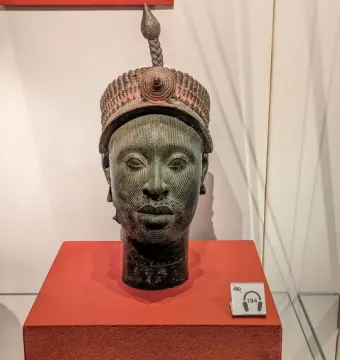
Bronze Head from Ife, also known as Cabeça de Ifé or Ori Olocum, is one of eighteen copper-alloy sculptures unearthed in 1938 in Ife, Nigeria, the ancient religious and royal center of the Yoruba. It is believed to represent Odudua, regarded as a principal ancestor of the Yoruba people. The sculpture was probably made in the 13th or 14th century, before any European contact with the local population. Its realism and highly sophisticated craftsmanship challenged Western ideas of African art at the time. One year after its discovery, the head was taken to the British Museum.
April 2019 © Vassil · CC0
November 2013 © sailko · CC BY-SA 3.0
© No informado · Public domain
December 2023 © Sourabh.biswas003 · CC BY-SA 4.0
November 2013 © sailko · CC BY-SA 3.0
Identification | |
| Title | Bronze Head from Ife |
| Alternative names | Cabeça de Ifé; Ori Olocum; Ife head; The Ife head |
| Type | Head sculpture |
| Number of related sculptures | One of eighteen copper-alloy sculptures |
Historical context | |
| Cultural context | Yoruba; Ife was a religious and royal center, sometimes described as the ancient capital of the Yoruba kingdom |
| Date | Probably made in the 13th–15th century CE; some sources specify the 11th or 12th century CE |
| Historical context of production | Created before European contact with the local population |
Creator | |
| Subject | Probably a king (Ooni); some sources say it may represent Odudua, the principal ancestor of the Yoruba people |
Discovery and provenance | |
| Discovery date | 1938, in January in some accounts |
| Discovery location | Wunmonije compound/district, Ife, Nigeria |
| Discovery circumstances | Found by chance during construction work for a house; workers were digging a foundation pit |
| Associated finds | Found with sixteen or seventeen other heads of brass and copper, and the upper half of a bronze figure |
| Acquisition and movement | Removed from Nigeria, passed via Paris, and acquired for the British Museum in 1939; before export controls were fully enforced, another account says it was taken to the British Museum one year after discovery |
| Export history | The discovery helped prompt Nigerian authorities to restrict the export of antiquities; colonial legislation to prevent further exports was enacted in 1938 |
| Other exported objects | Two other heads were sent to America before export restrictions were enacted |
Physical characteristics | |
| Size | Approximately three-quarters life-size |
| Height | 35 cm |
Materials | |
| Material | Copper alloy, usually described as bronze; British Museum descriptions include heavy leaded brass-zinc / brass and zinc with a lot of lead / approximately 70% copper, 16.5% zinc, and 11.3% lead |
Technique | |
| Technique | Lost-wax casting |
Appearance | |
| Style | Very naturalistic; realistic; refined |
| Facial features | Face covered with incised striations; lips unmarked |
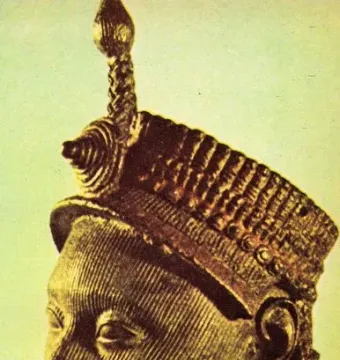
| Headdress | Elaborate crown made of multiple layers of tubular beads and tassels / hair fringes |
| Crown ornament | Crested with a rosette and a plume (or aigrette) bent slightly to one side |
| Surface decoration | Traces of red and black paint remain on the crown surface |
| Typicality | The crown decoration is typical of Ife bronze heads |
Significance | |
| Historical reception | Its realism and sophisticated craftsmanship challenged Western conceptions of African art |
| Art-historical significance | The lifelike rendering of medieval Ife sculptures is exceptional in sub-Saharan African art |
| Interpretation | It was initially considered the earliest manifestation of a tradition continued in Yoruba art, early Benin art, and other works |
| Related archaeological evidence | Excavations at Igbo-Ukwu in 1959 provided scientific evidence of an established metalworking culture and bronze artifacts datable to the 9th or 10th century |
| Scholar associated with renewed interest | Leo Frobenius, a German ethnologist and archaeologist who was among the first European scholars to take serious interest in African art, especially Yoruba art |