
The Stone Guest
The Stone Guest is Alexander Dargomyzhsky’s three-act opera set to the text of Alexander Pushkin’s tragedy of the same name. The opera was completed by C. Cui and orchestrated by Nikolai Rimsky-Korsakov. In this version, it was first performed in St. Petersburg at the Mariinsky Theatre on 16 February 1872, under E. Napravnik. The work holds a special place in Russian cultural history for its recitative-declamatory style and for setting Pushkin’s text with minimal changes. Its premiere divided critics, though composers of the Mighty Handful strongly supported it. Later, Rimsky-Korsakov made a new orchestration, and the opera was staged again in Moscow and Petrograd in the early 20th century.
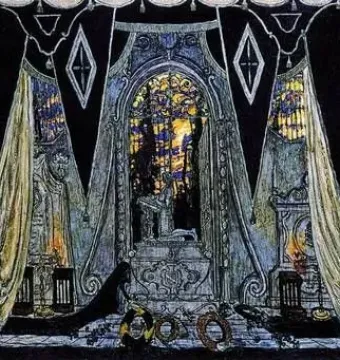
1917 © А. Головин · Public domain
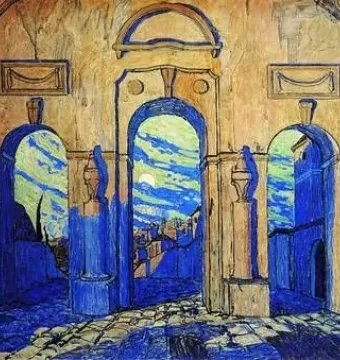
1917 © Aleksandr Golovin · Public domain
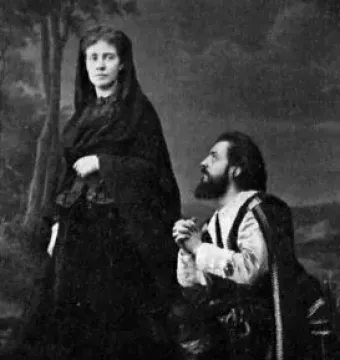
May 2013 © M. Pekelis · Public domain
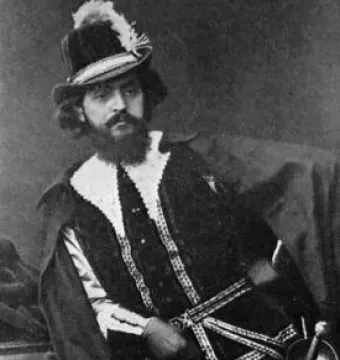
May 2013 © M. Pekelis · Public domain
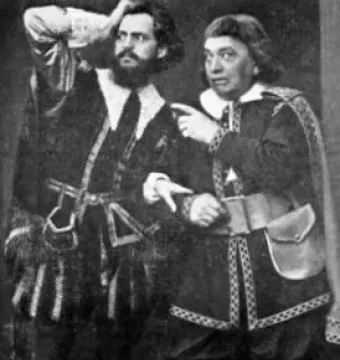
May 2013 © M. Pekelis · Public domain
Identification | |
| Title | The Stone Guest |
| Type | Opera |
| Structure | Three acts; one source describes four tableaux |
| Subject | The statue of the Commendatore (the Stone Guest), the avenger of Don Juan's murder and adultery |
| Original title | Каменный гость (Kamenny gost'; French: Le Convive de pierre; German: Der steinerne Gast; Spanish: El convidado de piedra o Don Juan y el comendador; Polish: Kamienny gość) |
Creator | |
| Completion | The unfinished work was completed after Dargomyzhsky's death by César Cui, according to the composer's wishes; the last few lines of tableau 1/final scene were written by Cui from sketches |
| Composer | Alexander Dargomyzhsky |
| Libretto | By the composer, based almost word-for-word on Alexander Pushkin's 1830 verse tragedy The Stone Guest from Little Tragedies |
| Revised version date | Completed in 1903 |
| Revised version | Rimsky-Korsakov later revised the orchestration, rewrote some original passages, and added an orchestral prelude |
| Orchestration | Orchestrated by Nikolai Rimsky-Korsakov |
Historical context | |
| Audience and critical context | Created in close contact with composers of the Mighty Handful and presented progressively at their meetings while being written |
| Composer's assessment | Dargomyzhsky described it as an unusual experiment and a creative 'reconnaissance' |
| Musical features | Written almost entirely in recitative and declamation, with no closed arias and almost no ensemble scenes; Laura has two songs |
| Composer's health | Dargomyzhsky suffered from heart disease, which slowed the composition |
| Artistic aim | To set Pushkin's text exactly as written, with music reproducing the melody and intonation of verse and reflecting dramatic truth and human speech |
| Source context | Part of Pushkin's Little Tragedies and connected to the Don Juan myth |
| Composition period | Began in 1863 and was nearly finished at Dargomyzhsky's death in January 1869; another source gives 1866–1869 |
| Style | Recitative-declamatory opera; innovative for its time |
Location and ownership | |
| Other notable performances | Petrograd, Theatre of Musical Drama, 1915; Mariinsky Theatre production by V. Meyerhold and A. Golovin, conducted by N. Malko, 27 January 1917; Salzburg Festival, 1928; Maggio Musicale Fiorentino, 1952; United States premiere in 1986 at Marymount Manhattan Theater, New York City |
| Alternative orchestration performance | Mikhail Kollontai orchestrated a version without Cui's and Rimsky-Korsakov's additions and corrections, performed in Klagenfurt, Austria, in 1987 |
| Revised version premiere | Bolshoi Theatre, Moscow, 1907 |
| First Moscow staging | Private Opera, Moscow, 1887 |
| Premiere | Mariinsky Theatre, Saint Petersburg, 16 February 1872 (Old Style) / 28 February 1872; conducted by Eduard Nápravník |
Significance | |
| Historical significance | Considered a foundational and highly influential work in Russian opera and Russian musical culture; especially important for later composers of The Five/Mighty Handful, including Mussorgsky, Rimsky-Korsakov, and Borodin |
| Reception | The 1872 premiere provoked conflicting critical assessments; the Mighty Handful supported it, while G. Laroche and I. Turgenev rejected its innovative concept |
| Legacy | Its recitative-declamatory approach influenced later Pushkin-based operas such as Rimsky-Korsakov's Mozart and Salieri, Cui's A Feast During the Plague, and Rachmaninoff's The Miserly Knight; Mussorgsky especially developed similar ideas in Boris Godunov and Khovanshchina |
| Interpretation | Some sources describe it as an opera-drama in which text and music merge into one whole; Alfred Einstein called it a 'laboratory work' that was unfruitful for the general public but important as a starting point for further search |
Other | |
| Premiere cast note | Osip Petrov is mentioned among the original cast; I. Alchevsky sang Don Juan in the 1917 production |
| Duration | About 80 minutes |
Iconography and meaning | |
| Role in the plot | The statue serves as the avenger of murder and adultery |
| Narrative setting | Spain, around 1600; in the drama the action takes place at a cemetery of the Monastery of Sant’Antonio and later in Donna Anna's apartment/house |
| Characters | Don Juan, Leporello, Donna Anna, Don Carlos, Laura, the Commander (Komtur), and a monk |
| Depicted scene | The statue is invited to the cemetery by Don Juan, later comes to Donna Anna's apartment to punish him, and at the end takes Don Juan by the hand and both sink into death |
Physical characteristics | |
| Number of acts | Three acts |
| Vocal style | Melodic recitative and musical declamation; the characters are made to 'speak notes' |
| Characterization | Characters are portrayed with carefully worked-out psychological precision, with distinct musical characterization for Don Juan, Donna Anna, Leporello, and others |
| Characters | Don Juan is portrayed as a poetic, woman-obsessed, but not stupid man; Leporello as an intelligent, cunning, morally stronger comic servant; Laura as a theatrical, attention-seeking woman who prefers male company; Donna Anna as modest and honor-bound |