
Pandora
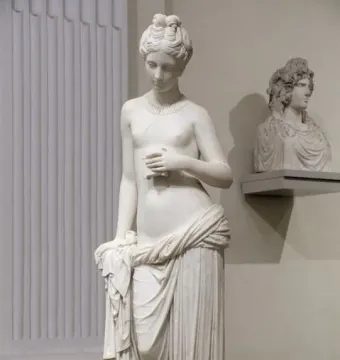
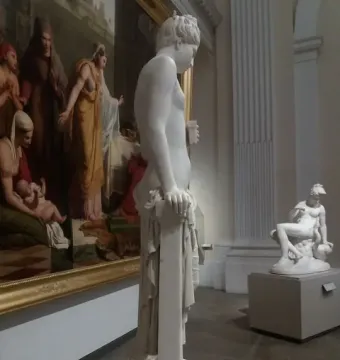
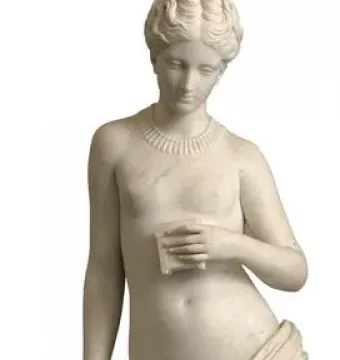
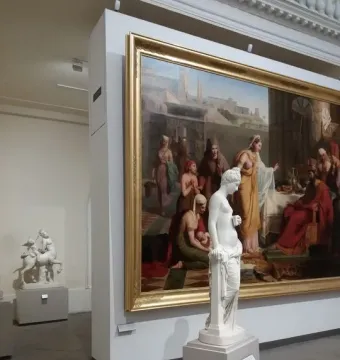
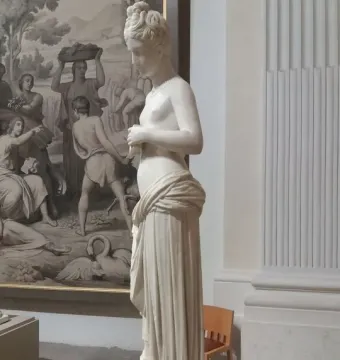
Pandora is an 1819 neoclassical marble sculpture by Jean-Pierre Cortot, created during his stay at the Villa Medici. It depicts the moment when Pandora receives her box from Jupiter. The work was exhibited in Paris at the Salon of 1819 and awarded a gold medal. Measuring 159 × 48 × 35 cm, it was purchased by the French Minister of the Interior for the collection of the Musée des Beaux-Arts de Lyon, where it has been since 1820. François-Louis Dejuinne made a drawing inspired by the sculpture, now held at the Musée des Beaux-Arts d’Angers.
December 2023 © Romainbehar · CC0
January 2019 © Romainbehar · CC0
© Musée des Beaux-Arts de Lyon · Public domain
July 2019 © Romainbehar · CC0
January 2019 © Romainbehar · CC0
Identification | |
| Alternative title | Pandore |
| Title | Pandora |
Creator | |
| Artist | Jean-Pierre Cortot |
Historical context | |
| Date | 1819 |
| Creation place | Rome, at the Villa Medici |
| Creation circumstances | Made during Cortot's stay at the Villa Medici after winning the Prix de Rome |
| Working period | 1818–1819 |
| Earlier version | A nude version was made in 1813, exhibited in 1814, reworked for the 1815 exhibition, especially the head, and then disappeared |
| Letter on the work | In a letter dated 17 April 1817, Cortot said he was resuming the subject with a version 'of a younger nature and half-draped' |
| Exhibited at | Paris Salon of 1819 |
| Award | Gold medal at the Salon of 1819 |
Discovery and provenance | |
| Possible preparatory drawing | A drawing by François-Louis Dejuinne in the Musée des Beaux-Arts d'Angers, inscribed 'composed and executed in marble by Cortot', was identified by Panofsky as the model for the statue |
| Relation to Dejuinne | Cortot and François-Louis Dejuinne knew each other; Dejuinne had been at the Villa Medici in 1813 |
| Attribution of model | According to Dora and Erwin Panofsky, the Dejuinne drawing was the model for the statue |
| Collection history | It was the second sculpture by Cortot to enter the Musée des Beaux-Arts de Lyon's collections, after the now-lost Eurydice |
| Acquired for | Musée des Beaux-Arts de Lyon |
| Acquisition | Purchased by the city of Lyon, together with Cortot's Narcissus, for 15,000 francs |
| Sent to | Lyon on 28 June 1820 |
Physical characteristics | |
| Type | Marble sculpture |
| Dimensions | 159 × 48 × 35 cm |
Materials | |
| Material | Marble |
Appearance | |
| Formal description | Fine, upright, thoughtful, with flawless forms |
| Subject | Pandora receiving the box from Jupiter |
| Stylistic treatment | Cortot skillfully simulates fabric folds; the chest is treated like a jewelry box and the figure follows the classical tendencies of the period |
| Overall appearance | Resembles an ancient Roman column |
| Composition | A young, half-draped woman leans against a small column and holds the box in front of her chest |
| Clothing | Draped dress with straight, fluted folds |
Iconography and meaning | |
| Object held | A small box, or jewel casket, given to Pandora by Jupiter to deliver to Epimetheus, whom she was to marry |
| Narrative meaning | Pandora opens the box out of curiosity, releasing all the evils and crimes of humanity |
| Mythological context | Pandora was created by Vulcan on Jupiter's orders; Jupiter used her to take revenge on Prometheus for stealing sacred fire and giving it to humanity |
Style | |
| Style | Neoclassical |
| Critical reception | In the 1960s, Dora and Erwin Panofsky judged it an example of 19th-century works in which Pandora's name and attributes are little more than a pretext for an alluring female nude or semi-nude |
| Comparative works | Henri-Joseph Rutxhiel made a marble Pandora in 1809, exhibited at the Salon de peinture et de sculpture in 1822, and John Gibson made a neoclassical Pandora in 1856; both are mentioned as related comparisons |