
Metamorphoses
Metamorphoses, also known as Les Métamorphoses d'Ovide ou Les Satyres, is a sculpture by Auguste Rodin created as part of The Gates of Hell. It is inspired by the story of Salmacis and Hermaphroditus in Book IV, lines 285–388 of Ovid’s Metamorphoses. Bronze editions of the work are currently held at the Museo Soumaya in Mexico City and at the Yamasaki Majak Museum of Art in Nagoya, Japan. Rodin’s models were two Paris Opera ballerinas recommended to him by Edgar Degas in the mid-1880s, and they also posed for Psyché, Daphné et Cupidon, and Les Femmes maudites.
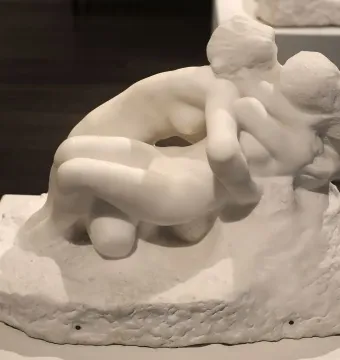
June 2024 © Francesco Bini · CC BY-SA 4.0
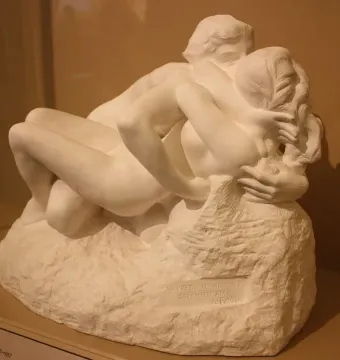
February 2009 © va_va_val · CC BY-SA 2.5
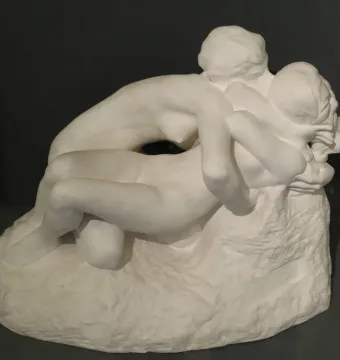
January 2024 © 14GTR · CC0
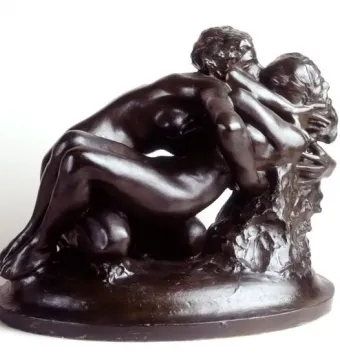
March 2005 © Museo Soumaya (Soumaya Museum) · Public domain
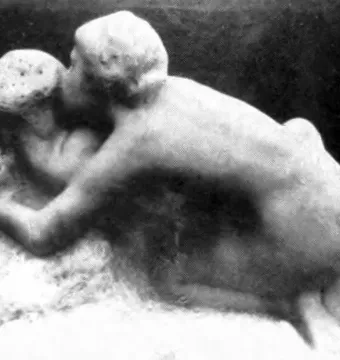
1921 © User:Mathmitch7 · Public domain
Identification | |
| Title | Metamorphoses |
| Alternative titles | Les Métamorphoses d'Ovide ou Les Satyres; The Metamorphosis of Ovid; The Satyrs; Ovid's Metamorphoses or The Satyrs |
| Type | Sculpture |
Creator | |
| Artist | Auguste Rodin |
Historical context | |
| Source of inspiration | Ovid's poetry as a source for transformations, metamorphoses, and the movement of life |
| Related works by Rodin | The Damned Women (1885), The Fallen Angel, Triumph of Youth, and Embracing Bacchantes |
| Related contemporaries | Toulouse-Lautrec, Gustave Courbet, and the accursed poets |
| Broader historical context | In the late 19th century, lesbian subjects were seen as an exploration of boundaries and sexuality |
| Narrative context of source work | Ovid's Metamorphoses is a lyrical work dealing with the origin of the world up to the rule of Julius Caesar, with stories of mythological and extraordinary beings |
| Date conceived | 1885 |
| Inspirations for The Gates of Hell | Dante's The Divine Comedy and Ghiberti's Gates of Paradise |
| Commission context | Ordered to decorate the new building of the Museum of Decorative Arts in Paris |
| Created for | The Gates of Hell |
| Position within The Gates of Hell | Upper right corner |
Iconography and meaning | |
| Subject source | The story of Salmacis and Hermaphroditus in Book IV, lines 285–388 of Ovid's Metamorphoses |
| Alternative subject interpretation | Some art historians identify it with the legend of Iphis and Ianthe |
| Alternative names used by art historians | Fantasies; Satyresses; Friends; Lust; Friends of the Vienna Secession |
| Depicted figures | Two abstract nude female figures |
| Pose and action | Semi-reclining, embracing, intertwined, and kissing |
| Gender characteristics | The upper figure has some masculine features |
| Thematic interpretation | The scene has both lesbian and transgender motifs |
| Character | Openly erotic sculpture |
| Series | One of Rodin's sculptures with lesbian scenes |
Materials | |
| Material | Bronze |
| Model material | Plaster |
Discovery and provenance | |
| Original owner of the statuette | English artist Charles Shannon |
| Hypothesis about later influence | Art historians suggest Charles Shannon was inspired by this work when creating similarly themed works |
| Inscription on replica | A dedication to the English critic William Henley |
| William Henley relationship to Rodin | A close friend of Rodin |
| Recommendation date | Mid-1880s |
| Models recommended by | Edgar Degas |
| Model(s) | Two ballerinas from the Paris Opera |
| Other works using the same models | Psyché, Daphné et Cupidon, Les Femmes maudites, Daphnis and Chloë, Cupid and Psyche, Daphne and Cupid, and Cursed Women |
Location and ownership | |
| Bronze edition locations | Museo Soumaya, Mexico City, Mexico; Yamasaki Majak Museum of Art, Nagoya, Japan |
| Replica locations | Rodin Museums in Paris and Philadelphia, the Musée d'Orsay, Stanford University, and Soumaya Museum |
Physical characteristics | |
| Model date | 1886 |
History and restoration | |
| Modern reception | Contemporary art historians avoided writing about it because of its explicit eroticism |