
Madonna of Bruges
Madonna of Bruges is a marble sculpture by Michelangelo showing Mary with the Child Jesus. Unlike earlier Madonna and Child images, Jesus stands almost unsupported while Mary looks down and away, giving the work an unusually restrained mood. Created in the early 16th century, it also reflects the pyramidal composition of the High Renaissance and shares similarities with Michelangelo’s Pietà in its chiaroscuro and drapery. The sculpture was originally likely intended for an altar. It is notable as the only Michelangelo sculpture to leave Italy during his lifetime. After being taken from Bruges twice in times of war, it now stands in the Church of Our Lady in Bruges.
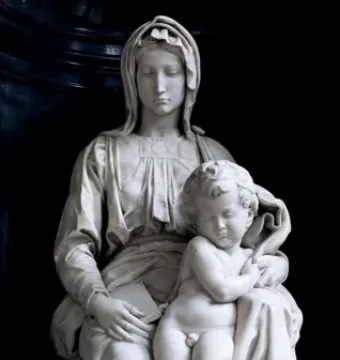
April 2010 © PMRMaeyaert · CC BY-SA 4.0
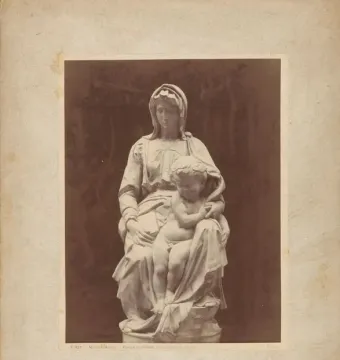
© Rijksmuseum · CC0
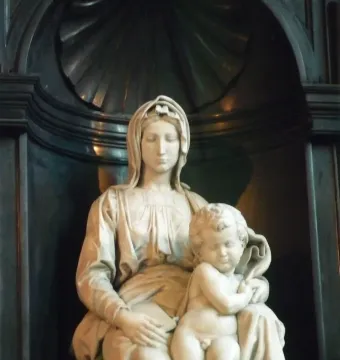
1504 © Michelangelo · Public domain
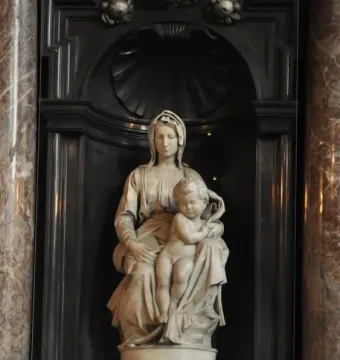
1502 © Michelangelo · Public domain
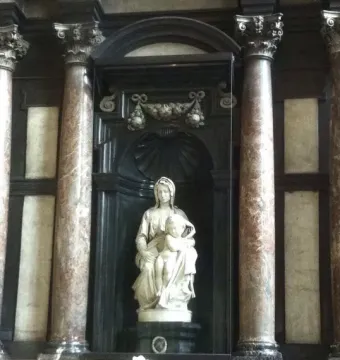
August 2014 © Beatriz Plaza Santana, creado por Miguel Ángel · CC BY-SA 4.0
Identification | |
| Title | Madonna of Bruges |
| Subject | Madonna and Child |
| Alternative names | Madonna with Child; Madonna met het Kind; Brügger Madonna |
| Type | Marble sculpture |
Historical context | |
| Style | High Renaissance; Florentine Renaissance |
| Historical context | Michelangelo was returning to Florence in the early 16th century after successes in Rome, while working on the David |
| Date | 1503–1505 |
Creator | |
| Artist | Michelangelo Buonarroti |
| Signature | Unsigned |
| Stylistic influence | Similar to Leonardo da Vinci's late-15th-century works |
Discovery and provenance | |
| Purchase date | 1504 |
| First documented sighting | Seen by Albrecht Dürer in 1521 |
| Delivery | Delivered to Bruges by 1506, probably via Viareggio or Lucca |
| Possible intermediary | Jacopo Galli |
| Commission secrecy | The commission and shipment were handled secretly |
| Commissioned for | A family chapel in Bruges; possibly an altarpiece for Siena Cathedral, though this was later rejected by scholarship |
| Commissioned by | The Mouscron family of Bruges, also called the Moscheroni/Moscron merchants |
| Payment | 4,000 florins; 100 gold ducats in recorded payments (50 ducats on 2 December 1503 and 50 ducats in October 1504) |
Physical characteristics | |
| Height | 1.23 metres; 1.26 m including base |
| Composition | Pyramidal composition; compact, closed grouping |
| Viewpoint | Designed for frontal viewing; if used as an altarpiece, intended to be seen slightly turned to the right and from above |
Materials | |
| Material | White Carrara marble; polished marble |
| Marble origin | Area around Carrara, Italy |
Technique | |
| Technique | Marble sculpture; full sculpture |
Appearance | |
| Facial detail | Lowered eyelids on both figures |
| Setting | Installed in a black marble niche with a large shell motif at the top |
| Head drapery | An Omega-fold centered above Mary's forehead, with hair, headscarf, and mantle arranged over the head |
| Mary's clothing | Closed dress with a decorative ornament at the chest, with two bands falling from it |
| Mary's face | Long and oval, of classical beauty |
| Mary's expression | Serene, thoughtful, and looking downward and away |
| Jesus's expression | Dreamy |
| Mary and Jesus interaction | Mary lightly restrains Jesus and holds his right hand with her left hand |
| Jesus's pose | Standing upright between Mary's knees, almost unsupported |
| Mary's pose | Seated |
| Mary's right hand | Resting on a closed book |
Iconography and meaning | |
| Iconographic type | Apparently based on the Platytera type of Mary |
| Biblical reference | Luke 2:19 |
| Interpretation | The closed book and lowered gaze suggest Mary's uncertainty and awareness of future events; the shell motif symbolizes Mary's fertility and virginity |
| Comparison with earlier depictions | Differs from earlier Madonna and Child images that usually show a pious Virgin smiling at the child in her arms |
| Relationship to Michelangelo's Pietà | Shares similarities with the Pietà in the drapery and Mary's oval face, and in the chiaroscuro effect; the sculpture has greater vertical solemnity and an architectural quality |
Location and ownership | |
| Original intended location | Altarpiece of Siena Cathedral |
| Ownership history | Owned by the Mouscron family of Bruges before donation to the church |
| Initial placement | Mouscron chapel in the Church of Our Lady, later turned into the Moscron Altar |
| Current location | Church of Our Lady, Bruges, Belgium |
History and restoration | |
| Donation to church | Donated in 1514 by Jan Moscron and his wife to the Church of Our Lady as part of an altar with a tabernacle |
| First removal | Removed from Belgium in 1794 by French occupiers and taken to Paris |
| First return | Returned to Bruges on 3 January 1816 after Napoleon's defeat |
| Second removal | Removed again in September 1944 during the German retreat; taken to Germany wrapped in mattresses in a Red Cross truck/convoy |
| Recovery | Found in 1945 in the Altaussee salt mine in Austria and recovered by the Monuments, Fine Arts, and Archives program |
| Postwar return | Returned to Belgium in mid-1945, briefly exhibited in the Royal Museums of Fine Arts of Brussels, and returned to the Church of Our Lady on 12 November 1945 |
| Protection | Placed behind bulletproof glass after the 1972 attack on Michelangelo's Pietà in the Vatican |
Significance | |
| Uniqueness | The first sculpture by Michelangelo to leave Italy during his lifetime |
| Influence | It appears to have influenced Madonnas by painters including Raphael, perhaps through Perugino |
| Cultural reference | Featured in the 2014 film The Monuments Men |
Other | |
| Copies and replicas | Many copies and replicas exist, including a reduced replica in Sint-Salvatorskathedraal in Bruges, a bronze copy in the Vatican, plaster casts in Moscow and London, and copies in Copenhagen and Ghent |
| Preparatory drawing | A preparatory drawing exists in the British Museum, where the Virgin is replaced by a young nude model |