
Ganymede with Jupiter's Eagle
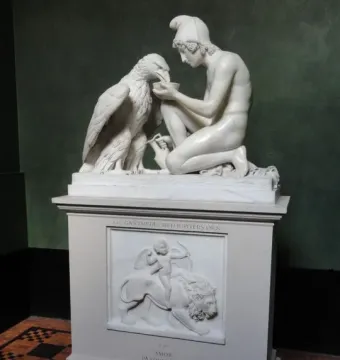
Ganymede with Jupiter's Eagle is a sculpture by the Danish artist Bertel Thorvaldsen. Several versions exist; the most famous is displayed at the Thorvaldsen Museum in Copenhagen. Other marble examples are held in museums and collections in Brescia, Leipzig, Norfolk, London, New York, Bray, and Minneapolis, and the Thorvaldsen Museum also owns two plaster versions. Thorvaldsen’s marble copy was made in Italy from 1815, brought from Livorno to Copenhagen aboard the Danish corvette Galathea in 1833, and left to the museum after the artist’s death in 1844. The work shows Ganymede kneeling before Jupiter’s eagle, with smooth skin and carefully worked plumage, and has been praised for its unsettling beauty and formal perfection.
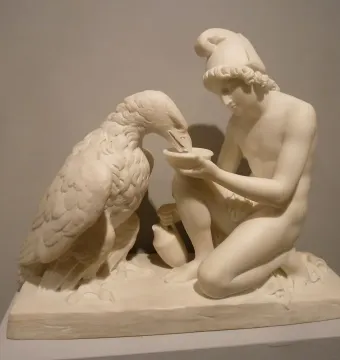
© Bertel Thorvaldsen · Public domain
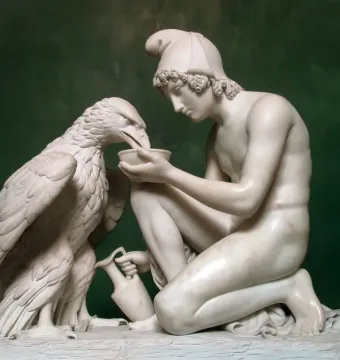
© Bertel Thorvaldsen · CC BY-SA 3.0
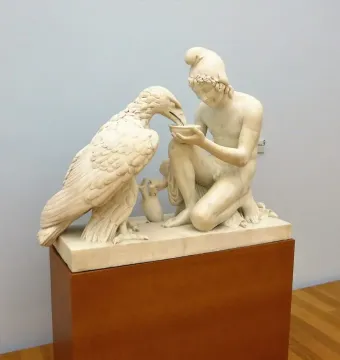
July 2017 © Bärwinkel,Klaus · CC BY 3.0
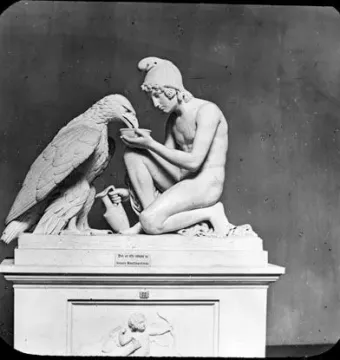
April 2011 © Bibliothèque de Toulouse · Public domain
May 2012 © Daderot · CC0
Identification | |
| Title | Ganymede and the Eagle |
| Alternative titles | Ganymede with Jupiter's Eagle; Ganymede drinking for Jupiter's eagle; Ganymede, watering Zeus's eagle |
| Type | Sculpture |
Creator | |
| Artist | Bertel Thorvaldsen |
| Artist nationality | Danish |
Historical context | |
| Thorvaldsen in Rome | He lived in Rome from 1797 to 1838 and was a central figure for Scandinavian and German artists on the Grand Tour studying ancient Roman culture |
| Thorvaldsen reputation | Contemporaries considered Thorvaldsen the most important sculptor after Antonio Canova |
| Thorvaldsen's Ganymede works | He made five different sculptures and two reliefs on the subject of Ganymede |
| Art movement | Neoclassicism |
Iconography and meaning | |
| Mythological context | Ganymede was a Trojan prince in Greek mythology; Zeus fell in love with him, abducted him to Olympus with the help of an eagle sometimes identified as Zeus himself, and made him cupbearer of the gods, living in eternal youth |
| Interpretation | The eagle combines the power of the father of the gods and the ferocity of a predator, overcome by beauty and love; in art, the relationship between Zeus and Ganymede is usually portrayed as erotic |
| Thorvaldsen's iconographic choice | Thorvaldsen did not depict either the violent abduction of the boy or the handsome youth as cupbearer |
| Subject | Ganymede and Jupiter's eagle (Zeus's eagle) |
Appearance | |
| Depiction | Ganymede kneels in front of the eagle; he has smooth skin and a trusting gaze; the eagle's plumage is carefully worked |
Physical characteristics | |
| Number of examples | Several |
Materials | |
| Materials | Marble; plaster versions also exist |
Location and ownership | |
| Other marble examples | Pinacoteca Tosio Martinengo, Brescia, Italy; Museum of Fine Arts, Leipzig, Germany; Chrysler Museum of Art, Norfolk, Virginia, United States; Heim Gallery, London; Kennedy Galleries, New York, United States; Killruddery House, Bray, Ireland; Minneapolis Institute of Art, Minneapolis, Minnesota, United States; Athenaeum, Boston, Massachusetts, United States |
| Thorvaldsen Museum plaster examples | Two plaster examples |
| First marble version later provenance | Presented in 1966 by the Morse Foundation to the Minneapolis Institute of Art |
| Most famous example | Thorvaldsen Museum, Copenhagen |
| Museum acquisition | After Thorvaldsen's death in 1844, the Galathea sculptures were left to the Thorvaldsen Museum |
| Related works by Thorvaldsen | Thorvaldsen also depicted Ganymede as cupbearer in two other sculptures: Ganymedes skænker i skålen (1816) and Ganymedes rækker skålen (plaster version c. 1805, marble version 1820s), both exhibited in the Thorvaldsen Museum |
| Other version ownership in the 19th century | A marble version belonged in the mid-19th century to the Hottinguer banking family in Paris |
Discovery and provenance | |
| Possible original plaster model | Another version, possibly the original plaster model, was also aboard the Galathea |
| Second version | According to Thorvaldsen, a second version was produced in 1824 and may be identical to the marble version sent to Copenhagen aboard the Galathea in 1833 |
| First marble version related commission | The duke also had a bust of himself and a copy of Thorvaldsen's Charites relief made in Rome |
| First marble version arrival | Confirmed to have arrived safely in London on 4 January 1830 |
| First marble version completion date | 1829 |
| First marble version basis | Probably based on a sketch, drawing, small clay statuette, or possibly a full-size model in clay or plaster |
| First marble version commission context | Commissioned after the duke visited Rome in spring 1817 |
| First marble version patron | George Leveson-Gower, 1st Duke of Sutherland |
| Marble version made | Made in Italy from 1815 onwards |
| Marble version transported | Taken from Livorno to Copenhagen on the Danish corvette Galathea in 1833 |
Significance | |
| Art historical assessment | Fritz Baumgart described the sculpture as marked by 'eerie beauty' and unsurpassed in formal perfection |