
The Passion Pulpit
The Passion Pulpit is one of the bronze pulpits made for the Basilica of San Lorenzo and part of Donatello’s final sculptural work. From 1460 onward, Donatello oversaw the planning and design, with assistance from several helpers, including Bartolomeo Bellano and Bertoldo di Giovanni. The Passion Pulpit was probably the second to be completed, which meant the assistants played a more important role in its execution. It is slightly smaller than the Pulpit of the Resurrection, measuring 280 cm in length and 137 cm in height, excluding the columns on which it rests.
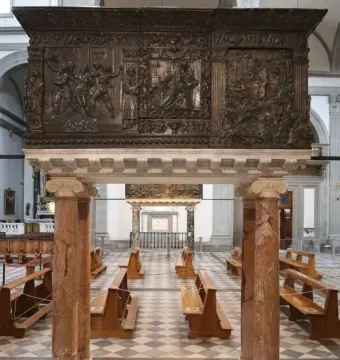
June 2021 © Francesco Bini · CC BY-SA 4.0
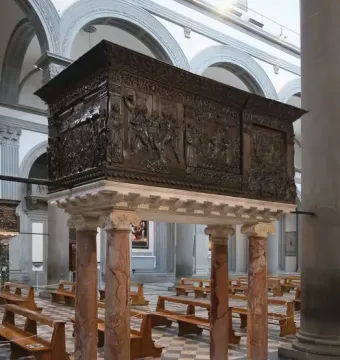
June 2021 © Francesco Bini · CC BY-SA 4.0
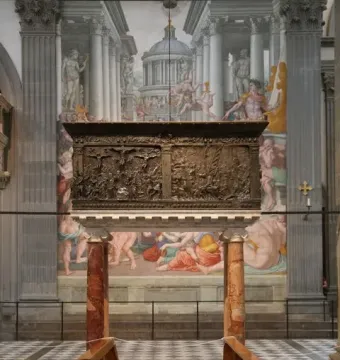
June 2021 © Francesco Bini · CC BY-SA 4.0
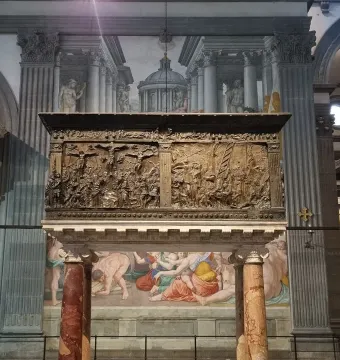
December 2023 © Giacomo.spiller · CC BY-SA 4.0
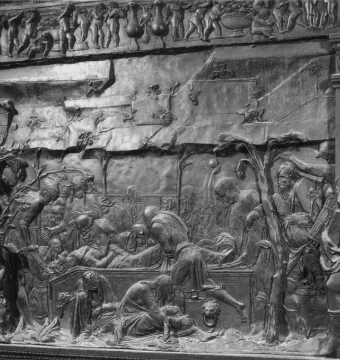
© Donatello · Public domain
Identification | |
| Title | The Passion Pulpit |
| Other titles | Púlpito de la Pasión; La chaire de la Passion |
| Type | Pulpit |
| Part of | The Pulpits of San Lorenzo |
| Original title | Il pulpito della Passione |
Historical context | |
| Date | After 1460, probably 1459–1460 |
| Inscribed date | 15 June 1465 |
| Artist's age at the time | About 70 years old |
| Status in artist's career | One of Donatello's last works and his final masterpiece |
Creator | |
| Artist | Donatello |
| Artist origin | Florentine |
| Role of Donatello | Originator of the project and the design; planned, designed, and drew it from 1460 |
| Attribution | Commonly regarded as Donatello's work, though workshop collaboration makes autograph authorship difficult to determine |
| Assistants | Bartolomeo Bellano; Bertoldo di Giovanni; other collaborators |
| Assistant involvement | Execution and other phases were carried out with substantial assistance; the assistants' role is more important here than in the Pulpit of the Resurrection |
Discovery and provenance | |
| Possible intended burial use | Possibly for Cosimo de' Medici and his wife, or for his son Giovanni di Cosimo de' Medici |
| Commissioner | Unknown, possibly Cosimo de' Medici |
| Original function | Unknown; some scholars have hypothesized a sarcophagus function, while a choir loft use is considered unlikely |
Location and ownership | |
| Current location | Basilica of San Lorenzo, Florence, Italy |
| Position in building | In the right or left nave of the basilica |
| Related work | The Pulpit of the Resurrection |
Physical characteristics | |
| Material | Bronze |
| Dimensions | 280 cm long; 137 cm high, excluding the columns |
| Size comparison | Slightly smaller than the Pulpit of the Resurrection |
| Structure | Mounted on four marble columns each |
| Current arrangement date | Probably installed in this form many years after Donatello's death |
Technique | |
| Relief technique | Bronze relief with deeply perspectival sculptural settings |
| Casting and finishing | Final casting and chasing were probably carried out by Bellano |
| Modeling | A wax model was probably involved in the casting process |
Appearance | |
| Symbolic objects | Includes arms, the grill of Saint Lawrence, a scorpion, a putto on horseback, SPQR, a cross banner, a book, a halo, and crowns of sanctity |
| Decoration | Includes composite capitals, lion heads, latticework, arches, columns, pillars, cornices, and brick-patterned walls |
| Frieze | A continuous upper frieze topped by a projecting cymatium recalling classical sarcophagi |
| Frieze decoration | Decorated with vine-harvesting putti, erotic centaurs, and confronting knights |
| Design | The two pulpits have a similar, highly original layout with extreme compositional freedom |
| Architectural articulation | Regularly divided by fluted pilasters, with capitals featuring putti holding garlands |
Iconography and meaning | |
| Scene: Entombment | Christ is placed in an antique-style foreshortened sarcophagus in a more peaceful scene with mourners, a grotto-like setting, and ancient-inspired figures |
| Iconographic interpretation | The work freely and originally reinvents biblical themes and pushes Donatello's study of human emotion, spatiality, and compositional freedom to an extreme |
| Scene: Martyrdom of Saint Lawrence | Saint Lawrence lies on a burning grill while an executioner and a servant with bellows tend the torture |
| Scene: Pentecost | Mary and the apostles stand in a semicircle as the Holy Spirit, shown as a dove, sends flames onto their heads |
| Scene: Ascension | Christ ascends in a closed room with a balcony, plants and vines on the balustrade, and the apostles and Virgin Mary arranged in a semicircle below |
| Scene: Harrowing of Hell | Christ rescues the righteous immediately after the Resurrection, with prophets and saints gathered around him, Saint John the Baptist at the partition, and a fleeing devil |
| Scene: Resurrection and the Three Marys | An angel opens the tomb, three sleeping guards are present, and the Three Marys appear in successive emotional states |
| Scene: Resurrection | Christ rises above the cornice line on the mountains, holding the cross banner and wearing burial cloths, while armed guards sleep near the tomb |
| Scene: Lamentation | Christ's body is taken from the cross in a more restrained scene with Mary kissing his face, mourners arranged in a semicircle, and ancient relief-inspired figures and anatomy |
| Scene: Christ Before Caiaphas and Pilate | Christ is interrogated before Caiaphas and then before Pilate in two barrel-vaulted rooms with arches, balconies, perspective guides, and hanging cages; Pilate's servant is shown two-faced |
| Scene: Agony in the Garden | Christ prays in Gethsemane, meets an angel, and the apostles sleep in groups that increase in size toward the viewer; Judas is absent because he is informing the priests of the Sanhedrin |
| Scene count | Seven scenes in total |
| Interpretive note | The absence of the Last Supper may be related to the nearby high altar, where that episode was commemorated daily during Mass |
| Missing scene | The Last Supper is absent |
| Narrative structure | The scenes are treated as a group, as if set in three rooms of the same building |
| Subject | Scenes from the Passion and Resurrection of Christ, including the Harrowing of Hell, the Resurrection, the Ascension, Pentecost, and the Martyrdom of Saint Lawrence |
| Scene: Crucifixion | Christ's Passion unfolds above a crowded scene with soldiers, horses, grieving women, foreshortened angels, and the tortured right-hand thief being whipped by a devil |
History and restoration | |
| Inscription | 'Opus Donatello Flo' in a medallion; generally considered posthumous |
| State at artist's death | It is not possible to establish what degree of finish the reliefs had when Donatello died in 1466 |
| Dating uncertainty | It is unclear whether the 15 June 1465 inscription refers to completion of the relief, the pulpit as a whole, the group, the wax model, or the casting/founding of the work |
| Temporary installation | Mounted temporarily in 1515 for the visit of Leo X to Florence |
| Frieze authorship | The friezes of both pulpits were executed after Donatello's death, probably by an old collaborator |
| Later additions | Completed with two darkened wooden panels in 1616 and 1634; two more wooden scenes were added later in the 15th century; two seventeenth-century wooden panels on the south side correspond to the access door |
| Reassembly date | 1558–1565 |
Significance | |
| Artistic significance | Considered the extreme point of Donatello's art and his last masterpiece |
| Critical history | Baccio Bandinelli dismissed the pulpits in the 16th century as Donatello's worst works, attributing the unfinished details to old age and blindness; later criticism gradually became more positive, and the work is now judged favorably for its expressive intensity and reinvention of biblical themes |
| Stylistic significance | Noted for expressive intensity, compositional freedom, airiness, richness of relief, and complex perspective with strong three-dimensional effects |