
Hercules and Antaeus
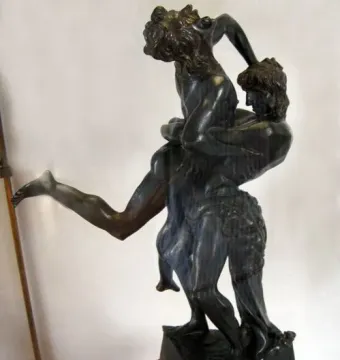
Hercules and Antaeus is a Renaissance bronze sculpture, or bronzetto, created by Antonio Pollaiolo around 1475. The work is preserved in the National Museum of the Bargello in Florence. Its subject comes from the myth in which Hercules confronts the giant Antaeus, son of Gaia, during his quest for the golden apples of the Garden of the Hesperides. Because Antaeus regained his strength whenever he touched the earth, Hercules lifts him from the ground and defeats him by strangling him.
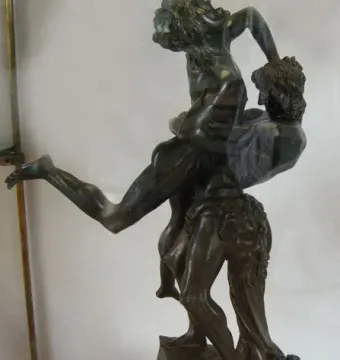
April 2009 © sailko · CC BY 2.5
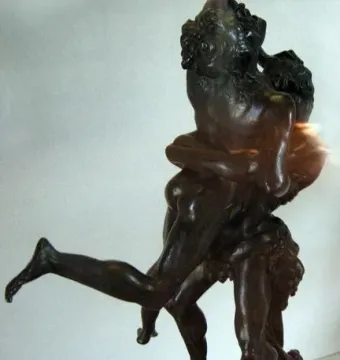
April 2009 © Francesco Bini · CC BY-SA 4.0
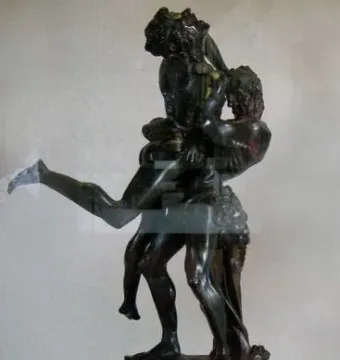
April 2009 © Francesco Bini · CC BY-SA 4.0
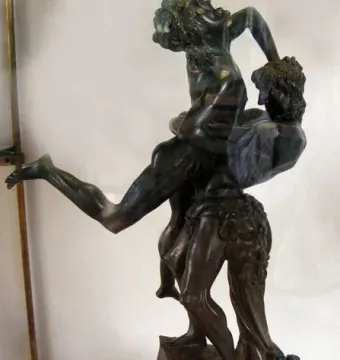
April 2009 © Francesco Bini · CC BY-SA 4.0
April 2009 © Francesco Bini · CC BY-SA 4.0
Identification | |
| Title | Hercules and Antaeus |
| Italian title | Ercole e Anteo |
| Type | bronzetto (small bronze sculpture) |
| Style | Renaissance art |
Historical context | |
| Date | circa 1475 |
| Subject | Hercules and Antaeus |
| Mythological source | Greek mythology |
| Mythological context | Hercules encounters Antaeus during his quest for the golden apples of the Garden of the Hesperides |
Creator | |
| Attribution status | The only sculpture of this type unquestionably considered an original work by his hand |
| Artist | Antonio Pollaiuolo |
Discovery and provenance | |
| Commissioned by | The Medici family, possibly Lorenzo de' Medici (Lorenzo il Magnifico) |
| Related works | A small panel painting of Hercules and Antaeus by Antonio Pollaiuolo; a lost series of three large square paintings on the Labors of Hercules, including Hercules and Antaeus |
| Related lost paintings date | circa 1464 |
| Related lost paintings size | About 3.5 meters on each side |
| Other related lost subjects | Hercules and the Hydra; Hercules and the Nemean Lion |
| Workshop context | Made by Antonio and Piero Pollaiuolo, leaders of one of the most important artistic workshops in Florence in the 1470s, in competition with Andrea del Verrocchio's workshop |
| Comparative work | The small panel painting on the same subject in the Uffizi Gallery, Florence |
Materials | |
| Material | Bronze |
| Base support material | Tortoises |
Physical characteristics | |
| Base shape | Triangular prism |
| Height | 45 cm |
Appearance | |
| Depicted moment | Hercules has lifted Antaeus off the ground and is squeezing him around the waist as Antaeus struggles and cries out in defeat |
| Hercules identification | Hercules wears the Nemean lion skin (leonté) |
| Figure treatment | Two bodies arched in opposite directions, with limbs and gaze creating broken, acute-angled lines of force |
| Movement effect | Strong dramatic movement and explosive energy |
| Anatomical treatment | Muscles and tendons are rendered with exceptional anatomical precision and tension |
| Viewing experience | The free projection of the two bodies in space is especially perceptible when viewing the work from different angles while moving around it |
Iconography and meaning | |
| Mythological interpretation | Antaeus' strength depended on contact with the earth; Hercules defeats him by lifting him away from the ground, cutting him off from that source of strength |
| Existential interpretation | The work expresses the existential drama of the Neoplatonic human being, who must pursue an apparently unattainable condition throughout life |
| Neoplatonic view of humanity | Human beings were seen as inclined toward the good but unable to achieve perfection and at risk of falling back into irrationality driven by instinct |
| Neoplatonic influence | Influenced by the Florentine Neoplatonic Academy |
| Neoplatonic reading | Read as a symbol of the conflict between higher and lower principles and the human soul's tension between virtue and vice |
| Classical revival theme | A reinterpretation of classical myths in a Christian philosophical key, evoking the revival of antiquity as evidence of a lost aesthetic harmony |
| Humanist theme | The hero overcomes adversity by combining intellectual and physical qualities, embodying a humanist ideal |
| Stylistic and symbolic significance of nudity | The protagonists' nudity alludes to the ancient world |
Location and ownership | |
| Current location | Museo Nazionale del Bargello, Florence |
| Comparative work location | Uffizi Gallery, Florence |
History and restoration | |
| Art-historical comment | Giorgio Vasari's description of Pollaiuolo's lost Hercules and Antaeus painting is said to apply perfectly to this bronze, emphasizing the tension of muscles and nerves and the expressive faces and toes straining in effort |
| Art-historical reference | Giorgio Vasari noted that Pollaiuolo was among the first to study human anatomy scientifically |
Other | |
| Base motif reception | The turtle motif continued into the following century |