
Golden Woman
Golden Woman is a legendary idol, also called the Golden Hag or Golden Lady, with the archaic name Zlata baba. It was said to be an object of worship among indigenous peoples of northeastern Europe and northwestern Siberia. Early references are inconsistent, giving different accounts of both its location and its appearance. In 1517, Maciej Miechowita described it as a great idol beyond the land of Viatka, where nearby peoples revered it and made offerings when passing. In 1591, Giles Fletcher noted similar reports in maps and descriptions, but treated the idol as a myth. He also mentioned a rock near the Ob River that resembled a ragged woman holding a child, which Obdorian Samoyeds used in pagan sorcery.
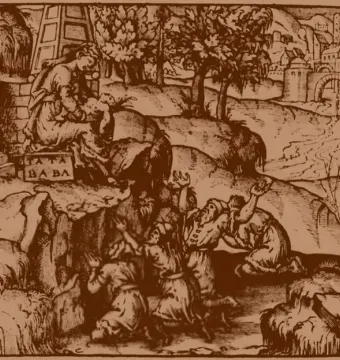
January 1575 © André Thévet · Public domain
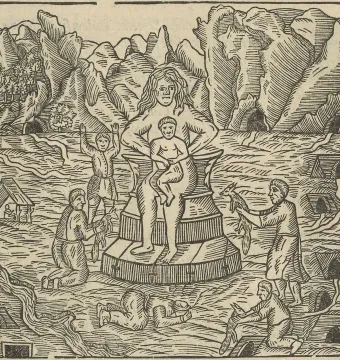
© Aleksander Gwagnin · Public domain
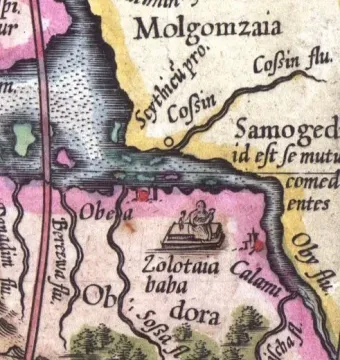
· Public domain
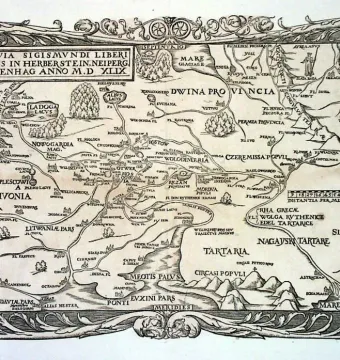
1549 © Sigismund von Herberstein · Public domain
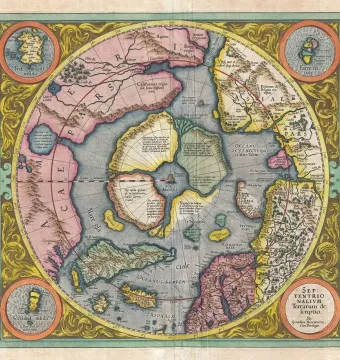
1606 © http://www.geographicus.com/mm5/cartographers/mercator.txt · Public domain
Identification | |
| Title | Golden Woman |
| Gender | Female |
| Alternative names | Golden Baba; Golden Hag; Golden Lady; Golden Old Lady; Golden Old Woman; Slata baba; Zlata baba (Злата баба); Zlotababa; aurea vetula; aureae anus idolum; Sorni nai (Khanty); Kaltas-ekva (Mansi) |
| Type | Legendary idol; sculpture; statue |
| Original name | Золотая баба |
Historical context | |
| Nature | A legendary idol allegedly worshipped by indigenous peoples of northeastern Europe and northwestern Siberia |
| Associated peoples | Finno-Ugric population of northeastern Europe and northwestern Siberia; ancient Komi; Khanty (Ostyaks); Mansi (Voguls); Obdors; Yugors; Ob-Ugrians; Permian Komi; Permians; local pagan peoples |
| Religious function | An object of worship; in some accounts consulted by priests for guidance and predictions |
| First mention | Probably in the Scandinavian Saga of Saint Olaf, preserved most fully in Snorri Sturluson's Heimskringla (13th century) |
| Historical reliability | Early references are contradictory about both its location and its description; the testimonies are rather contradictory |
| Historical status | By the mid-17th century educated Europeans regarded it as mostly legendary; one account says the idol had already been destroyed by Russians |
| Legendary behavior | Said to reward devotion, punish broken vows, and bring death to those who approached without proper reverence; in one legend it ordered itself hidden before the arrival of Cossacks |
Creator | |
| Attribution | Unknown / legendary |
Discovery and provenance | |
| Reported Christian connection | One theory linked it to a Christian image or statue, possibly brought beyond the Urals during the Christianization of Rus' |
| Reported provenance in one theory | According to one hypothesis, it was brought to the Ob by unwillingly baptized pagans from Great Perm |
| More detailed written accounts | 16th-century Western European travelers' and writers' books about Muscovy |
| Early historical account | In 1026, Norwegian Vikings led by Thorir Dog raided Biarmia and reportedly saw a shrine of the Finnish thunder god Yumala on a river identified by some with the Northern Dvina |
Physical characteristics | |
| Described form | A statue or idol in the form of a woman, sometimes old or ragged; in some accounts a goddess or female deity; sometimes shown with a child |
| Associated child figure | Sometimes described as having a child on her lap, a son with her, or a grandchild nearby |
| Attributes | Described variously as seated, naked, dressed in long clothing, on a high pedestal, or with ringing bells on her body; one early account says she had a necklace and a crown decorated with twelve images |
| Sound-producing property | According to some accounts, instruments placed near it emitted a constant trumpet-like sound; later a Mansi witness said the idol shouted loudly |
| Depicted figure | A female deity or old woman; in some descriptions a goddess with a child; in some images with a cornucopia, a child, or in the form of Minerva or the Virgin Mary |
Materials | |
| Material | Gold in the legend; also described as wooden, silver, bronze, or other non-gold forms in later accounts and depictions |
| Bowl contents | Silver coins mixed with earth |
| Surroundings | A fenced sanctuary with a mound behind the fence |
Technique | |
| Depiction medium | Shown in some 16th-century maps of Muscovy as a captioned image; depictions appear conjectural or symbolic rather than based on direct observation |
Appearance | |
| Map caption text | 'Golden Baba — golden old woman — an object of religious cult of the Obdors and Yugors; the priest asks this idol what they should do and where they should migrate' |
| Iconographic variations | Shown as a naked woman on a high pedestal, a woman in long clothing with a child, a seated figure with a child, an antique Minerva with a spear, a seated Virgin Mary-like figure with a child, or a female deity holding a cornucopia |
| Map representations | Some 16th-century Western European maps of Muscovy show a statue with a child in her arms and the caption 'Slata baba' in the lower Ob region |
Iconography and meaning | |
| Religious function | Consulted by priests for guidance on what to do and where to move; believed to give accurate answers and predictions |
| Legendary location in later tradition | Around Berezov, near Manya-Tump, on the Berezovsky side, at Rachevsky town, or in the upper reaches of the Konda River |
| Alternative name meaning | 'Golden old woman'; in Richental's Latin translation, 'ad Auream Vettullam' |
Location and ownership | |
| Location in saga tradition | Biarmia, on a river identified by some with the Northern Dvina |
| Location in 15th-century account | A city beyond Russia, by the Golden Old Woman |
| Location in 16th-century accounts | Placed variously beyond Vyatka, on the road from Vyatka to Scythia, on the border of Muscovy and Lithuania, and near the mouth of the Ob River in Obdoria |
| Location in Russian sources | Associated with Komi worship in 1398; later linked to the Ob-Ugric lands after the annexation of Siberian territories |
| Associated regions | Obdoria; the Tobol and Ob River regions; Belogorsk volost near the Irtysh; the Ob region; Kazym; the Taz; the Ural area; Great Perm |
| Sources placing it near the Ob | Sigismund von Herberstein (1549), Alexander Guagnini (1578), and Giles Fletcher (1591) |
| Map location | Lower Ob region on some 16th-century Western European maps of Muscovy |
| Associated cult | Object of religious worship by Obdors, Yugors, Ob Ugrians, Khanty, Mansi, Permian Komi, and other local peoples in different accounts |
History and restoration | |
| Related local replica or counterpart | A 'silver woman' was said to survive as a cult object in a Mansi settlement, described as a silver seated naked woman used for asking help in hunting |
| Destruction claim | Jakob Reitenfels stated that Russians found and broke the idol some years earlier |
| Modern Komi tradition | No motifs of the Golden Baba were found in contemporary Komi legends and oral traditions |
| Reported sighting | Cossacks under Bogdan Bryazga allegedly found nothing but empty yurts in spring 1583 after the idol was supposedly hidden |
Significance | |
| Scholarly dispute | Whether the sagas' Biarmian deity Yomali can be identified with the Ob-Ugric goddess is a long-standing debate |
| Possible interpretation | Some scholars identify the Biarmian deity Yomali with Perun/Perkunas and Thor; the Ob-Ugric goddess may instead represent a Mother Goddess |
| Interpretations and hypotheses | Various scholars and authors proposed that it was a Roman statue of Juno, a Tibetan goddess Tara, the Chinese deity Guanyin, a relic of Hyperborea, a Slavic goddess Zhiva, a stone baba from the steppe, a Catholic Madonna, or the Mansi mother goddess Kaltaщ (Kaltas) / Sorni-ekva |
| Possible comparisons | Compared by V. Ya. Petrukhin with the ancient Iranian fertility goddess Ardwisura Anahita |
| Cultural interpretation | The idol may have served as a geographic marker in some descriptions, though this is questioned because of the added details about nearby sounding instruments |
| Etymological note | The Mansi epithet Sorni-ekva literally means 'golden old woman'; sorni can mean both gold and solar brilliance |
| Travellers' consensus trend | The later the description, the farther east its supposed location shifts |
Other | |
| Caution on certainty | The sculpture's identification is disputed and surrounded by legend, speculation, and contradictory descriptions |
| References | Maciej Miechowita (1517); Ulrich von Richental (c. 1420); Olaus Magnus (1555); Sigismund von Herberstein (1549); Anthony Jenkinson (1562); Alessandro Guagnini (1578); Giles Fletcher (1591); Gerrit de Jode (1593); Petrus Petreius de Erlesunda (1615); Augustin Meyerberg (1661); Jakob Reitenfels (1670–1673, Moscow); Nicholas Spafariy (1675); Remizov Chronicle (late 17th century); Nicolaas Witsen (1705); Johann Philipp von Strahlenberg (1730); I. I. Lepekhin; G. F. Miller |