
Cupid and Psyche (Roman Sculpture)
Cupid and Psyche is a marble Roman sculpture conserved in the Capitoline Museums in Rome. It is a 1st or 2nd century Roman copy of a late Hellenistic original. The work was discovered in February 1749 in the garden of the vigna of the canonico Panicale on the Aventine Hill and was soon given to the Capitoline Museums by Pope Benedict XIV. Its graceful balance and sentimental appearance made it highly admired by Neoclassical artists and visitors, and it was widely copied in materials ranging from bronze to biscuit porcelain. The sculpture was later taken to Paris under the terms of the Treaty of Tolentino in 1797 and returned to Rome after the fall of Napoleon.
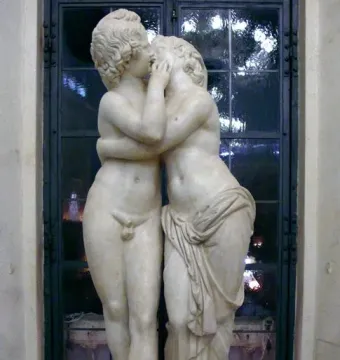
December 2010 © Rosemania · CC BY 2.0
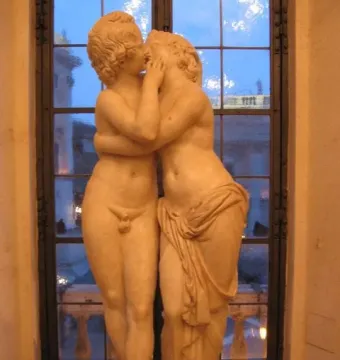
March 2006 © Shii · Public domain
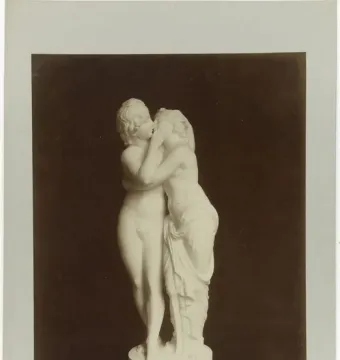
© Rijksmuseum · CC0
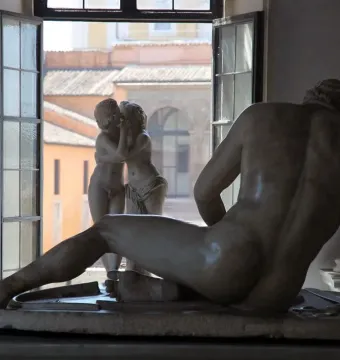
August 2012 © Jean Fontayne · CC BY-SA 3.0
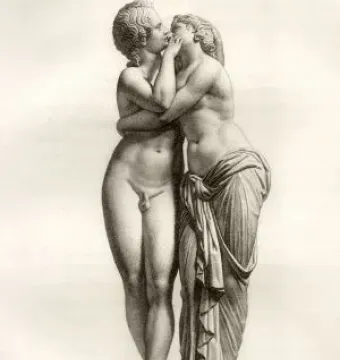
© Pierre Bouillon · Public domain
Identification | |
| Title | Cupid and Psyche |
| Alternative titles | Eros and Psyche; Cupido and Psyche |
| Type | Marble sculpture |
| Subject | Cupid and Psyche |
Historical context | |
| Date | Roman copy of a lost ancient Greek original, from the 1st or 2nd century CE |
Creator | |
| Original model | Late Hellenistic Greek original (lost) |
Discovery and provenance | |
| Discovery date | February 1749 |
| Discovery location | Garden of the vigna of Canonico Panicale on the Aventine Hill, Rome |
| Donor | Pope Benedict XIV |
| Donation date | 1749, shortly after discovery |
| Post-discovery transfer | Transferred to the Capitoline Museums in Rome |
| Removal to Paris | Taken to Paris in 1797 under the terms of the Treaty of Tolentino |
| Return | Returned to Rome after the fall of Napoleon |
Physical characteristics | |
| Restored pose detail | Cupid turns his head away coyly |
| Material | Marble |
Appearance | |
| Stylistic qualities | Graceful balance and sentimental appearance |
Location and ownership | |
| Current location | Capitoline Museums, Rome |
History and restoration | |
| Reception | A favorite among generations of Neoclassical artists and visitors |
| Critical assessment | Some viewers were dissatisfied by its mediocre execution |
| Jean-Baptiste de Saint-Victor's view | He thought it was a reflection of some earlier, better work |
| Joseph-Jérôme Le Français de Lalande's view | He hoped it might inspire a modern sculptor to produce a superior work on the same subject |
Significance | |
| Influence and copies | Copied in many materials, including bronze and biscuit porcelain |
| Antonio Canova's response | Canova consciously set out to outdo the antique original with his Cupid and Psyche of 1808 |
| Influence on later artists | The Capitoline Cupid and Psyche inspired many sculptors |
| Copies of Canova's work | Authorial copies are preserved in the Louvre and the Hermitage |
Other | |
| Related earlier work | A Roman marble of a winged Cupid and Psyche discovered in the 17th century and later removed to the Medici collection in Florence |
| Another version | A second version of Cupid and Psyche was discovered by conte Giuseppe Fede in early excavations at Hadrian's Villa, Tivoli; it is lost today and was drawn in completed and restored condition by Pompeo Batoni for Richard Topham's paper museum of antiquities in 1727–30 |
| Related sculpture in Florence | A similar Cupid and Psyche sculpture is in the Uffizi Gallery in Florence; it may be a copy or variation of the same original and is depicted in Johann Zoffany's The Tribune of the Uffizi at the left edge |