
Pseudo-Seneca
Pseudo-Seneca is a Roman bronze bust discovered in 1754 in the Villa of the Papyri at Herculaneum. It is considered the best example of about two dozen models showing the same face. The work was once thought to portray Seneca the Younger because of its gaunt features, which seemed to reflect Stoic philosophy. Modern scholars now regard it as a fictional portrait, probably intended to represent Hesiod or Aristophanes. The original model is thought to have been a Greek bronze from around 200 BC. The bust is preserved in the National Archaeological Museum of Naples.
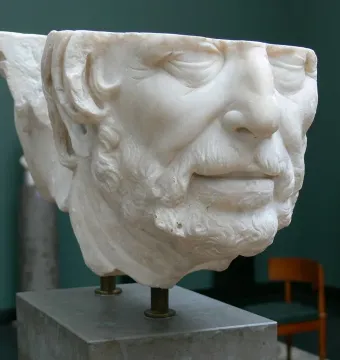
July 2008 © Wolfgang Sauber · CC BY-SA 3.0
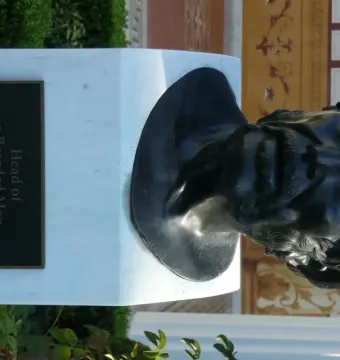
December 2008 © Dave & Margie Hill / Kleerup · CC BY-SA 2.0
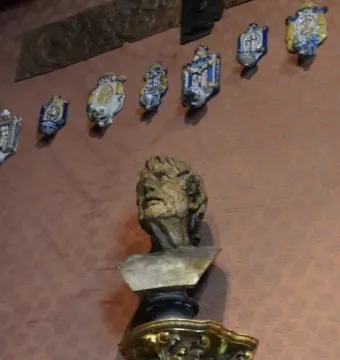
June 2013 © Joanbanjo · CC BY-SA 3.0
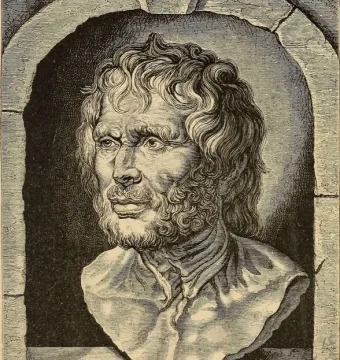
1868 © Internet Archive Book Images · No restrictions
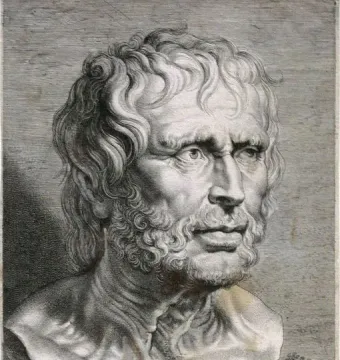
© Lucas Vorsterman the Elder · Public domain
Identification | |
| Title | Pseudo-Seneca |
| Basis for traditional identification | Its gaunt, emaciated features were thought to reflect Seneca's Stoic philosophy |
| Historical classification | Roman |
| Suggested scholarly view | Gisela Richter and other commentators considered Hesiod the most acceptable identification |
| Current interpretive status | Its identification remains conjectural and disputed |
| Type | Roman bronze bust |
| Type of subject | Imaginary portrait |
| Other proposed identifications | Aesop, Archilochus, Callimachus, Carneades, Epicarmus, Eratosthenes, Euripides, Hipponax, Lucretius, Philemon, and Philetas of Cos |
| Possible intended subject | Hesiod or Aristophanes |
| Modern interpretation | A fictitious or imaginary portrait, probably of a Greek author or man of letters |
| Type of subject | Bust |
| Traditional identification | Seneca the Younger |
Historical context | |
| Date | Late 1st century BC |
Creator | |
| Erika Simon's reconstruction hypothesis | The lost original may have been created in the circle of Crates of Mallus and the sculptors of the Pergamon Altar |
| Prototype | A lost Hellenistic Greek bronze, probably made in Alexandria around 200 BC |
Discovery and provenance | |
| Inventory number | 5616 |
| Number of known replicas | About forty |
| Discovery date | 1754 |
| Ownership history of 17th-century version | Formerly owned by Peter Paul Rubens |
| Discovery place | Grand peristyle of the Villa of the Papyri, Herculaneum |
Physical characteristics | |
| Height | 36 cm |
| Facial features | Emaciated features with hair falling in disordered, wet-looking strands |
Materials | |
| Eye material | Pâte de verre (glass paste) |
| Material of 17th-century version | Marble |
| Material | Bronze |
Significance | |
| Significance | Considered the finest and most powerful example among about two dozen to forty replicas of the same face |
Location and ownership | |
| Current location | National Archaeological Museum of Naples |
| Museum of 17th-century version | Ashmolean Museum |
History and restoration | |
| Early modern collecting context | In the 16th and 17th centuries, busts of great Classical writers were collected by gentlemen and scholars for study and contemplation |
| Early modern comparison | Compared with Cicero's study and the imagines illustrium at Pollius Felix's villa in Sorrento, as described by Statius |
| Early modern interpretation of Seneca | Seen as an emaciated, rough, luxury-despising Stoic philosopher opposed to the corruption of Nero's court and ready to commit suicide |
| 17th-century version | A 17th-century marble version now in the Ashmolean Museum, formerly owned by Peter Paul Rubens |
| Later discovery affecting identification | In 1813, a Roman inscribed marble herm portrait identified as Seneca showed a man with quite different features, undermining the identification |
| Publication | An engraving was published in Le Antichità di Ercolano, volume V (1767), under the royal patronage of Ferdinand I of the Two Sicilies |
| Early reception | At the time of discovery, about a dozen copies were known, and the Herculaneum version was quickly recognized by Winckelmann as outstanding, though he had already begun to doubt the Seneca identification by 1764 |
Other | |
| Possible former ownership hypothesis | It has been hypothesized that the bust may once have belonged to a cultured person from the Roman city |