
Sabouroff Head
Sabouroff head is an important example of late Archaic Greek marble sculpture, dated to around 550–525 BC and measuring 23 cm high. Named after the Russian diplomat Pyotr Alexandrovich Saburov, whose antiquities collection once included it, the head has been in the Berlin Antiquities Collection since 1884 under inventory number Sk 308. Its exact origin is uncertain: it is thought to come from Attica or Aegina, though a origin in Caria in Asia Minor has also been suggested. The sculpture is notable for its unusual hair and beard design, especially the separate treatment of the moustache, which is rare in Archaic art.
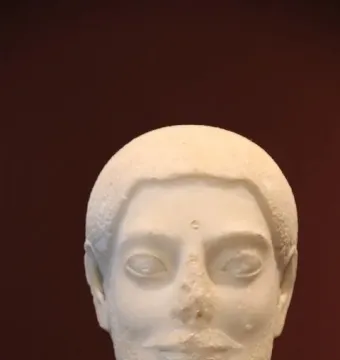
August 2016 © Gary Todd · CC0
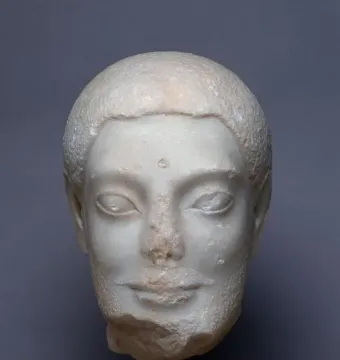
© Staatliche Museen zu Berlin, Antikensammlung / Ingrid Geske · CC BY-SA 4.0
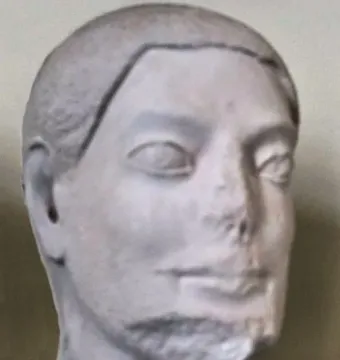
November 2018 © Wuselig · CC BY-SA 4.0
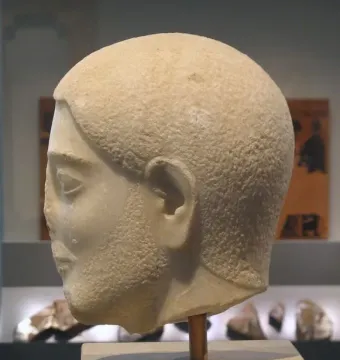
June 2014 © Mark Landon · CC BY 4.0
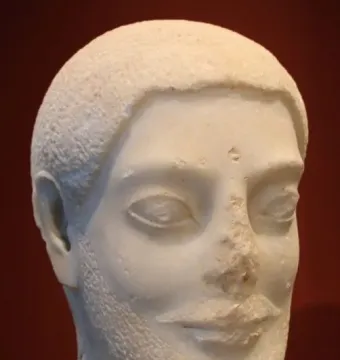
March 2014 © Sailko · CC BY 3.0
Identification | |
| Title | Sabouroff head |
| Also known as | La Cabeza de Sabouroff |
| Type | Greek marble sculpture head of a kouros |
Historical context | |
| Period | Late Archaic Greek period |
| Date | ca. 550–525 BC |
Physical characteristics | |
| Height | 23 cm |
Materials | |
| Material | Marble |
Creator | |
| Named after | Pjotr Alexandrowitsch Saburow (Peter Alexandrovich Saburov), Russian diplomat and collector of ancient Greek sculpture and antiquities |
Discovery and provenance | |
| Former collection | Saburow's antiquities collection |
| Former owner | Pjotr Alexandrowitsch Saburow (Sabouroff) |
| Original context | Probably part of a life-sized statue |
| Probable origin | Possibly Attica or Aegina; alternatively Caria in Asia Minor |
Location and ownership | |
| In collection since | 1884 |
| Inventory number | Sk 308 |
| Current location | Antikensammlung Berlin |
Appearance | |
| Hair | Unusually designed for the period |
| Beard | A common Archaic attribute and a sign of the depicted person's age |
| Moustache | Rendered separately from the beard on the cheeks and chin, which is very rare in Archaic Greek sculpture and gives the head an exotic appearance |
| Overall appearance | Unusual |
| Portrait quality | Stylistically closer to a portrait than any other surviving work from Archaic Greece except the Boxer Relief in Athens |
| Comparison work | Boxer Relief in Athens |
Technique | |
| Scientific analysis | Analyzed from a plaster cast at Heidelberg University using a high-resolution optical 3D scanner and the GigaMesh Software Framework, with Voronoi cells and geodesic distances |
| Scientific findings | Measurements showed asymmetry and a slight tilt of the head |
Iconography and meaning | |
| Interpretation of analysis | The asymmetry and slight tilt are characteristic of rider statues and may indicate that it was part of an equestrian sculpture |
Significance | |
| Stylistic significance | An important representative of Greek marble sculpture of the Late Archaic period |