
Jōmon Venus
Jōmon Venus is a dogū, a humanoid clay female figurine from the Middle Jōmon period, dating to around 2500 BC. It was discovered in 1986 in Chino, Nagano Prefecture, Japan, and designated a National Treasure in 1995, becoming the first Jōmon-period artifact to receive that status. Made of ocher-colored clay, the statuette is carefully polished and contains mica. Its form is thought to resemble a pregnant woman, with broad hips, a pronounced gluteal arch, prominent breasts, and an enlarged belly. Unlike most of the 20,000 dogū found in Japan, it is complete and retains all its limbs.
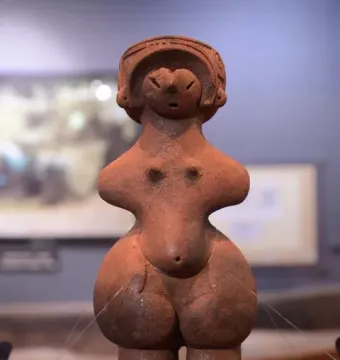
March 2025 © C1815 · CC0
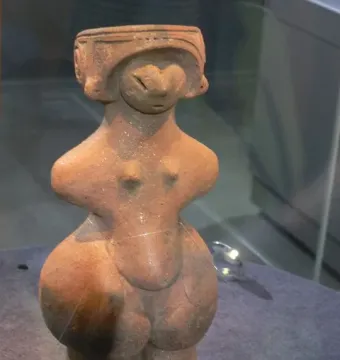
October 2012 © Takuma-sa · CC BY-SA 3.0
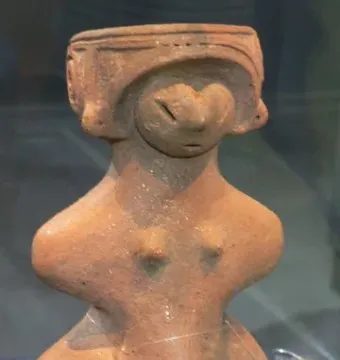
October 2012 © Takuma-sa · CC BY-SA 3.0
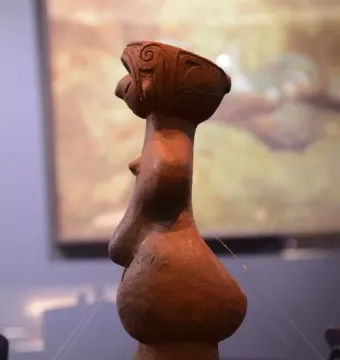
March 2025 © C1815 · CC0
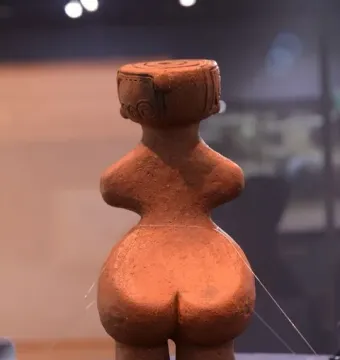
March 2025 © C1815 · CC0
Identification | |
| Title | Jōmon Venus |
| Alternate names | Tanabatake Venus; Venus of Tanabatake; Venus Tanabatake; Venus of Jōmon |
| Type | Dogū figurine |
Historical context | |
| Period | Middle Jōmon period, c. 3000–2000 BC |
| Discovery year | 1986 |
| Discovery context | Found during archaeological excavations before construction of an industrial park/industrial zone near Chino |
Discovery and provenance | |
| Discovery site | Tanabatake archaeological site, former hamlet of Tanabatake, Chino, Nagano Prefecture, Japan |
| Site setting | At the foot of the southern slope of Mount Kirigamine in the Yatsugatake Mountains, about 140 km northwest of Tokyo |
| Findspot | Among the burial pits in the center of the excavation site |
| Associated settlement | A village of 149 houses, 146 of which date to the Middle Jōmon period |
| Site significance | Obsidian finds indicate the village was a prosperous trading center for volcanic glass |
Creator | |
| Production | Handcrafted by human hand |
Physical characteristics | |
| Condition | Complete and undamaged, with all limbs intact |
| Weight | 2.14 kg |
| Height | 27 cm |
Materials | |
| Material | Ocher-colored clay / terracotta |
| Surface | Carefully polished clay containing mica, with a black mica cover |
Technique | |
| Construction technique | The prominent volumes of the head, breasts, hips, and buttocks were made separately, then placed on an earthen core and fired |
| Firing | Low-fired on the ground at 600–800 °C |
Appearance | |
| Depicted figure | Female figure, probably a pregnant woman |
| Physical features | Wide hips, pronounced buttocks/gluteal arch, prominent breasts, and an enlarged/pregnant abdomen |
| Head adornment | A hairstyle or headdress characteristic of the period |
| Interpretation | Thought to resemble a pregnant woman and, because of its features, a work of art |
Location and ownership | |
| Custody | In the care of the city of Chino since discovery |
| Current display location | Togariishi Museum of Jōmon Archaeology, Chino |
| Designation | Important Cultural Property of Japan (1989); National Treasure of Japan (1995) |
Significance | |
| Historical significance | First Jōmon-period artifact to be designated a National Treasure of Japan |
| Related comparison | The Masked Goddess, discovered in 2000 at the nearby Nakappara archaeological site, was the second artifact of this kind to receive National Treasure status in 2014 |