
The Thinker of Cernavodă
The Thinker of Cernavodă is a Neolithic terracotta sculpture from the Hamangia culture, discovered in 1956 near Cernavodă in southeastern Romania. The figure shows a seated person with the chin resting on one hand, giving it a distinctly contemplative appearance. It is about 11 cm tall and is often interpreted as a thinker or philosopher. Found with the companion figure known as The Sitting Woman in a large Hamangia necropolis, it is one of the best-known artifacts from this culture. Since 2005, The Thinker and The Sitting Woman have been displayed at the National Museum of Romanian History in Bucharest.
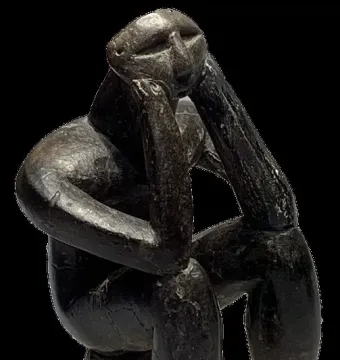
March 2023 © Chainwit. · CC BY-SA 4.0
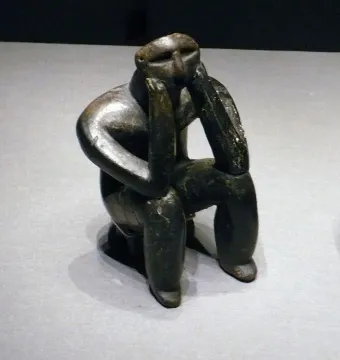
March 2016 © 三猎 · CC BY-SA 4.0
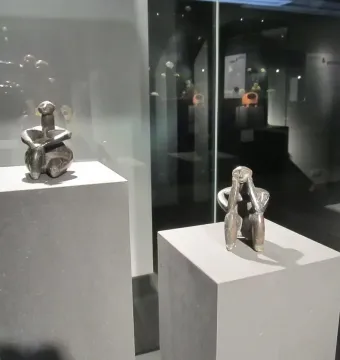
February 2020 © Nenea hartia · CC BY-SA 4.0
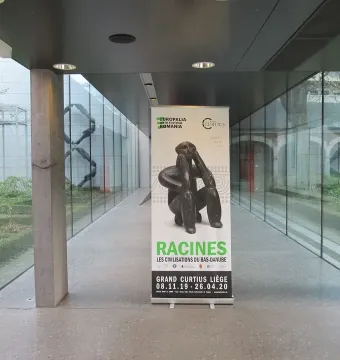
February 2020 © Nenea hartia · CC BY-SA 4.0
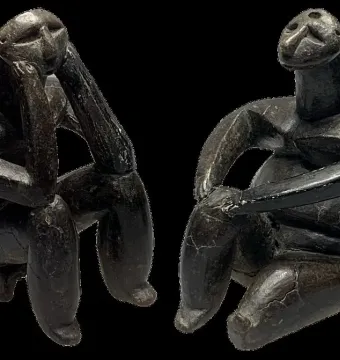
March 2023 © Chainwit. · CC BY-SA 4.0
Identification | |
| Title | Thinker of Cernavodă |
| Alternative names | The Thinker of Hamangia; Thinker of Hamangia; The Thinker |
| Companion sculpture | The Sitting Woman |
| Type | Archaeological artifact; ceramic figurine; statuette |
Historical context | |
| Culture | Hamangia culture |
| Period | Neolithic |
| Date | Around 5000 BC |
| Region of origin | What is now Romania; Dobruja, Romania; Western Black Sea region |
| Cultural origin | Originating in Anatolia, according to the article fragment |
Discovery and provenance | |
| Date of discovery | 1956 |
| Discovery location | Near Cernavodă, in southeastern Romania |
| Find context | Found in a vast Hamangia culture necropolis |
| Associated burial practice | The culture buried its dead crouched or lying down in designated necropolises |
| Number of graves in necropolis | Approximately 400 graves |
| Funerary association | Found among grave goods such as pottery, seashells, gold objects, and statuettes |
Creator | |
| Naming inspiration | Named after Auguste Rodin's sculpture The Thinker |
Physical characteristics | |
| Height | 11 cm |
Materials | |
| Material | Terracotta; fired clay |
Appearance | |
| Depicted figure | A seated person |
| Pose | Seated on a small stool, chin supported by one hand |
| Style | Contemplative or meditative posture |
Iconography and meaning | |
| Common interpretation | Often interpreted as a thinker or philosopher because of its contemplative posture |
| Interpretation | The posture suggests deep contemplation and may indicate contemplation of life and death; the find has also been taken to argue for the existence of some developed ideology in this period |
| Perceived qualities | Described as radiating vitality and deep emotion |
| Art historical significance | Stands out from typical ancient pre-literate art, which often emphasized hunting and fertility themes and faceless Venus figurines with exaggerated buttocks and breasts |
| Comparative references | Compared with the Thinker of Karditsa, the Middle Bronze II Yehud Thinker, and the modern Thinker Christ |
Location and ownership | |
| Current display location | National Museum of Romanian History in Bucharest |
| Current display since | 2005 |
| Banknote depiction | Appears on the reverse of the Romanian 200 lei banknote since 2006 |
History and restoration | |
| Exhibition | Displayed at the Curtius Museum in Liège during Europalia in 2019 |
| Companion figure pose | The Sitting Woman sits directly on the ground without a chair, with both hands on one leg, left leg extended, right leg bent; hips distinctly delineated and an evocative facial expression |