
Warrior of Moixent
Warrior of Moixent is a small Iberian bronze figure found at the archaeological site of La Bastida de les Alcusses, near Moixent in southern Valencia, Spain. Measuring 7.3 cm high, it is technically refined, with a smooth surface and dark green patina. The statuette shows a nude warrior seated on a horse, representing a member of the Iberian equestrian elite. He holds the typical warrior attributes: a falcata in his right hand and a round shield, or caetra, on the left, and wears a helmet with a large plume. The horse is carefully detailed, with pointed ears, visible eyes, an open mouth, a long mane, and a tail reaching the ground. It is now kept in the Prehistory Museum of Valencia.
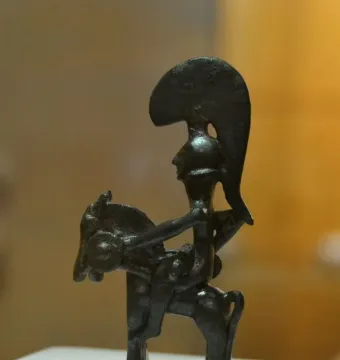
May 2013 © Joanbanjo · CC BY-SA 3.0
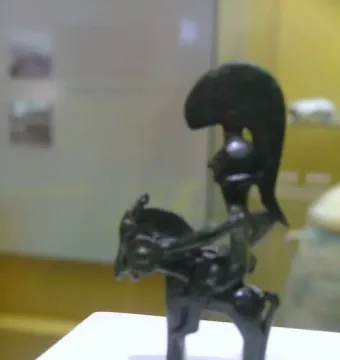
December 2008 © Dorieo · CC BY-SA 4.0
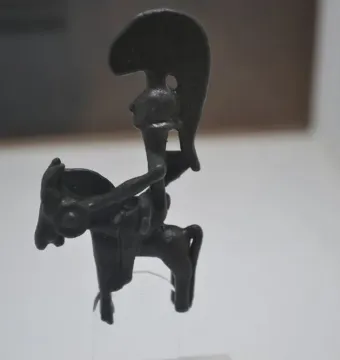
September 2015 © Dorieo · CC BY-SA 4.0
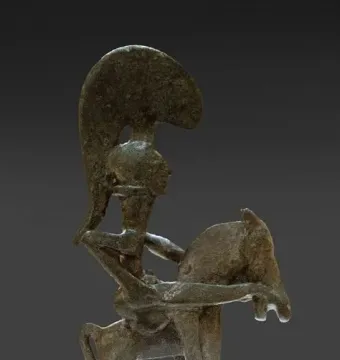
August 2017 © Ángel M. Felicísimo · CC BY 2.0
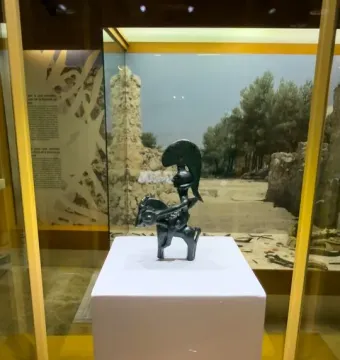
October 2025 © Mike Peel · CC BY-SA 4.0
Identification | |
| Title | Warrior of Moixent |
| Type | small bronze figurine |
| Original Spanish name | El Guerrero de Mogente |
Historical context | |
| Culture | Iberian |
| Associated people | the Contestans |
| Site type | oppidum |
| Site significance | an important city in the region of Iberian Contestania |
| Probable foundation date | towards the end of an unspecified century |
| Destruction date | 330 BC |
| Later history | abandoned completely three generations later after a violent conflict |
Creator | |
| Discovery by | the worker Vicente Espí |
Discovery and provenance | |
| Discovery location | Near Moixent, south of the province of Valencia, Spain |
| Archaeological context | discovered during excavations of the ancient Iberian city of La Bastida de les Alcusses |
| Associated ancient site | La Bastida de les Alcusses |
| Archaeological finds at the site | many pieces of great archaeological value |
| Site location | on a summit in the municipal term of Moixent (Valencia), in the Serra Grossa mountain system |
| Site discovery date | 1909 |
| Discovery site | Department 218 of the Iberian settlement of La Bastida de les Alcusses |
| Discovery date | 1931 |
| Excavation start year | 1928 |
Physical characteristics | |
| Height | 7.3 cm |
| Surface | smooth |
| Patina | dark green |
| Technical quality | excellent from a technical point of view |
Materials | |
| Material | bronze |
Appearance | |
| Most characteristic feature | helmet with a large plume |
| Horse details | pointed ears, eyes, slightly open mouth, long mane, and tail reaching the ground |
| Held object in right hand | falcata (Iberian sword) |
| Held object in left hand | round shield (caetra) |
| Depicted figure | a nude Iberian warrior seated on a horse |
Iconography and meaning | |
| Interpretation | probably an ex-voto, an offering to the gods deposited in sanctuaries or places of worship |
| Alternative interpretations | a funerary sculpture that could serve the deceased in passage to the afterlife, or a thank-offering to the divinities for favors granted |
| Represents | a member of the Iberian equestrian elite |
Location and ownership | |
| Current location | Valencia Prehistory Museum |
| Display status | on display in the room dedicated to Iberian culture |
Significance | |
| Historical/cultural significance | one of the most important finds of Iberian culture in the Valencian Country, together with the Lady of Elche |
| Symbolic status | an identity symbol of the town of Moixent and of the entire Valencian Country |
| Museum use | in 1977, on the occasion of the 50th anniversary of the Prehistoric Research Service, it became the museum’s logo |