
Venus of Dolní Věstonice
Venus of Dolní Věstonice is a terracotta female figurine dated to between 29,000 and 25,000 BC, from the Gravettian period. It was found at the Paleolithic archaeological site of Dolní Věstonice, in the village of the same name south of Brno in the Czech Republic. The figure is 111 millimeters high and 43 mm wide, though part of the lower extremities is missing. Its head is featureless except for two possible eye incisions, while the breasts, navel, and inguinal line are carefully detailed. Studies have also identified a fingerprint in the clay, apparently made by a boy between seven and fifteen years old before firing.
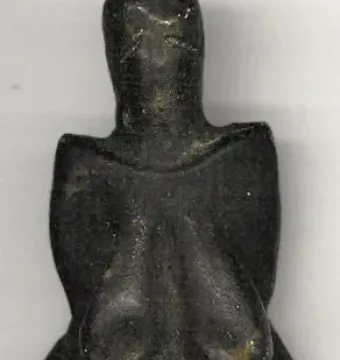
© Jbtv · CC BY-SA 3.0
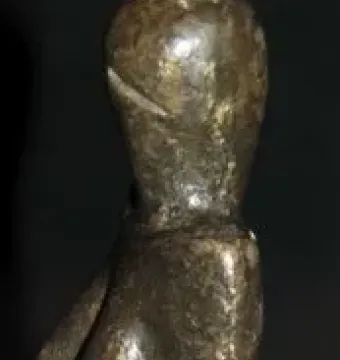
2008 © Don Hitchcock · CC BY-SA 3.0
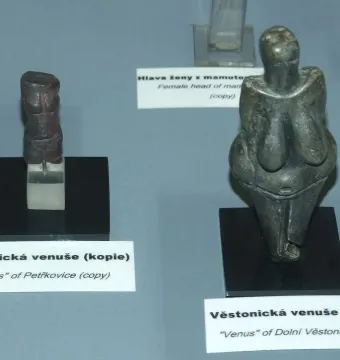
2009 © Kozuch · CC BY-SA 3.0
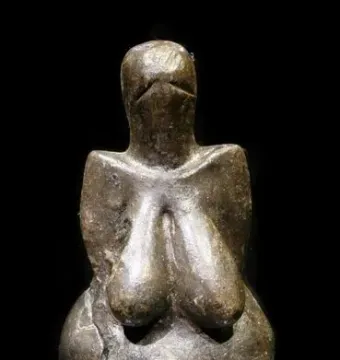
September 2007 © che · CC BY-SA 2.5
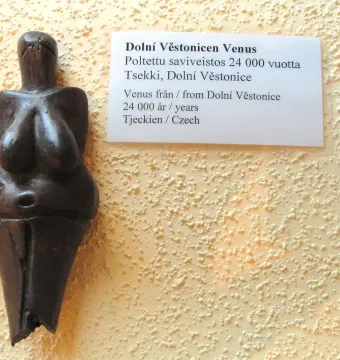
August 2012 © Daderot · CC0
Identification | |
| Title | Venus of Dolní Věstonice |
| Original name | Věstonická Venuše |
| Alternative name | Venus of Wisternitz; Vestonice Venus; Věstonice Venus |
| Type | Paleolithic Venus figurine; nude female figurine |
Historical context | |
| Date | between 29,000 and 25,000 BCE |
| Cultural period | Gravettian culture, or its regional variant Pavlovian |
| Creation context | Paleolithic find |
Creator | |
| Maker | unknown |
Discovery and provenance | |
| Possible production context | the excavations may have revealed the workshop of a Paleolithic artist |
| Associated finds | stone tools, animal bones, animal figures (bear, lion, mammoth, horse, fox, rhinoceros, and owl), other female figures, and more than 2,000 fired or baked clay balls |
| Finders | worker Josef Seidl and technical supervisor Emanuel Dania; Karel Absolon was not present and was in France at the time, though he was traditionally credited as discoverer |
| Excavation history | found during systematic archaeological research at the site, led by Karel Absolon, carried out from 1924 to 1938 |
| Discovery context | found in an ash layer in the remains of a prehistoric hearth about 10 meters in diameter, broken into two pieces about 10 cm apart |
| Discovery site | Dolní Věstonice archaeological site, Dolní Věstonice, south of Brno, Moravia, Czech Republic |
| Discovery date | 13 July 1925 |
Physical characteristics | |
| Height | 111 mm |
| Width | 43 mm at the widest point |
| Condition | lower extremities and feet are partly missing; the figurine was broken into two pieces when found |
| Head | no details except two incisions that may represent the eyes; four small holes at the top may indicate former feather decoration |
| Arms | only schematically indicated |
| Body | large breasts, navel, and inguinal line rendered in great detail |
| Lower end | appears to have had a pointed lower end |
| Style | naturalistic, fully plastic representation |
Materials | |
| Material | fired clay terracotta (ceramic) |