
Ain Sakhri Lovers
Ain Sakhri Lovers is the title given to a 10.2 cm sculpture from a series of figurines discovered by René Neuville in 1933 in one of the Ain Sakhri caves near Bethlehem. The sculpture is dated to around 9000 BC and is considered the oldest known representation of two people engaged in a sexual relationship. The source text presents it as an important prehistoric work because of both its age and its subject matter.
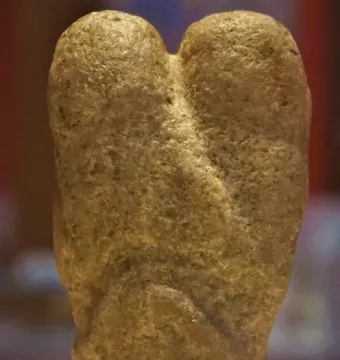
March 2018 © Joyofmuseums · CC BY-SA 4.0
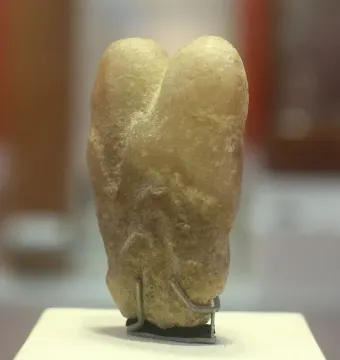
December 2016 © Geni · CC BY-SA 4.0
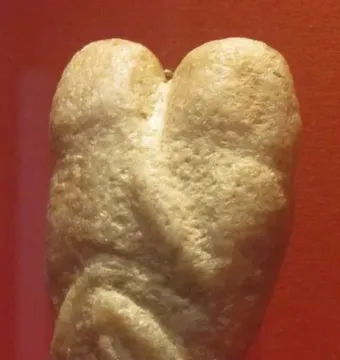
March 2012 © BabelStone · CC BY-SA 3.0
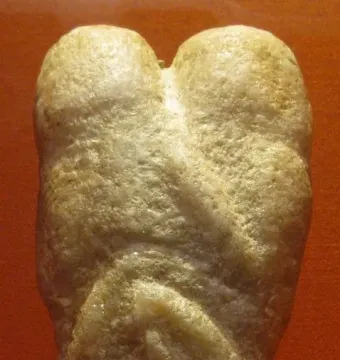
© Geni · CC BY-SA 4.0
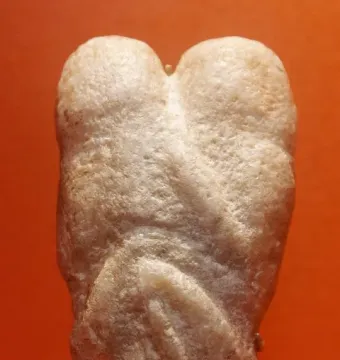
February 2012 © Marie-Lan Nguyen · Public domain
Identification | |
| Title | Ain Sakhri lovers |
| Alternative names | Figurine of the lovers of Ain Sakhri; Die Liebenden von Ain Sakhri; Les Amants de Ain Sakhri; Ain Sakhri figurine; Ain Sakhri Lovers |
| Type | Sculpture, figurine, Natufian sculpture, stone sculpture, statuette |
Historical context | |
| Date | Approximately 11,000 years ago (c. 9,000 BC) |
| Cultural attribution | Natufian culture |
| Historical significance | Possibly the oldest known representation of two people engaged in sexual intercourse |
Creator | |
| Maker | A Natufian person |
Discovery and provenance | |
| Discovered by | René Neuville |
| Discovery date | 1933 |
| Discovery context | Neuville found it while examining chance finds in a small museum of French clergy in Bethlehem |
| Findspot | One of the Ain Sakhri caves near Bethlehem, in Wadi Jareitun/Wadi Hariton/Wadi Khareitoun |
| Name origin | Named after the Ain Sakhri caves where it was found |
| Provenance | Bedouin finds from Wadi Jareitun/Wadi Hariton/Wadi Khareitoun, then linked to the Ain Sakhri caves |
| Initial identification | Neuville immediately recognized its importance, with Abbé/Henri Breuil present |
| Post-discovery ownership | After Neuville's death in 1952, it was sold at Sotheby's in 1958 by M. Y. Neuville and purchased by the British Museum |
Location and ownership | |
| Current location | British Museum, London |
Physical characteristics | |
| Height | 10.2 cm |
| Subject | Two human figures, apparently a couple facing each other |
| Sex of figures | Uncertain; only presumed |
| Visible details | No facial details are shown |
| Form | Clearly phallic in character |
Materials | |
| Material | Calcite pebble (stone) |
Technique | |
| Technique | Carved from a single calcite pebble/cobble using a stone-point tool |
Appearance | |
| Perspective-dependent appearance | Its appearance changes depending on the viewer's angle |
| Possible interpretations | Depending on the angle, it may resemble a couple, male or female genitalia, breasts, or two testicles |
| Artistic assessment | Considered an ingenious / cleverly made sculpture |
Iconography and meaning | |
| Depiction | A sexual embrace / human coitus |
| Interpretation | Thought to have had a domestic rather than funerary function |
| Marc Quinn's comment | He compared its angle-dependent appearance to a modern pornographic film with close-ups and long shots |
Other | |
| Associated archaeology | Excavations in the caves showed Natufian domestic occupation and earlier use as a hearth / dwelling site |
| Natufian context note | The Natufians hunted gazelles, gathered seeds, and are described as among the first people to domesticate dogs, sheep, and goats |