
Madonna del Perdono
Madonna del Perdono is a marble relief attributed to Donatello and dated to 1457–1459. It comes from the destroyed Porta del Perdono of Siena Cathedral, demolished around 1660 to make room for Bernini’s Chapel of the Madonna del Voto. The work, now conserved in the Museo dell'Opera Metropolitana del Duomo, shows the Madonna and Child surrounded by four cherubim within a tondo. Executed in stiacciato relief with blue-glass inlays, it uses subtle optical effects that enhance its depth when seen from the appropriate viewpoint. The Madonna’s face is sweet and melancholic, while the Child rests a hand on her neck with natural tenderness.
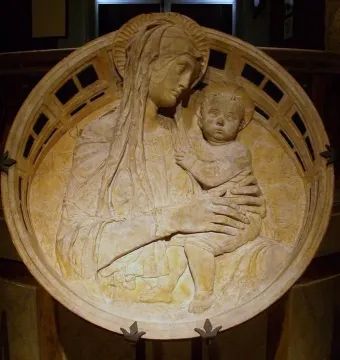
February 2011 © Joanbanjo · CC BY-SA 3.0
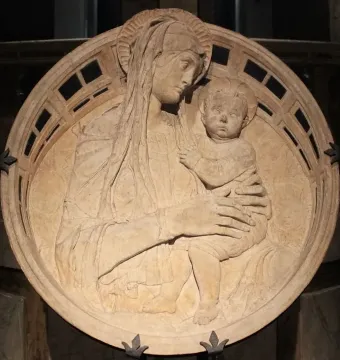
July 2015 © Miguel Hermoso Cuesta · CC BY-SA 4.0
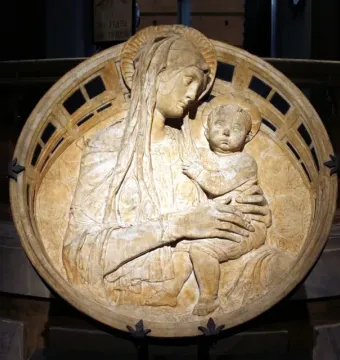
September 2016 © José Luiz · CC BY-SA 4.0
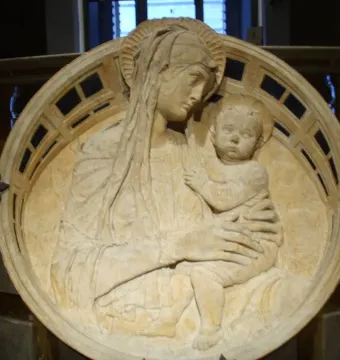
© Sailko · CC BY 2.5
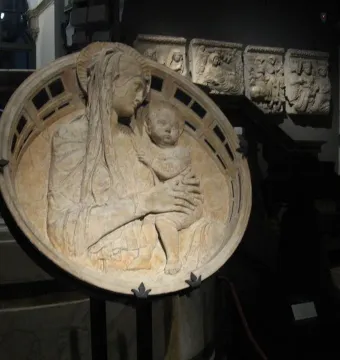
May 2007 © 41099823@N00 · CC BY-SA 2.0
Identification | |
| Title | Madonna del Perdono |
| Type | Tondo relief sculpture |
| French name | La Vierge du Pardon |
Creator | |
| Date of production | 1457–1459, probably 1457 |
| Cherubs' authorship | Probably made by a collaborator |
| Attribution | Attributed to Donatello |
| Probable place of production | Siena, Italy |
Historical context | |
| Commission context | Made for the unfinished bronze doors project for Siena Cathedral |
Discovery and provenance | |
| Origin | From the destroyed Porta del Perdono of Siena Cathedral |
| Original location destruction date | Around 1660 |
| Original location destruction reason | Demolished to make room for Bernini's Chapel of the Madonna del Voto |
| Related chapel | Chapel of the Madonna del Voto |
| Related architect | Gian Lorenzo Bernini |
Location and ownership | |
| Current location | Museo dell'Opera Metropolitana del Duomo, Siena |
Physical characteristics | |
| Form | Round tondo |
| Composition | Madonna and Child with four cherubs |
Materials | |
| Material | Marble with blue glass inlays |
Technique | |
| Relief technique | Stiacciato |
Appearance | |
| Relief depth | Very low relief, with the background cherubs barely perceptible |
| Visual effect | Optical corrections tied to the viewpoint create a convincing illusion of three-dimensional depth |
| Upper border detail | The upper edge of the tondo has glass inlays that create the impression of a caved-in or broken-through surface |
| Museum display | Displayed at an angle in the museum to enhance the illusionistic effect |
Iconography and meaning | |
| Madonna's expression | Sweet and melancholic |
| Madonna's meaning | Her expression seems to foreshadow her son's painful fate, as in the Madonna Pazzi |
| Child's gesture | Jesus, partly hidden, rests his hand naturally and tenderly on his mother's neck |
| Cherubs' character | More schematic than the main figures |