
Parthenon Frieze
The Parthenon Frieze, also known as the Panathenaic Frieze, is a sculpted marble frieze that originally ran around the inner chamber of the Parthenon on the Acropolis of Athens. In the Ionic order, despite the building being Doric, it is made of Pentelic marble and stretches about 160 metres, with 378 human figures. It was probably carved under the direction of Phidias between 442 and 438 BCE. The most accepted interpretation is that it shows the procession of the peplos during the Panathenaia. Although a major work of Greek sculpture, its meaning remains debated. Large sections survive today in the British Museum, the Acropolis Museum in Athens, and other museums.
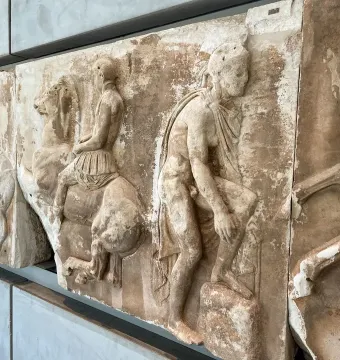
October 2023 © Nikos Kitsakis · CC BY 4.0
© Louis Moeller · CC0
Identification | |
| Title | Parthenon Frieze |
| Type | Ionic frieze relief sculpture |
| Alternative name | Frieze of the Panathenaia |
Historical context | |
| Date of creation | Probably between 443 and 438 BC |
| Historical context | Created as part of the Parthenon’s decorative program in Athens during the building campaign of 447–438 BC, funded by the Delian League treasury |
Creator | |
| Attribution | Probably made by several artists under the direction of Phidias; attribution to Phidias is circumstantial and not certain |
| Attribution basis | Based on Plutarch’s Life of Pericles, Phidias’s known work on the Athena Parthenos, and his central role in Pericles’ building program |
| Role of Phidias in Plutarch | Described as episkopos rather than architekton |
Physical characteristics | |
| Maximum projection depth | 5.6 cm |
| Survival rate | About 80% of the original frieze survives |
| Surviving length | About 128 metres |
| Average block length | 1.22 metres |
| Number of blocks | 114 blocks |
| Number of figures | 378 human figures and 245 animals |
| Height | About 1 metre |
| Length | 160 metres when complete |
| Technique | Bas-relief |
| Original location | Around the sekos (cella) of the Parthenon on the Acropolis of Athens, Greece |
| Material | Pentelic marble |
| Architectural style | Ionic, despite being on a Doric temple |
Technique | |
| Possible gilded elements | Apollo and Hera may have worn gilded bronze crowns; some sources also mention gold and silver |
| Possible painted details | Objects held by figures, such as Poseidon’s trident and Apollo’s laurel, may originally have been painted |
| Polychromy | No original color survives; the original background was possibly blue |
| Finishing | Finished with metal detailing and paint |
| Suggested number of sculptors | Nine sculptors, according to Jenifer Neils |
| Workshop size | Unknown; estimates range from three to eighty sculptors |
| Evidence for in situ carving | A 17 mm-high channel below the moulding and above the tenia may have provided access for the sculptor’s chisel |
| Production method | It is uncertain whether the frieze was carved in situ |
Iconography and meaning | |
| Related cult statue | A wooden xoanon kept in the Erechtheion |
| Borrowed motifs | The apobates and a sacrificial bovine |
| Related deity | Athena Polias |
| Objects carried in the procession | A new peplos embroidered for Athena Polias |
| Festival procession route | From the Dipylon to the Acropolis, over a little more than one kilometre |
| Festival depicted | The Panathenaia, especially the Great Panathenaia, celebrated every four years in Hekatombaion |
| Subject | A non-mythological scene linked to the Panathenaic festival and the worship of Athena |
| Ancient textual evidence | No surviving ancient text explains with certainty what the frieze represents |
| Central scene | The handing over or presentation of the peplos is in the center of the east side |
| Female figures | They appear for the first time on the east side |
| Procession sequence | West side: preparations; south and north sides: horsemen, then chariots, then men on foot; east side: the procession ends with the gods receiving it |
| Main interpretation | The procession of the peplos during the Great Panathenaia |
| Alternative interpretations | Some scholars interpret the frieze as the founding myths of Athens, others as the combatants of the Battle of Marathon, and others as expressing the dedication of the city to Athena |
Location and ownership | |
| Casts and moulds locations | Beazley Archive at the Ashmolean Museum in Oxford; Skulpturhalle in Basel; the Architecture Hall of the University of Washington in Seattle; Hammerwood Park near East Grinstead, Sussex; and the Spurlock Museum in Urbana |
| Restitution claim | Since Greek independence in the 1820s, Greece has repeatedly claimed the return of the British Museum part and other Parthenon sculptural elements from the United Kingdom |
| Original transport | The marble was quarried from Mount Pentelicus and transported 19 km to the Acropolis of Athens |
| Other holdings | The remainder of the fragments are held by several other museums, including nine other international museums |
| Acropolis Museum holdings | 40 blocks |
| British Museum holdings | 56 blocks, forming the major part of the Elgin Marbles |
| Current location | The frieze is dispersed among the British Museum in London, the Acropolis Museum in Athens, and several other museums including the Louvre and the Vatican Museums |
Discovery and provenance | |
| Condition over time | It remained relatively little altered for many centuries because it was not very visible or accessible |
| Basis for reconstruction of missing sections | The missing sections are known mainly from drawings made by Jacques Carrey in 1674 |
History and restoration | |
| Damage in 1687 | About one fifth of the frieze was destroyed during the Venetian siege of Athens under Francesco Morosini, mainly on the north and south sides |
| Later transfer to Britain | The British Museum material was taken to London by Lord Elgin in the early 1800s |
| Repatriated fragment | On 24 March 2023, a relief fragment of a young man from Block 5 was returned from the Vatican Museums to the Acropolis Museum |
Significance | |
| Artistic influence | It had a major influence on art soon after completion and again after the Parthenon marbles arrived in London in the early 19th century, especially in Neoclassical art and architecture |
| Influenced media | Ceramics, sculpture, poetry, Western architecture, and art |
| Influenced artists | John Keats |
| Art-historical significance | A masterpiece of classical Greek sculpture |
| Stylistic novelty | An innovative Ionic frieze on a Doric temple, replacing the usual Doric metopes and triglyphs |