
Bernward Doors
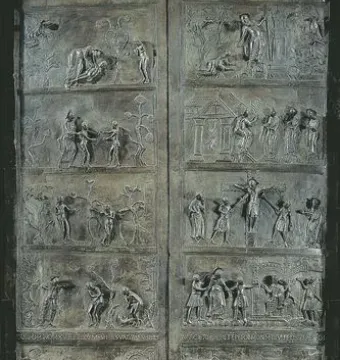
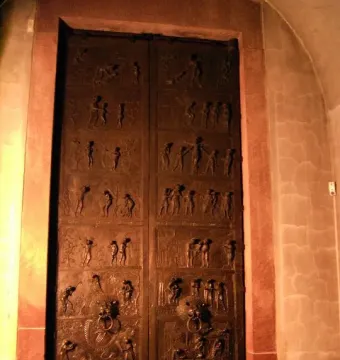
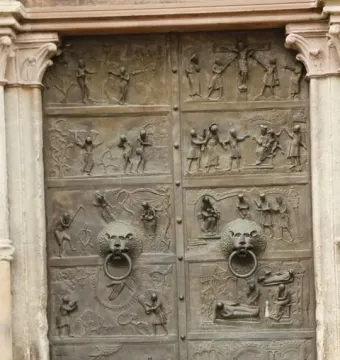
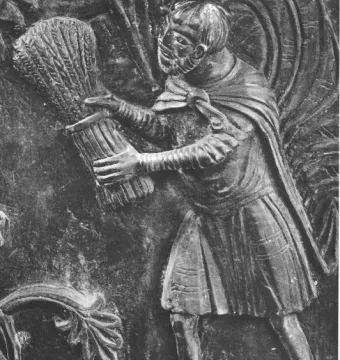
Bernward Doors are the two bronze leaves of a single doorway inside the western massif of Hildesheim Cathedral in Lower Saxony. Precisely dated by a dedicatory inscription to 1015, they are celebrated for their rich facing relief scenes from Genesis and the Passion. They are regarded as one of the oldest image cycles in German art and a masterpiece of Ottonian art, linking Carolingian art with 11th-century Romanesque art. The doors take their name from Bishop Bernward of Hildesheim, who commissioned them for the abbey church of Saint Michael in Hildesheim. His successor, Godehard, had them moved in 1035 to St. Mary’s Cathedral, where they remain today.
May 2010 © Bischöfliche Pressestelle Hildesheim (bph) · Attribution
· Public domain
July 2017 © José Luiz · CC BY-SA 4.0
1015 © Unknown authorUnknown author · Public domain
1015 © Unknown authorUnknown author · Public domain
Identification | |
| Title | Bernward Doors |
| Type | two-leaf bronze doors |
| Alternative names | Bernwardtür; Bernwards Tür; Bernwardstür |
Historical context | |
| Date | around 1015; the date is recorded in a Latin inscription and serves as a terminus ante quem for manufacture |
| Historical context | made in the context of Bishop Bernward of Hildesheim’s artistic program and the Ottonian renovatio imperii |
Creator | |
| Commissioned by | Bishop Bernward of Hildesheim |
| Named after | Bishop Bernward of Hildesheim |
Discovery and provenance | |
| Original destination | the Church of Saint Michael in Hildesheim, according to one hypothesis; another hypothesis says they were intended for Hildesheim Cathedral from the beginning |
| Original location | unknown; proposed original settings include the south aisle of Saint Michael, the cloister, a lost westbau, or Hildesheim Cathedral |
| Relocation | moved to Hildesheim Cathedral in 1035 by Bishop Godehard, according to one tradition/hypothesis |
Location and ownership | |
| Current location | west portal of Hildesheim Cathedral, Hildesheim, Lower Saxony, Germany |
| Current display | reinstalled in the east closing wall of the west paradise; the leaves now stand self-supporting and can be opened only on ceremonial occasions using the historic bronze pivots |
History and restoration | |
| Restoration | during the 2010–2014 cathedral restoration, the doors were repositioned from the western exterior wall back to their former installation area |
| Wartime protection | evacuated about three years before the bombing of Hildesheim on 22 March 1945, stored with other artworks in an underground passage at Kehrwiederwall, and survived the war there |
Physical characteristics | |
| Weight | about 1.85 tonnes each |
| Structure | each door leaf was cast in one piece |
| Thickness | about 3.5–4.5 cm |
| Dimensions | 472.0 × 125.0 cm (left leaf); 472.0 × 114.5 cm (right leaf) |
Materials | |
| Material | bronze; a rotguss alloy (copper with lead, tin, and zinc) according to material analysis |
Technique | |
| Casting technique | lost-wax casting |
| Manufacturing method | the figural scenes were modeled on wax or tallow panels and assembled in an iron frame |
| Surface treatment | flat punchwork relief with rectangular panels framed by narrow moldings |
Appearance | |
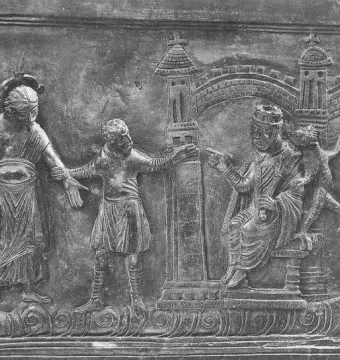
| Iconography | biblical relief scenes from Genesis and the life, birth, and Passion of Jesus Christ, arranged in corresponding scenes on the two leaves |
| Motifs | trees with meandering almost leafless branches, birds including eagles, architectural motifs, angels, and the Hand of God |
| Figure style | carefully modeled figures with strongly linear drapery; upper parts project beyond the surface to create greater depth |
Iconography and meaning | |
| Interpretation | the cycle contrasts the fall of humankind with the victory over sin through Christ’s saving sacrifice for humanity |
| Possible medieval interpretation | possibly a porta salutis, the door to salvation |
Significance | |
| Art-historical status | considered a masterpiece of Ottonian art and one of its main works |
| Art-historical significance | regarded as one of the earliest image cycles in German art; also described as the first image cycle in German sculpture and the oldest known monumental image cycle in German sculpture |
| Art-historical relationship | bridges Carolingian art and 11th-century Romanesque art |
| Comparative context | related to Mainz Cathedral doors, Italian bronze doors such as those of San Zeno in Verona, Monreale Cathedral, and Pisa Cathedral, and Carolingian miniature painting from Tours |
Other | |
| Associated work | Christ Column |
| Related patronage context | part of Bishop Bernward’s effort to raise the cultural standing of his episcopal city within the Ottonian political world |
| Inscriptions | a Latin inscription on the crossbar names 1015 and states that Bernward had the doors made for his memorial in front of the angelic temple |