
Saint Gregory
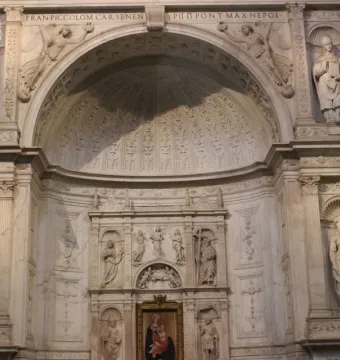
Saint Gregory is a marble sculpture by Michelangelo, about 126 cm high, executed around 1501–1504. It is placed in the Cathedral of Santa Maria Assunta in Siena, within the Piccolomini Altar complex. The statue was made for the Piccolomini series and is considered one of the more modest works in that group, likely because it was intended for a narrow niche. The figure shows a contraposto pose and a slightly reclined head to the left, creating a sense of pathos. The saint and pope wears a tiara and holds a large book, apparently presented to the viewer. The drapery is varied but ordinary in effect, lacking the strong chiaroscuro seen in the related San Paolo.
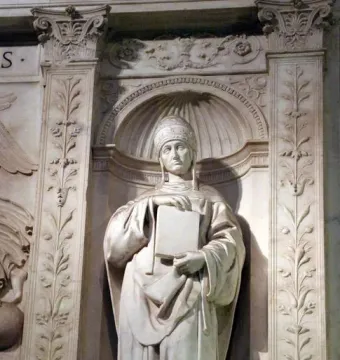
© Sailko · CC BY 3.0
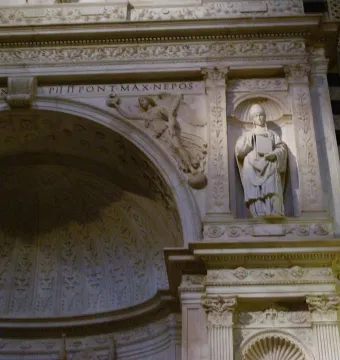
February 2011 © Joanbanjo · CC BY-SA 3.0
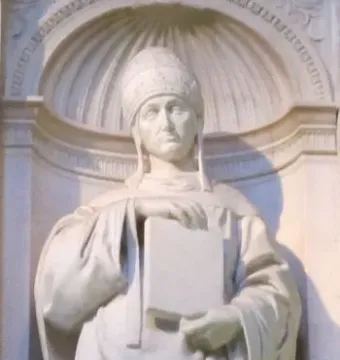
© sailko · CC BY-SA 3.0
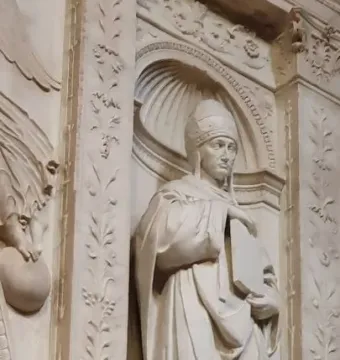
April 2019 © Yair Haklai · CC BY-SA 4.0
July 2015 © Miguel Hermoso Cuesta · CC BY-SA 4.0
Identification | |
| Title | Saint Gregory I |
| Type | marble sculpture |
| Subject | Saint Gregory I (Pope Gregory I) |
| Original title | San Gregorio |
Historical context | |
| Planned completion date | by 1504 |
| Previous assigned artist | Pietro Torrigiani |
| Completed statues | Only four statues were completed: Saint Paul, Saint Peter, Saint Gregory I, and Saint Pius I |
| Reason previous artist left | He abandoned the commission after carving one statue |
| Number originally commissioned | 15 statues |
| Commissioned for | the Piccolomini altar in Siena Cathedral |
| Commission date | 1501 |
| Date created | c. 1501–1504 |
Creator | |
| Artist | Michelangelo Buonarroti |
| Artist nationality / profession | Italian sculptor and painter |
Discovery and provenance | |
| Place of work | Florence |
| Delivery method | Sent from Florence |
| Production pace | About one statue per year |
| Use of assistants | Extensive use of assistants |
| Work period | Until 1504 |
Physical characteristics | |
| Height | 126 cm |
Materials | |
| Material | Marble |
Appearance | |
| Figure quality | Possibly the weakest figure in the Piccolomini statues series |
| Reason for quality assessment | Probably due to heavy use of assistants |
| Pose | Contrapposto |
| Drapery | Varied and unschematic, but rather ordinary |
| Head position | Head slightly tilted to the left |
Iconography and meaning | |
| Depiction | Saint Gregory wears a tiara and holds a large book shown toward the viewer |
| Expressive effect | Conveys a certain pathos |
| Comparative stylistic note | Lacks the expressive chiaroscuro effects seen in the Saint Paul of the same series |
Location and ownership | |
| Current location | Cathedral of Santa Maria Assunta, Siena, Italy |
| Placement | Within the Piccolomini Altar complex, in relatively narrow niches |
| Associated chapel | Piccolomini Chapel in Siena Cathedral |
| Series | Piccolomini statues |
History and restoration | |
| Scholarly interpretation | Symonds suggested Michelangelo may have finished the statue of Saint Francis after Pietro Torrigiano, but the extent of Michelangelo's contribution to the other statues is uncertain |
| Interpretive context | The Piccolomini statues appear more modest than other works completed earlier by Michelangelo, probably also because of their confined niche spaces |
| Scholarly assessment | Symonds did not consider it important to investigate the issue further |
| Commission context | Michelangelo signed a contract to make the statues for the altar |
| Scholarly interpretation | Lawrence Jencken(s) suggested Michelangelo may have regarded these works as products of his youth and haste |
| Early biographical mention | Neither Giorgio Vasari nor Ascanio Condivi mention these works by Michelangelo |
| Sketch requirement | Before starting work, Michelangelo had to provide paper sketches of the statues showing their clothing and gestures so additions or removals could be made as needed |
Significance | |
| Career context | At the time, Michelangelo was becoming famous and moving toward much larger projects, including the David |
Other | |
| Related commission | Andrea Bregno, early 1480s |
| Source condition | Michelangelo's own contribution to the other statues is uncertain |