
Hercules and Cacus
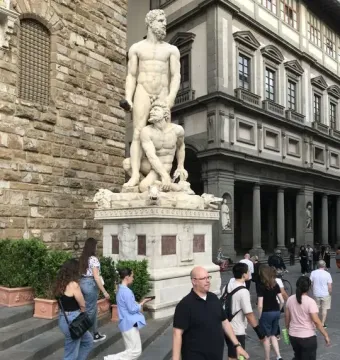
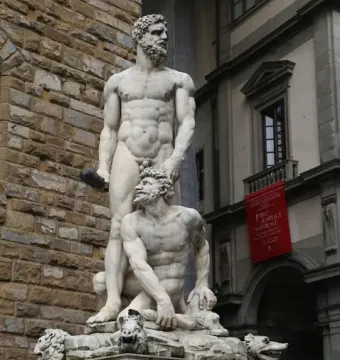
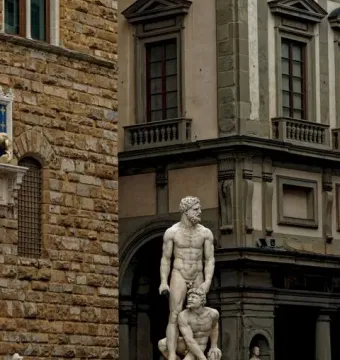
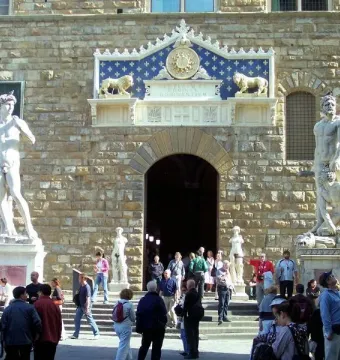
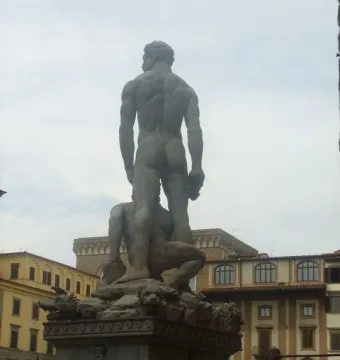
Hercules and Cacus is a sculptural group installed in the southeast corner of Florence’s Piazza della Signoria, beside the Loggia dei Lanzi and Palazzo Vecchio. It was created by the Italian Mannerist sculptor Baccio Bandinelli between 1530 and 1534. Placed symmetrically opposite Michelangelo’s David, it reflects the aesthetics of the late Renaissance and the crisis of Renaissance ideals. The work became famous for the harsh criticism it received: contemporaries mocked its heavy, fragmented form and awkward modeling, and both Giorgio Vasari and Benvenuto Cellini attacked it in writing. In art historical comparisons, it is often discussed as a contrast to Michelangelo’s work and as a marker of the transition from High Renaissance to Mannerism.
May 2024 © Kristof Magnusson · CC BY-SA 4.0
August 2014 © Rufus46 · CC BY-SA 3.0
April 2010 © Txllxt TxllxT · CC BY-SA 4.0
© sonofgroucho · CC BY 2.0
© Sailko · CC BY 2.5
Identification | |
| Title | Hercules and Cacus |
| Type | Marble sculptural group |
| Original title | Ercole e Caco |
Historical context | |
| Date created | 1530–1534 |
Creator | |
| Artist | Baccio Bandinelli |
| Artist nationality | Florentine |
| Art style | Italian Mannerism |
Discovery and provenance | |
| Marble block material | Carrara marble |
| Placement | Installed symmetrically opposite the entrance to Palazzo Vecchio, beside a copy of Michelangelo's David |
| Current location | Piazza della Signoria, Florence, Italy, in front of Palazzo Vecchio, near the Loggia dei Lanzi |
| Unveiling date | 1534 |
| Completion date | 1534 |
| Return to work | Work resumed after Charles V helped the Medici retake Florence in 1530 and Clement VII installed Alessandro de' Medici as duke of Florence |
| Interruption | Interrupted by the Sack of Rome in 1527 and Clement VII's imprisonment; the Medici were exiled from Florence again |
| Design change | The subject was changed to Samson and the Philistines during the interruption, probably to separate the project from the Medici |
| Final assignment of commission | Definitively assigned to Baccio Bandinelli after the Medici returned to power in 1530 |
| Marble block arrival in Florence | 1525 |
| Commissioning context | Commissioned by the republican government of Florence to commemorate the victory over the Medici |
| Later commission holder | Clement VII (Giulio de' Medici) |
| Original intended function | To complement Michelangelo's David as a symbol of the republic |
| Commissioning patron | Piero Soderini, leader of the Republic of Florence |
| Original intended artist | Michelangelo |
| Original commissioner | Michelangelo Buonarroti |
| Original commission date | 1505 |
Physical characteristics | |
| Replacement of original element | The club in Hercules's hand is a later replacement |
| Signature | The work bears the artist's signature in Latin |
| Base | Mounted on a pedestal with low-relief busts of fauns and an authorial Latin signature |
| Base decoration | Low-relief busts of fauns |
| Height | 5.05 metres |
| Construction | Made from at least twenty pieces of marble |
Materials | |
| Material | White Carrara marble |
| Replacement material | Aluminum |
| Original material | Bronze |
Technique | |
| Model | A wax bozzetto by Bandinelli, shown to Pope Clement VII and preserved at the Museo di Casa Buonarroti |
| Working method | Bandinelli had to make new models when the supplied marble block proved too small for the first design |
Appearance | |
| Stylistic description | Mannerist, marked by gigantism, bulky forms, fragmented silhouette, rough modeling, unclear plasticity, and broken outline |
| Physical impression | Heavy muscular mass with awkward movement and theatrical faces |
| Critical visual features | The figures are described as lacking expressiveness and appearing awkwardly proportioned |
Iconography and meaning | |
| Interpretive meaning | An allegorical glorification of Hercules's strength and ingenuity in defeating evil |
| Animal heads at the base | Lion, boar, wolf, and dog heads symbolize defeated vices |
| Political symbolism | A symbol of the Medici's return to power, with Hercules representing strength and the vanquished evoking republican defeat |
| Narrative summary | Cacus stole Hercules's cattle and hid them in a cave; Hercules found the cave by the lowing of the cows, cleared away the stones, and killed Cacus with his club |
| Hercules | Hercules (Greek Heracles), who had driven off the cattle of Geryon |
| Cacus | A fire-breathing monster, son of Vulcan, dwelling in a cave on the Aventine Hill or, in another version, the Palatine |
| Mythological episode | An episode from Virgil and other poets about Hercules defeating Cacus during the Twelve Labors of Heracles, specifically the theft of the cattle of Geryon |
| Subject | Heracles (Hercules) and Cacus |
Significance | |
| Art-historical significance | Seen as reflecting the aesthetics of the crisis and end of the Renaissance and as a Mannerist response to High Renaissance ideals |
| Reception | Mocked from the time of its unveiling, including by Giorgio Vasari and Benvenuto Cellini |
| Relation to Michelangelo | Designed as a pendant to Michelangelo's David and repeatedly judged against Michelangelo's works |
| Commission history significance | The sculpture's history was highly political |
History and restoration | |
| 1994 restoration | During restoration in February–April 1994 it was discovered that the sculpture consists of at least twenty pieces of marble and that the club was not original |
| Medici reward to the artist | The Medici rewarded Bandinelli with land and money |
| Later official role of the sculptor | Bandinelli was later placed in charge of all sculptural and architectural programs for the Medici under Cosimo I |