
Judith and Holofernes
Judith and Holofernes is a bronze sculptural group by Donatello, made toward the end of his career between 1453 and 1457. The work stands 236 cm high without its pedestal and was originally intended for a fountain in the Medici palace. Donatello conceived it as a fully three-dimensional group, free of architectural framing, and the statue was originally gilded, with traces still visible in places such as the sword. It was divided into eleven parts in the casting process. After the Medici were expelled in 1494, the sculpture was placed in the Piazza della Signoria as a symbol of liberty and the victory of the weak over the strong. Since 1988, it has been kept in the Sala dei Gigli of the Palazzo Vecchio in Florence, with a copy now standing outside.
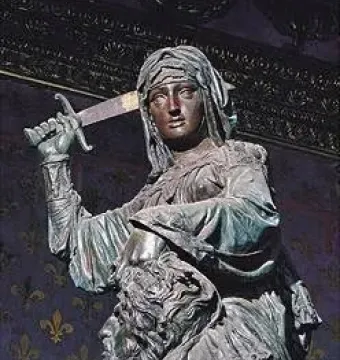
© Comune di Firenze · GFDL
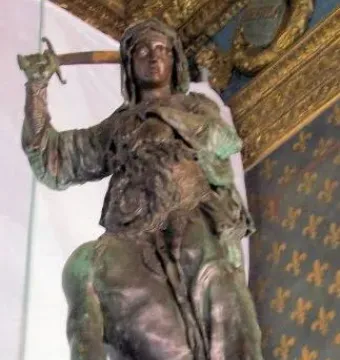
© sonofgroucho · CC BY 2.0
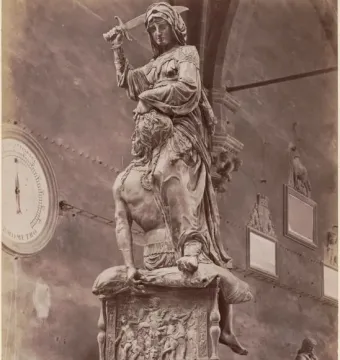
© Anonymous · CC0
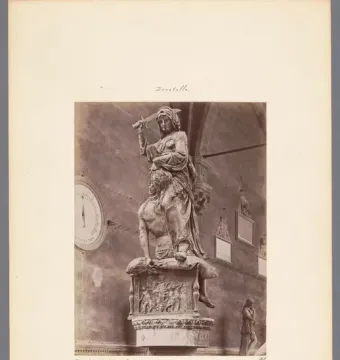
© Rijksmuseum · CC0
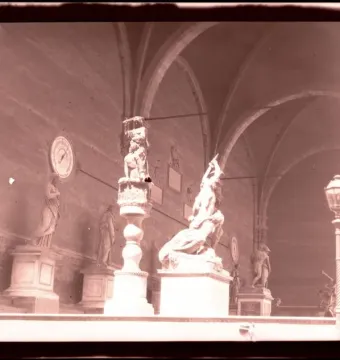
© Edmund F. Arras · Public domain
Identification | |
| Title | Judith and Holofernes |
| Original titles | Judith y Holofernes; Judith und Holofernes; Giuditta e Oloferne; Judyta i Holofernes; Judith et Holopherne |
| Type | Bronze sculptural group |
Historical context | |
| Date of creation | c. 1453–1457 |
| Creation period | Toward the end of Donatello's career; one of his last works |
| Artistic period | Renaissance |
Creator | |
| Artist | Donatello |
| Artist nationality | Italian (Florentine) |
Discovery and provenance | |
| Evidence for fountain use | Four holes at the corners of the cushion/base suggest water outlets |
| Original location | The garden of Palazzo Medici-Riccardi, Florence |
| Original display date | Around 1457 |
| Original intended location | A fountain in the Medici palace garden |
| Commission purpose | In memory of his father; decoration for a fountain in the garden of Palazzo Medici-Riccardi |
| Commissioned by | Cosimo de' Medici or Piero de' Medici |
Physical characteristics | |
| Form | Free-standing statue conceived in the round; designed to be viewed from all sides |
| Composition | Pyramidal arrangement |
| Viewing | Not designed to be seen from a single viewpoint |
| Number of faces | Four |
| Height | 236 cm without the base |
Materials | |
| Material | Bronze |
| Pedestal material | Granite |
Technique | |
| Casting method | Cast in eleven parts |
| Reason for multi-part casting | To facilitate gilding |
Appearance | |
| Judith | Veiled, fully clothed, youthful expression, richly pleated dress, raised sword, right foot on Holofernes' genitals, left foot on his wrist |
| Interpretive details | The two figures are treated in strongly contrasting ways; the dress contrasts with Judith's smooth facial modeling |
| Composition details | Judith's face and sword form the apex; Holofernes' head is the secondary focal point; the work is meant to be walked around |
| Holofernes | Nude, anatomically modeled, long wild hair, rough disfigured face, body collapsing and held up by Judith's hand, head on a cushion |
| Inscription | OPVS. Donatelli. FLOR. |
| Base decoration | Bacchanalian scenes and three relief carvings; four corner holes |
| Base form | Triangular-prism-shaped base resembling a cushion |
| Surface finish | Originally gilded; traces remain, especially on the sword |
Iconography and meaning | |
| Depicted figures | Judith and Holofernes |
| Symbolism | Freedom, virtue, and victory of the weak over the strong in a just cause |
| Political meaning | A metaphor for Medici rule and for Florentine republican liberty and victory over tyranny |
| Associated motif | Power of Women topos |
| Depicted scene | Judith beheading the Assyrian commander Holofernes, from the Book of Judith |
| Interpretation of Judith | A tragic heroine who saves her people by committing an act contrary to the commandment against killing |
Location and ownership | |
| Current location | Sala dei Gigli, Palazzo Vecchio, Florence, Italy |
| Current location since | 1988 |
| Outdoor copy location | Piazza della Signoria, in front of Palazzo Vecchio, Florence |
History and restoration | |
| Public reaction | The replacement on Piazza della Signoria was disapproved by supporters of the previous authorities |
| Later inscription | 'This example of salvation presented to the citizens in 1495' |
| Inscriptions on pedestal | Two now-lost inscriptions on the granite pedestal: 'Kingdoms fall through Lust, cities rise through Virtue; here is the neck of Pride cut by the hand of Humility' and 'Peter, son of Cosimo de' Medici, dedicates this statue of a woman to the liberty and courage that the spirit of invisible resolution of its citizens gives to the Republic' |
| Historical events | Looted after the second expulsion of the Medici in 1494; placed in Piazza della Signoria as a civic symbol |
| Replacement | Replaced outdoors by a copy |
| Restoration | Carefully restored in 1988 |
| Reason for relocations | Moved to make room for Michelangelo's David and later displaced by Giambologna's Rape of the Sabine Women |
| Relocations | Placed in front of the main door of Palazzo Vecchio; later moved under the Loggia della Signoria; moved to the narrow side toward the Uffizi in 1582; placed on the Arengario of Palazzo Vecchio between the World Wars; moved indoors to Palazzo Vecchio in 1988 |
Significance | |
| Historical significance | Among the earliest Renaissance bronze statues designed to be viewed all around ('alla rotonda'); one of Donatello's first fully three-dimensional sculptural groups; first sculptor since antiquity to create an individual design free of architectural structures |
| Stylistic significance | Combines naturalism, dramatic psychological expression, and a strongly composed pyramidal arrangement |
| Related work | Donatello's David |
| Comparison with later works | Michelangelo's David established a new larger scale for statues in the square and made Judith appear smaller and more delicate |