
Adam de Notre-Dame
Adam de Notre-Dame is a Gothic sculpture attributed to Pierre de Montreuil, originally made for the south transept facade of Notre-Dame Cathedral in Paris. Carved in limestone around 1260 and once polychromed, it stands 2 meters tall and was conceived as part of a paired group with Eve beneath Christ the Judge. Today preserved in the Musée de Cluny, the figure is notable for its unusually large-scale nude body, calm expression, and mixture of classical and Gothic features. Although restored over time and now showing only traces of its original color, it is regarded as one of the masterpieces of medieval sculpture and a rare survival of monumental nudity in the Middle Ages.
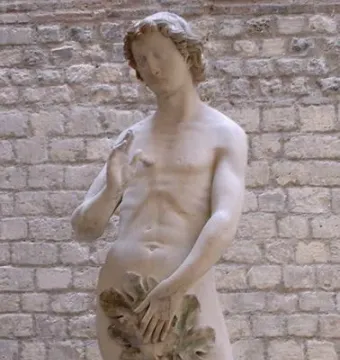
· CC BY-SA 3.0
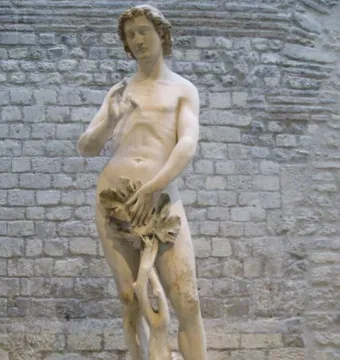
· CC BY-SA 3.0
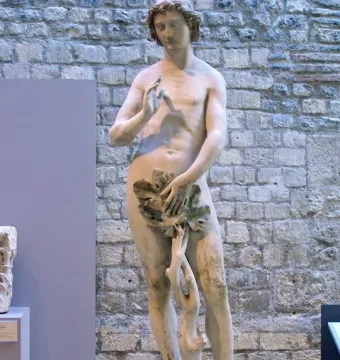
March 2013 © LPLT · CC BY-SA 3.0
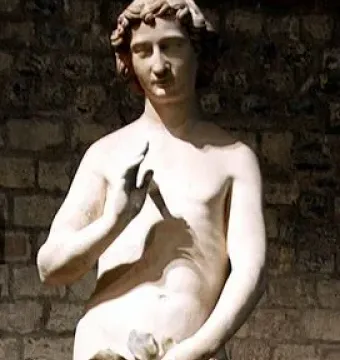
December 2011 © Jean-Pol GRANDMONT · CC BY 4.0
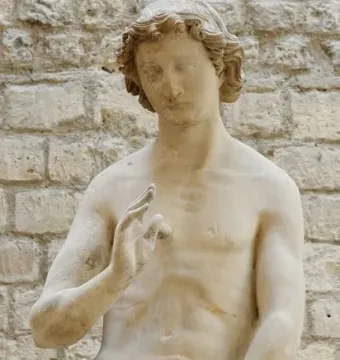
January 2013 © Marie-Lan Nguyen · Public domain
Identification | |
| Title | Adam de Notre-Dame |
| Alternative name | Adam of Paris |
| Type | Gothic statue |
| Subject | Adam |
Historical context | |
| Date of creation | c. 1260s, probably shortly after 1260 |
Creator | |
| Attribution | Attributed to Pierre de Montreuil |
| Pierre de Montreuil role | Architect, mason-sculptor, master builder, and head of a construction and ornamentation workshop |
| Pierre de Montreuil note | Famous in his time; owned a quarry in Conflans; worked as a mason at the Abbey of Saint-Denis; documented as builder of the refectory of Saint-Denis (1239–1244) and the Chapel of the Virgin at Saint-Germain-des-Prés (1245–1255), both later demolished |
| Notre-Dame role | Considered the finisher of the south transept of Notre-Dame Cathedral after the death of Jehan de Chelles in 1258 |
| Other attribution note | The attribution of the Sainte-Chapelle to Pierre de Montreuil has been rejected by recent research |
Discovery and provenance | |
| Identification of origin | An old drawing discovered in 1856 showed the statue beside Eve on the south transept facade, confirming its origin |
| Museum acquisition | Received by the Musée de Cluny in 1887; first recorded in the Musée des Monuments Français collection in 1797 |
| Museum inventory number | Cl. 11657 |
| Current location | Musée de Cluny, Paris, France |
| Original setting | Part of a sculptural ensemble at the feet of Christ Judge, with Eve; angels around them held the instruments of the Passion and played trumpets |
| Original location | South transept facade of Notre-Dame Cathedral, Paris, France |
Physical characteristics | |
| Scale | Over-life-size, about 2 meters high |
| Figure type | Nude, monumental sculpture |
| Condition | Generally in very good condition |
| Body type | Slender and elegant, with some disproportion |
| Pose | Standing in contrapposto, weight on the right leg, torso slightly bent forward, head turned back |
| Hand gesture | The left hand covers the genitals in modesty |
| Facial expression | Tranquil |
| Hair | Gothic-style hair |
| Anatomy | Carefully rendered veins and muscles |
Materials | |
| Original color | Pale pink |
| Polychromy | Originally polychromed; only traces survive |
| Material | Limestone |
Technique | |
| Restoration impact | Successive restorations since musealization slightly altered the position of some joints, especially the right hand |
| Restoration treatment | Minor 19th-century restorative additions and partial reassembly of missing or damaged parts, including one arm, the hands, and the feet |
| Right hand position | Formerly held close to the chest and the apple of temptation; now turned outward as if blessing |
Appearance | |
| Fig leaf detail | A fig leaf is used to cover the genitals, and a small fig tree grows between the feet |
| Style | French High Gothic sculpture with a fusion of classical and medieval references |
| Stylistic context | Made during the reintroduction of classical tradition, when Romanesque austerity was giving way to new naturalism |
| Classical references | Pose close to Greek contrapposto; hand gesture recalls the Venus pudica type derived from Praxiteles' Aphrodite of Cnidus; tranquil face reminiscent of Imperial Roman busts of Apollo |
Iconography and meaning | |
| Meaning | Adam, the first man in the biblical narrative |
| Nudity significance | An important example of renewed medieval interest in the nude body, seen as beautiful and as a mirror of divinity |
| Pairing | Originally paired with a now-lost Eve |
| Meaning of title 'doctor' | An honorific title implying an elite intellectual level reserved for university graduates |
Location and ownership | |
| Transfer location | Hôtel de Cluny |
| Transfer context | Transferred there during the 19th-century restorations of Notre-Dame Cathedral |
History and restoration | |
| Dating correction | The 1856 discovery corrected the earlier belief that it was a 13th-century creation by confirming the exact origin and context |
| Modern documentation | First modern notices were the 1797 records of its entry into the Musée des Monuments Français collection, with Notre-Dame provenance but no details |
| Historical reception | Long ignored by art criticism, then in the last forty years its reputation became established as a masterpiece and one of the most remarkable works of medieval sculpture |
| Influence on contemporary sculpture | It does not seem to have influenced other Parisian sculptors of its time |
| Later influence | Its style continued in sculptures on other monuments in France, especially Reims Cathedral |
Significance | |
| Assessment | Of extraordinary quality and modernity; one of the finest achievements of French Gothic sculpture |
| Rarity | Rare example of medieval nude sculpture at this scale |
| Survival status | The only surviving life-size nude sculpture from 13th-century French art |
| Artistic interpretation | A manifesto of ideal beauty and an extreme exploration of human movement and bodily expression |
Other | |
| Related work | Closely related to the Golden Virgin of Amiens Cathedral and a Christ in Limbo in the Louvre |
| Related sculptural group | Related to a group of sculptures attributed to the same author, originally from the Notre-Dame rood screen, removed at the end of the 17th century by Robert de Cotte |