
Baptismal Font at St Bartholomew's Church, Liège
The Baptismal Font at St Bartholomew's Church in Liège is regarded by some historians as a masterpiece of Mosan art, both for its aesthetic design and its technical execution. Known in French as the fonts baptismaux of Notre-Dame, it comes from the Collegiate Church of Saint-Barthélemy in Liège. Admirers of Mosan art have even described it as one of the seven wonders of Belgium. The sculpture belongs to the artistic tradition of the Meuse Valley, a major center of Romanesque metalwork in the area corresponding broadly to modern Belgium and France and associated with the Diocese of Liège.
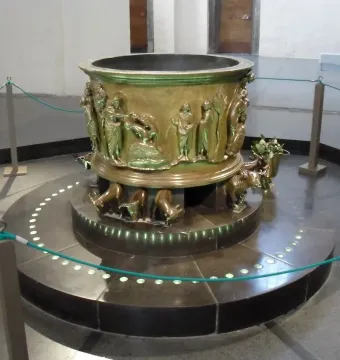
May 2011 © Harvey Stillnot · CC BY-SA 3.0
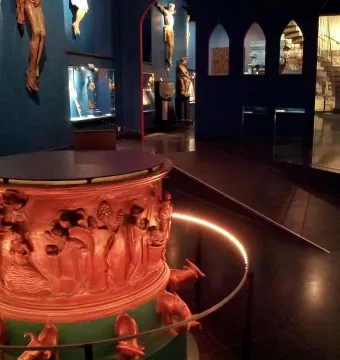
October 2014 © Kleon3 · CC BY-SA 4.0
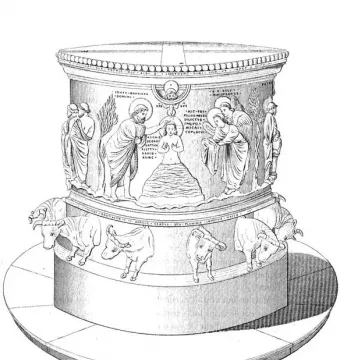
1846 © Afernand74 · Public domain
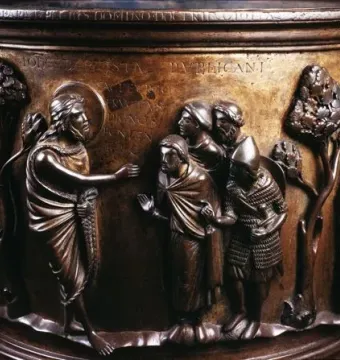
January 2017 © PMRMaeyaert · CC BY-SA 4.0
August 2006 © Marie-Claire · CC BY 3.0
Identification | |
| Title | Baptismal font at St Bartholomew's Church, Liège |
| Common name | The Liège font |
| Type | Baptismal font |
| Original French name | Fonts baptismaux de Notre-Dame |
Historical context | |
| Reputation | Considered by some historians to be a masterpiece of Mosan art and presented by admirers as one of the seven wonders of Belgium. |
| Stylistic debate | The font's stylistic origin has been the subject of major debate among art historians; proposed explanations include Byzantine, older Mosan, Carolingian, and pre-Gothic influences. |
| Stylistic character | Notable for its classical style, with idealized rounded forms, several nude figures, and sophisticated classical poses. |
| Historical context | The Meuse valley in modern Belgium and France, roughly corresponding to the Diocese of Liège, was the main 12th-century center of Romanesque metalwork, and metalwork was then the most prestigious artistic medium. |
| Style | Romanesque |
| Artistic tradition | Mosan art |
Creator | |
| Artist | Traditionally attributed to Renier de Huy, a metalworker and sculptor; the attribution is disputed. |
| Artist information | Renier of Huy is documented in 1125 as a goldsmith; a 12th-century chronicle names him as the artist of the font, and he may have died around 1150. |
| Commissioner | Abbot Hellin (also given as Helin or Helinus), parish priest of Notre-Dame-aux-Fonts; some traditions instead credit Bishop Albéron II of Liège. |
| Commissioning date | After 1107 and before 1118. |
Discovery and provenance | |
| Traditional source for commissioning | The Chronicon Rythmicum Leodiense, in Abbot Hellin's obituary, is cited as the basis for the dating and the claim that Hellin 'had them made'. |
| Original church fate | Notre-Dame-aux-Fonts and the cathedral were destroyed during the French Revolution. |
| Relocation history | After the French Revolution, the font was hidden in private houses from 1796 to 1803 and moved to St Bartholomew's Church in 1804. |
| Metal source hypotheses | Lead analysis in 1993 and isotopic analysis suggest the metal came from Spain or Sardinia rather than local, Vesdre Valley, or Harz sources. |
| Contemporary source | The contemporary Chronicon Rythmicum Leodiense describes the font but does not name the artist. |
| Original location | Notre-Dame-aux-Fonts church in Liège, which served as the baptistery for the city and abutted the old cathedral of Saint Lambert. |
| Possible earlier provenance | Possibly originally from the Cathedral of Our Lady and Saint Lambert, Liège; other theories propose the Archbasilica of Saint John Lateran in Rome or a commission in Rome around 1000. |
| Alternative provenance hypothesis | Some historians proposed that the font was booty taken by Emperor Henry IV and later given to Bishop Otbert; another theory links its later transfer from Rome to the Meuse region by Henry IV or Henry V. |
Location and ownership | |
| Current location | St Bartholomew's Church, Liège, Belgium. |
| Current use | Still used for baptisms today, usually for a small fee. |
Physical characteristics | |
| Original base | The oxen emerged from a stone pedestal. |
| Support | Originally supported by twelve oxen; two are missing. |
| Composition | Approximately 77% copper and 17% zinc. |
| Material | The basin is made of brass, identified in some descriptions as bronze; the lost cover was presumably the same metal, and the present base and frame are stone. |
| Date | Between 1107 and 1118; an alternative theory places it around 1000. |
Technique | |
| Casting technique | Lost-wax casting. |
| Manufacturing note | The basin mold was made in one piece, and specialists argue that Liège did not have a founder capable of casting such a large and complex work at the time. |
History and restoration | |
| Missing original parts | Two oxen and the cover were lost during the French Revolution. |
| Later supports | The present stone pedestal and frame replaced the earlier solid round stone base, first built in 1804, in the 19th century. |
Appearance | |
| Main scene | The baptism of Christ. |
| Other scenes | The baptism of Cornelius and the baptism of Craton. |
Iconography and meaning | |
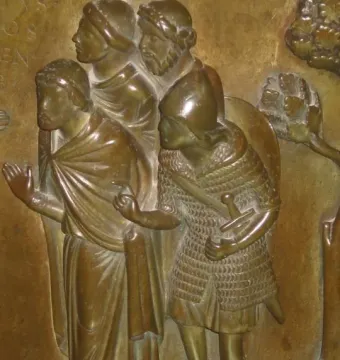
| Crowd depiction | The crowd facing John is a summary of his listeners, including publicans dressed as wealthy merchants and a man-at-arms in chain mail with a sword, helmet, and shield. |
| Lost cover decoration | The lost cover reportedly bore figures of the Four Evangelists and Old Testament prophets, presumably in metal. |
| Biblical sources | The imagery draws on the baptism of Jesus in the Synoptic Gospels, the baptism of Cornelius, and the bronze sea of Solomon's Temple in the Book of Kings. |
| Hand of God | In the Craton scene, the Hand of God appears from above to signal approval. |
| Craton scene details | Craton is shown as a Greek philosopher preaching contempt for wealth and baptized by John the Evangelist, who is identified by the book in his hand. |
| Cornelius scene details | Cornelius is shown as a Roman centurion from Caesarea Maritima, based on Acts 10. |
| John the Baptist depiction | John the Baptist is shown in the clothing of desert hermits and with great humility toward Christ. |
| Composition | An empty space between John the Baptist and the crowd symbolizes the gap between old and new conceptions; John extends an arm into this space. |
| Angels | Angels extend a cloth toward Christ and hide their hands beneath it, serving as acolytes in the scene. |
| Holy Trinity interpretation | The baptism scene is understood as a manifestation of the mystery of the Holy Trinity. |
| God the Father depiction | Shown above Christ as a haloed elderly head leaning toward Jesus, surrounded by a cloud with rays. |
| Christ depiction | Christ is shown immersed in the Jordan River, frontally depicted, making the sign of the Trinity with his right hand. |
| Support symbolism | The twelve oxen refer to the bronze sea of Solomon's Temple and may symbolize the twelve shepherds or the twelve apostles; they may also allude to Christ's mission to the Twelve Apostles. |
Significance | |
| Historical significance | Considered the principal masterpiece of Mosan art. |
| Comparative stylistic assessment | Its bodily proportions, postures, gestures, and clothing have been described as recalling classical models far beyond Byzantine, Carolingian, or early Christian art. |
| Reception history | By the time of Pierre Lambert de Saumery, the medieval art was already considered archaic, and limited later interest may have helped save the font during the Revolution. |
| Art-historical debate | The font's origin has been the subject of vigorous debate, with some scholars questioning even its Mosan origin. |
| Related works by the attributed master | A small bronze crucifix in the Schnütgen Museum, Cologne, is generally accepted as by the same master; another crucifix in Brussels may also be attributed to him, and a similar incense burner has been attributed to Renier or a follower. |
Other | |
| Alternative church names | Notre-Dame-aux-Fonts is also given as Notre-Dame-aux-Fuentes and as Church of Our Lady with the Font. |
| Original church function | It was the only church in Liège able to administer baptism and remained the mother parish of Liège until the end of the Principality of Liège. |
| Commissioning uncertainty | There are conflicting traditions about the patron: one credits Abbot Hellin, while another credits Bishop Albéron II of Liège. |
| Related comparison | Stone baptismal fonts in Furnaux, Mettet, were inspired by the same theology of Rupert of Deutz, but are not a replica of the Liège font. |