
Batlló Majesty
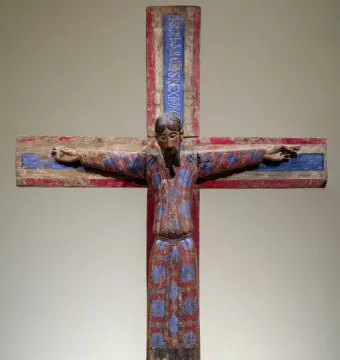
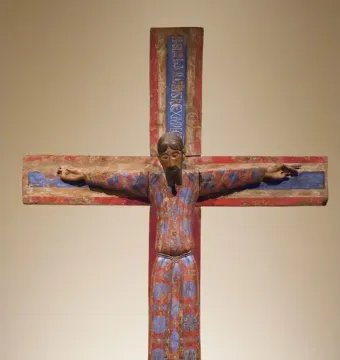
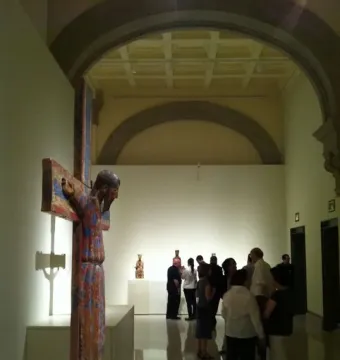
Batlló Majesty is a polychrome wooden crucifix from medieval Catalonia, depicting Christ in the Majestas or triumphant pose, without signs of suffering. It is considered one of the most interesting examples of this iconography in Catalonia and is thought to have originated in the Catalan Pyrenees, in the Garrotxa region. The work is now on display at the National Art Museum of Catalonia in Barcelona. It takes its name from collector Enric Batlló i Batlló, who bought it from an antiquarian and donated it to the Barcelona Provincial Council in 1914. When it arrived at the museum, it was covered with varnish that obscured the polychromy.
August 2019 © Ángel M. Felicísimo · CC BY 2.0
July 2011 © Turol Jones, un artista de cojones · CC BY 2.0
May 2008 © Roger Ferrer Ibáñez · CC BY-SA 2.0
May 2012 © Johnbod · CC BY-SA 3.0
June 2011 © Kippelboy · CC BY-SA 3.0
Identification | |
| Title | Batlló Majesty |
| Original name | Majestat Batlló |
| Alternative names | Majesty of Batlló; Majestade de Batlló |
| Type | Polychrome wooden crucifix |
| Date | 12th century; revised dating: late 12th century or early 13th century |
| Style | Romanesque |
| Depicted figure | Christ |
| Iconographic type | Christ in Majesty / triumphant Christ (Christus triumphans) on the cross |
| Creator | Unknown |
Historical context | |
| Historical context | Romanesque art in Catalonia; wood was commonly used for liturgical furniture and images inside churches at the time |
| Iconographic origin | Believed to have been introduced in Catalonia by the Pisans in 1114, when they came to help Count Ramon Berenguer III in the conquest of the Balearic Islands |
| Associated historical figure | Ramon Berenguer III, Count of Barcelona |
| Related historical event | Conquest of the Balearic Islands |
Creator | |
| Legendary attribution | A medieval legend attributes the sculpture to Nicodemus soon after the Crucifixion |
Discovery and provenance | |
| Provenance | Probably from the Catalan Pyrenees, especially the Garrotxa / Olot area near Girona |
| Probable origin | A church in Garrotxa (Girona) |
| Collector | Enric Batlló i Batlló |
| Acquisition history | Purchased by Enric Batlló i Batlló from an antiquities dealer / antique market and donated in 1914 to the Diputació de Barcelona (Province of Barcelona) |
| Name origin | Named after the collector Enric Batlló i Batlló |
| Museum inventory number | 015937-000 |
Location and ownership | |
| Current location | Museu Nacional d'Art de Catalunya, Barcelona, Catalonia, Spain |
| Possible function | Object of veneration in the Catholic Church; likely used as a rood cross and possibly carried in processions |
| Original or typical placement | Normally hung near church portals or altars dedicated to the Savior; used as liturgical furniture inside temples |
Physical characteristics | |
| Back decoration | Remains of a painted Agnus Dei at the center of the back of the cross |
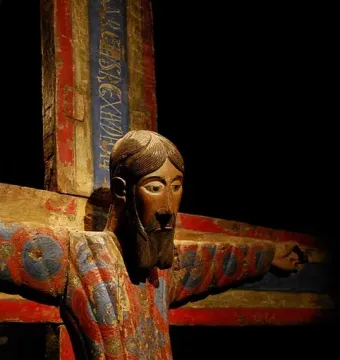
| Cross inscription | An inscription is present in the upper part of the cross; one reading gives JHS NAZARENUS REX IUDEORUM, but the fragmentary text is not preserved |
| Cross decoration | Blue, white, and red painted fringes/stripes |
| Decorative motifs | Red circles on a blue background with vegetal motifs |
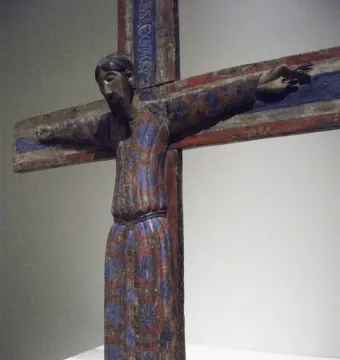
| Drapery | Parallel tubular folds running throughout the garment; some examples note alternating tones |
| Clothing | Long wide tunic with long sleeves (tunica manicata), cinched at the waist with a belt |
| Condition | Feet and some fingers are missing |
| Facial expression | No sign of pain |
| Posture | Rigid and solemn |
| Eyes | Open |
| Dimensions | Christ figure: 94 × 96 × 17 cm; cross: 156 × 120 × 4 cm |
Materials | |
| Primary material | Wood; cypress wood is specifically mentioned |
| Painted surface | Polychrome |
Technique | |
| Technique | Carved, then painted; crucifixes of this type were made from two blocks of wood, one for the body and one for the arms |
Appearance | |
| Iconography | Christ on the cross wearing a long tunic, triumphant, with open eyes and no visible suffering |
| Style details | Schematic carving with attention to detail in the hair and beard |
| Decorative influence | Eastern influence, with comparisons to Byzantine, Hispano-Moorish, and Islamic textiles |
| Comparative iconography | Related to the Volto Santo / Holy Face of Lucca |
| Comparative works | Crucifix of Brunswick Cathedral (1173); crucifix in the Museum of Sacred Art of San Gimignano; Catalan examples from Las Planas, Sant Salvador de Bellver, Beget, Angostrina, and Éller |
| Shared feature with other Catalan works | Only the Bellver and Beget examples have tubular folds |
Iconography and meaning | |
| Interpretation | Symbolizes Christ's triumph over death |
| Associated beliefs | Catalan majestic crucifixes were believed to have miraculous powers |
History and restoration | |
| Museum arrival condition | When it arrived at the museum, it was covered with a thick varnish layer that obscured the polychromy but helped preserve the colors |
| Restoration status | The bright colors have since been restored |
| Pigments | Red pigment: cinnabar; blue pigment: lapis lazuli |
| Patronage note | The Batlló family also commissioned Casa Batlló in 1877 |
Significance | |
| Art-historical significance | One of the most interesting and most elaborate examples of medieval majestic crucifixes in Catalonia; one of the finest and best-preserved examples of this type |
| Chronological significance | The revised dating creates problems for the chronology of other crucifixions |
Other | |
| Broader context | Over thirty examples of this type are known from Girona, Barcelona, Lleida, and Roussillon |
| Related textile comparison | The tunic circles are compared with the shroud of Saint Raymond / San Ramón, a 12th-century Islamic textile from the Cathedral of Roda de Isábena, who died in 1126 |
| Possible workshop origin | Believed to have come from a workshop of some importance, perhaps around the monastery of Ripoll |
| Comparative note | The main model for this type was the Volto Santo in Lucca; the Santa Faz of Lucca is described as a copy of an earlier prototype, possibly including the Batlló Majesty or a work from the Cathedral of Milan |