
Madara Rider
Madara Rider is an early medieval monumental rock relief on the Madara Plateau near the village of Madara in northeastern Bulgaria, not far from the former Bulgarian capital of Pliska. Cut into a sandstone cliff about 100 meters high, it formed part of the main cult site of the First Bulgarian Empire. The relief shows a rider 23 meters above the ground, accompanied by a dog and depicted with a lion at his feet, which he has just killed. It is generally attributed to the Proto-Bulgarians and dated to the early 8th century, though some theories suggest a Thracian origin. The monument has been a UNESCO World Heritage site since 1979.
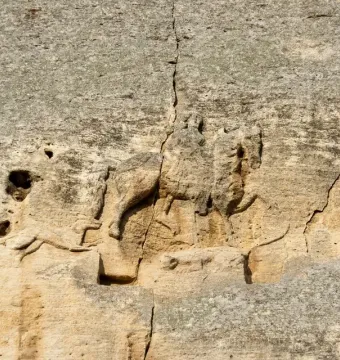
August 2009 © Feradz · CC BY 3.0
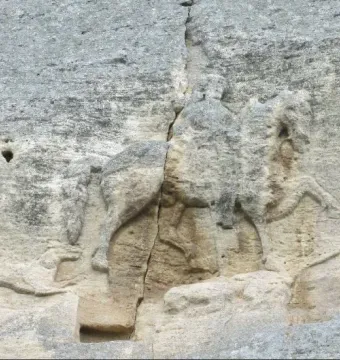
June 2017 © Vstar811 · CC BY-SA 4.0
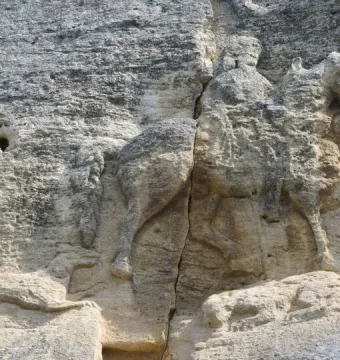
September 2016 © Octopus · CC BY-SA 3.0
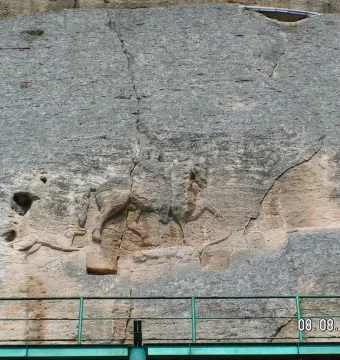
© Dom2002 · CC BY 2.5
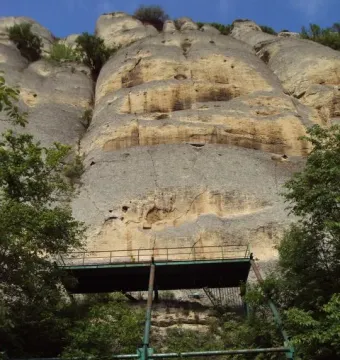
May 2016 © Vislupus · CC BY-SA 4.0
Identification | |
| Title | Madara Rider |
| Alternative names | Reiter von Madara; Madara Horseman; Madarski konnik; Jeździec tracki z Madary; Le cavalier de Madara; Мадарський вершник; Мадарски конник; Мадарский всадник |
| Original-language name | Madarski konnik |
| Type | Early medieval monumental rock relief |
Historical context | |
| Date | Very late 7th century or more often the very early 8th century; commonly around 710 CE |
| Historical period | Early medieval |
| Associated ruler | Khan Tervel |
| Origin attribution | Generally attributed to the Proto-Bulgarians, though a Thracian origin has also been proposed |
| Alternative interpretation | If Thracian in origin, it would represent a god or a Thracian horseman motif |
Creator | |
| Attributed creators | Proto-Bulgarians |
| Alternative attribution | Ancient Thracians |
Physical characteristics | |
| Form | Relief sculpture / bas-relief |
| Subject | A horseman or rider on horseback, almost life-size, facing right, thrusting a spear into a lion beneath the horse's front legs; an eagle appears in front of the rider and a dog runs behind him |
| Scale | Almost life-size |
| Height above ground | 23 m |
| Cliff | A nearly vertical sandstone cliff about 100 m high |
Materials | |
| Carved into | Rock cliff |
| Material | Sandstone |
Appearance | |
| Style | Very realistic, with essentially no unnecessary details |
Iconography and meaning | |
| Symbolism | A symbolic representation of military triumph |
| Interpretation | Possibly a portrait of Khan Tervel |
| Alternative identifications | A Thracian horseman motif; a Thracian god; the Bulgar deity Tangra; the Iranian deity Mithra |
Location and ownership | |
| National symbol | Declared a national symbol on 29 June 2008 after a national survey |
| UNESCO World Heritage status | Inscribed on the UNESCO World Heritage List in 1979 |
| Uniqueness | The only monument of its kind in Europe |
| Site context | Part of the main cult sanctuary of the First Bulgarian Empire |
| Location | Madara Plateau near the village of Madara, east of Shumen, in northeastern Bulgaria, not far from the former Bulgarian capital Pliska |
History and restoration | |
| Condition | Poor condition; subject to progressive erosion, with the halo and garments barely recognizable |
| Conservation | Conservation and protective work is currently being carried out in Madara |
| Inscriptions | Three groups of fragmentarily preserved Middle Greek relief inscriptions, found on both sides of and around the rider image |
| Inscription content | They record the deeds and campaigns of Bulgarian rulers Tervel, Krum, and Omurtag, and mention events involving Byzantine emperors, Thessaloniki, Kisinas, gold, broken treaties, and sacrifice to Tangra |
| Associated inscription detail | Inscription I c was identified by Vesselin Beschevliev and refers to Tervel and his uncle Khan Kuwer |
| Nearby archaeological finds | Between 1924 and 1935, about 250 m north of the relief, remains of a complex believed to have included a pagan shrine and a rectangular building were found; a damaged inscription by Khan Omurtag mentioning Tangra was also found there |
| Later discoveries | In the later 20th century, another building group about 3.2 km northeast of the relief was found, including a 5th–6th century basilica with an inner rectangular structure |