
Seated Hermes
Seated Hermes is a bronze sculpture found at the Villa of the Papyri in Herculaneum in 1758 and now held in the National Archaeological Museum of Naples. It was celebrated in the eighteenth century after engravings of it appeared in Le Antichità di Ercolano. To protect it from Napoleonic depredations, it was packed with other antiquities during the Bourbon flight to Palermo in 1798 and returned to the royal villa at Portici in 1816. Martin Robertson classified it as a Roman copy, made before AD 79, of a Greek bronze original from the late fourth or early third century BC, in the tradition of Lysippos. The figure rests one hand casually on a restored rock, which helps integrate the composition.
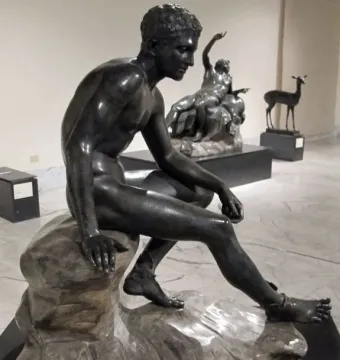
November 2013 © Sailko · CC BY-SA 3.0
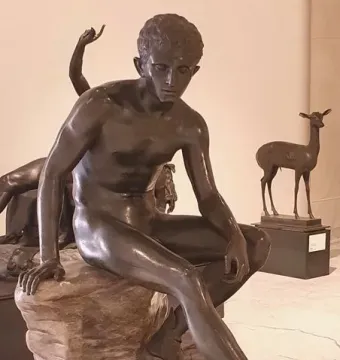
September 2023 © Yair Haklai · CC BY-SA 4.0
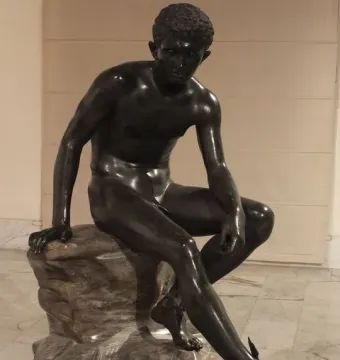
June 2014 © Amphipolis · CC BY-SA 2.0
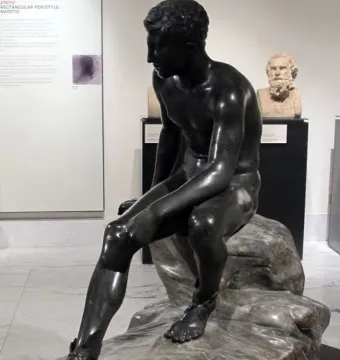
November 2013 © Sailko · CC BY-SA 3.0
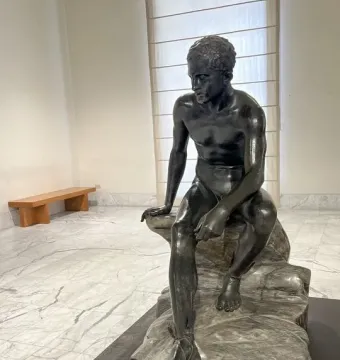
February 2025 © Van Der Meulen Christofle · CC0
Identification | |
| Title | Seated Hermes |
| Object type | Ancient bronze sculpture |
| Subject | Hermes |
| Alternative identification | Mercury |
| Alternative titles | Hermes Sitting on a Rock; Resting Hermes; L'Hermes in riposo; L'Hermès assis; Hermès assis; Hermes Merida-Vienna |
Historical context | |
| Ancient location | Gardens of the villa of Titus Atticus in Herculaneum |
| Ancient literary mention | Mentioned in Cicero's correspondence with Titus Pomponius Atticus |
| Date | Roman period, before AD 79 |
| Original Greek prototype date | Late 4th or early 3rd century BC |
Creator | |
| Original artist attribution | Attributed to Lysippos or his school |
| Evidence for attribution | The attribution is stylistic and is not supported by ancient literary sources |
| Scholarly classifications | Margarete Bieber placed it in the school of Lysippos; Martin Robertson described it as a Roman copy of a Greek bronze original in the Lysippan tradition |
| Alternative scholarly hypothesis | B. R. Vipper thought it showed Lysippos's style or workshop influence; another hypothesis makes it a free eclectic 4th-century BC creation or a Roman copy of a 2nd-century BC Hellenistic prototype derived from a Lysippan model |
Discovery and provenance | |
| Early reproduction | Reproduced in four large engravings in Le Antichità di Ercolano (1771); the engravings show it still in its original location |
| Later movements | Taken to Palermo during the 1799 Bourbon flight, back to the royal villa at Portici by 1816, removed to Germany by Hermann Göring in the late 1930s, and later returned to Naples by an Italian secret agent |
| Planned French removal | During the French occupation, General Jean Étienne Championnet identified it for transfer to the Musée Napoléon (the Louvre), as documented in a letter of 7 Ventôse Year VII (25 February 1799) |
| Napoleonic-era protection | Packed into one of fifty-two crates of antiquities and works of art that accompanied the Bourbon flight to Palermo in 1798 to protect it from Napoleonic looting |
| Discovery context | Found during excavations of the Vesuvian area |
| 18th-century reputation | Probably the most celebrated or famous work of art discovered at Herculaneum and Pompeii in the 18th century |
| Early reception | One of the first ancient bronze sculptures to enter the collection of modern art lovers; described by Francis Haskell and Nicholas Penny as one of the most important works found in 18th-century excavations at Pompeii and Herculaneum |
| Discovery place | Villa of the Papyri, Herculaneum, next to the western hemicycle of the natatio of the rectangular peristyle |
| Discovery date | 3 August 1758 |
Location and ownership | |
| Current location | National Archaeological Museum of Naples |
| Other surviving copies and casts | Bronze copy at the Kunsthistorisches Museum, Vienna; marble copy at Villa Getty, Malibu, California; tinted plaster cast at the Pushkin State Museum of Fine Arts, Moscow; many other copies exist in cities worldwide; related examples are at Villa San Michele, Anacapri, and in a park in São Paulo |
Physical characteristics | |
| Body position | Torso turned to the right and slightly inclined forward; the overall body leans left because of the right-hand support |
| Attribute | Probably a caduceus, with the handle preserved and the rest fragmentary |
| Eyes | The eyes were made of different materials: probably bone or ivory for the eyeballs, and gray and black stone for the irises and pupils |
| Wings | Wings attached to the feet with rosettes |
| Head and hair | Head turned toward the right shoulder; hair divided into short locks |
| Limb position | Right leg extended with the heel on the base; left leg bent with the foot touching the rock only by the toes; left arm bent and resting lightly on the thigh; right arm nearly extended with the hand on the rocky seat |
| Form | Statue in the round |
| Figure expression | Tired but alert, with a curved back, downward gaze, and head turned toward the right shoulder |
| Support element | Rock seat, restored with a modern marble reconstruction |
| Condition | Fragmentary in parts, especially the left-hand attribute; the original eyes are lost |
| Pose | Hermes is seated on a rock, leaning and appearing ready to spring up |
| Width | 75 cm |
| Height | 1.15 m |
Materials | |
| Main material | Bronze |
| Eyes materials | Probably bone or ivory for the eyeballs, and gray and black stone for the irises and pupils |
Technique | |
| Construction | Sculpture in the round |
Appearance | |
| Iconography | The god Hermes is shown seated and resting on a rock, with winged feet and probably a caduceus |
| Symbolic meaning | The pose suggests rest or otium, while the wings imply Hermes' speed and his ability to float rather than walk on the ground |
| Stylistic notes | Often described as swift, agile, energetic, with a slight hint of cunning in the head turn and facial expression |
| Comparative setting | Scholars have suggested that bronze statues posed on real rocks were often set up in late Hellenistic and Roman gardens, and that the natural boulder increased the idyllic quality of the composition |
Significance | |
| Notability | Probably the most celebrated work of art discovered at Herculaneum and Pompeii in the eighteenth century |
| Copies and influence | The type was reproduced in several copies and later became the subject of many copies |
Other | |
| Associated typological name | Hermes Merida-Vienna |
| Related copies in captions | National Archaeological Museum, Naples; Villa San Michele, Anacapri, Capri; park in São Paulo, Brazil; bronze image dated 1907 |