
Apollo of Cyrene
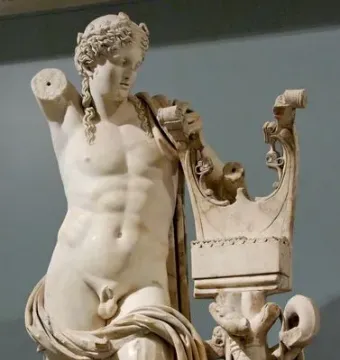
Apollo of Cyrene is a marble statue of the Greek god Apollo and a Roman copy from the 2nd century BC of a Hellenistic original by an unknown artist. It belongs to the Apollon Citharoedus type, showing the god associated with music and the Muses, and is modeled in contrapposto to emphasize movement. The 2.28-metre-high figure was found in January 1861 near the Temple of Apollo in Cyrene, Libya, broken into 121 fragments beside its original pedestal. Acquired by the British Museum, it was reassembled and later conserved, though the missing right arm and left hand were not restored. A complete copy is held in the National Archaeological Museum of Naples.
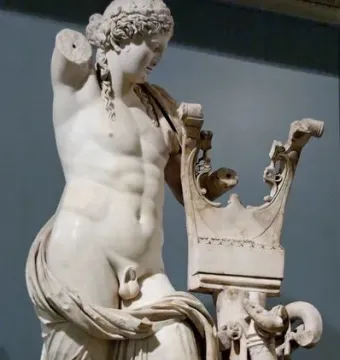
2006 © Marie-Lan Nguyen · Public domain
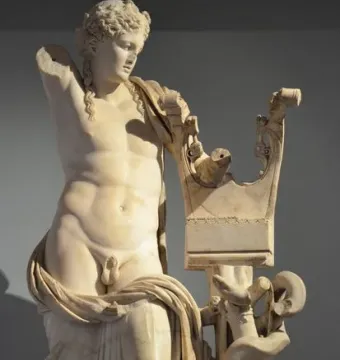
May 2014 © Carole Raddato · CC BY-SA 2.0
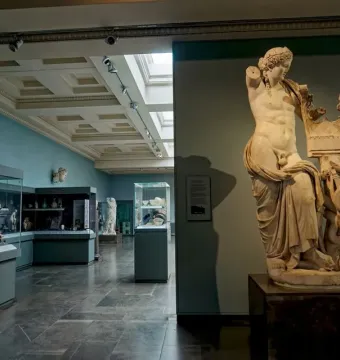
September 2010 © Txllxt TxllxT · CC BY-SA 4.0
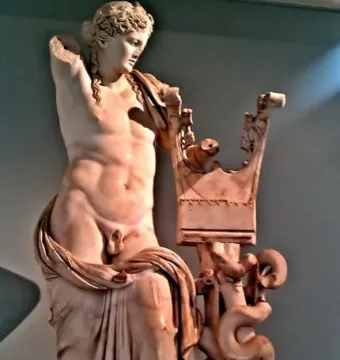
March 2012 © Andres Rueda · CC BY 2.0
· Public domain
Identification | |
| Title | Apollo of Cyrene |
| Depicted figure | the Greek god Apollo |
| Type | Roman marble statue |
Iconography and meaning | |
| Attribute | a lyre or cithara |
| Right arm meaning | Conventional indication of divine inspiration |
| Attribute meaning | An allusion to Apollo's role as god of music and patron of the Muses |
| Religious function | Probably the main idol of the Temple of Apollo in Cyrene, serving as a central focus for worship and ritual activities |
| Iconographic type | Apollo Citharoedus |
Historical context | |
| Stylistic tradition | Hellenistic |
| Copy date | 2nd century AD |
| Prototype composition | A combination of elements from Praxiteles' Apollo Lyceus and a variant by Timarchides |
| Original prototype | An ancient Greek Classical-period original, probably dated to between 200 and 150 BC |
Creator | |
| Original creator | Unknown |
Physical characteristics | |
| Height | 2.28 m |
| Material | Marble |
Discovery and provenance | |
| Discovery date | January 1861 |
| Discovery place | Temple of Apollo in Cyrene, Libya |
| Discoverers | Lieutenant Sir Robert Murdoch Smith and Commander Edwin Porcher |
| Condition at discovery | Found broken into 121 fragments beside the pedestal where it had originally been installed |
| Initial recipient | The British Museum |
History and restoration | |
| Missing parts | The right arm and left hand |
| Restoration | Reassembled, later conserved and filled; the right arm and left hand were not found and were not reconstructed |
| Probable destruction | Apparently destroyed when the Temple of Apollo was burned during the Jewish Revolt of 115–116 AD |
Location and ownership | |
| Current location | The British Museum |
| Parallel copy | A complete copy is in the National Archaeological Museum of Naples |
Technique | |
| Technique | Carved almost entirely from a single block of marble, except for the right arm and left wrist |
Appearance | |
| Head and hair | Thick hair tied at the nape and falling in moving curls |
| Torso | Nude in front |
| Lower body | The legs are covered by a mantle that also covers the back and falls over the left shoulder |
| Pose | Contrapposto |
| Right arm pose | Resting on the god's head |
| Associated objects | A cithara supported on a tree trunk to the left; a serpent coils around the trunk; a quiver hangs from it |
| Original appearance | Originally painted |
| Figure style | A curious mixture of masculine and feminine characteristics |
Reception | |
| Ancient reception | Copied several times in antiquity |
| Modern reception | Initially received little critical attention after rediscovery because Hellenistic art was then considered a degeneration of prestigious classicism |
| Critical recognition | In 1907, The Classical Review of Cambridge University recognized it as one of the best known copies of important Greek originals |
Significance | |
| Modern assessment | According to Peter Higgs, it is now one of the most notable works in the British Museum's antiquities section |