
Kritios Boy
Kritios Boy is an ancient Greek sculpture from the transition between the Archaic and Classical periods, considered fundamental to the development of naturalistic representation of the human body. It is housed in the Acropolis Museum in Athens. Carved in Parian marble and standing 0.86 m high, the nude youth was probably made between c. 485 and c. 480 BC. The torso was found on the Acropolis in 1864, while the head was discovered separately in 1888 and later reattached, though its association remains debated. The figure is missing both forearms, the right leg, and the left foot. It is especially important as the earliest known representation of contrapposto, signaling a decisive move away from Archaic symmetry and frontal rigidity.
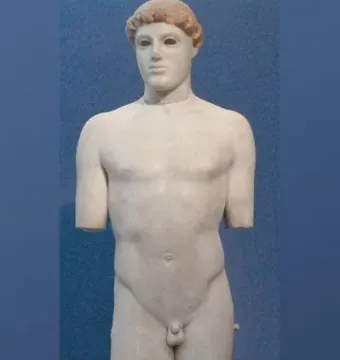
July 2022 © Ismoon · CC BY-SA 4.0
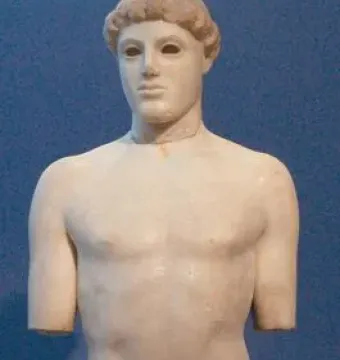
April 2022 © Ismoon · CC BY-SA 4.0
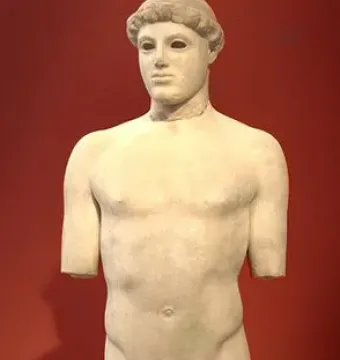
2005 © User:Tetraktys · CC BY-SA 3.0
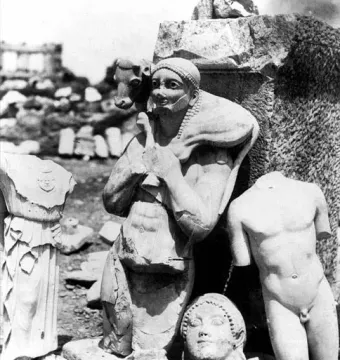
· Public domain
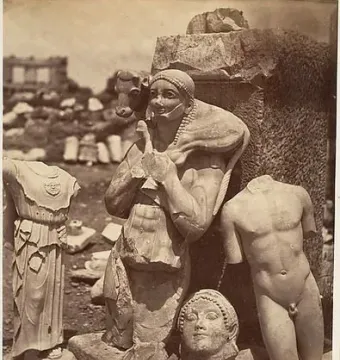
© невідомий фотограф 1865 р. · Public domain
Identification | |
| Title | Kritios Boy |
| Type | Ancient Greek marble statue |
| Subject | A nude ephebe (youth), possibly a hero, more probably Theseus, or a victorious athlete |
| Alternative name | Efebo de Crítio; Efeb Kritiosa; Efebo di Crizio; Kritian Boy; Marble Ephebe of Kritios; ephebos |
Historical context | |
| Date | Circa 485–480 BC |
| Date uncertainty | Dating is controversial; it cannot be dated with certainty either before or after the Persian sack of the Acropolis in 480–479 BC |
| Art historical period | Transition from the Late Archaic period to the Early Classical period; associated with the Severe Style |
Creator | |
| Attribution | Conjecturally attributed to Kritios, with links also made to Kritios and Nesiotes or their school |
| Associated artists | Kritios and Nesiotes |
Discovery and provenance | |
| Head discovery context | Found during excavation campaigns by Panagiotis Kavvadias and Georg Kawerau; its context was recorded as not looking like Persian debris |
| Original association of head and torso | The head now attached was initially identified as Acropolis head 699 and reconstructed with the torso by Adolf Furtwängler, but is now generally believed not to belong to the original sculpture |
| Original burial context | The statue’s parts were probably buried in the third quarter of the 5th century BC among debris from the Persian destruction of the Acropolis, possibly during reconstruction works under Pericles or Cimon; the torso and head were found in different places and at different times, and neither can be securely connected with a Persian destruction deposit |
| Torso discovery context | Found during excavations for the foundations of the planned Acropolis Museum |
| Head discovery date | 1888 |
| Findspot of head | Found separately in 1888 between the museum and the southern wall of the Acropolis of Athens |
| Torso discovery date | 1865–1866 |
| Findspot of torso | Acropolis of Athens, southeast of the Parthenon, in the Perserschutt and reused statue blocks from Building IV |
Physical characteristics | |
| Expression | Impassive, austere, and idealized; the archaic smile is absent |
| Anatomical treatment | The anatomy is rendered sparingly, with soft modeling and only essential features; the rib cage is naturally expanded and the body is shown with lifelike accuracy |
| Supporting fragment | A protruding marble fragment near the left hip may have belonged to a stabilizing projection connecting the body and the arms |
| Arm position | Probably hanging alongside the body |
| Pose | Contrapposto with the right leg slightly advanced and bent, the left leg bearing the weight, and the body showing a gentle curvature and uneven hips |
| Hair | Short hair with a relief fringe |
| Eyes | The eye sockets are empty; they probably originally had glass or other inlays |
| Damage | The nose, chin, and neck are damaged |
| Condition of joining surfaces | The matching surfaces have chipping, especially on the front and right side of the neck; large chips are present on the front and back of the neck |
| Head condition | The current head has a different finish and does not fit perfectly |
| Preserved parts missing | Both forearms, the right leg below the knee, and the left foot are missing; supports replace the missing feet |
| Size | Significantly smaller than life-size |
| Height | 86 cm; 117 cm including the supports |
Materials | |
| Primary material | Parian marble |
| Possible original material or model | Possibly derived from a bronze prototype; earlier bronze statues may have used contrapposto |
Technique | |
| Inlays | The eyes were probably originally inlaid with glass or another material |
History and restoration | |
| Damage interpretation | The neck chips are incompatible with a systematic ancient repair and may indicate intentional decapitation |
| Restoration history | The statue was first restored in the 1950s or early 1960s, when the iron pin was replaced by a bronze pin and plaster padding or a stucco joint was added; this lengthened the neck by about 1 cm and placed the head arbitrarily relative to the body. A second restoration in 1987 showed that the earlier assembly was arbitrary |
| Head and torso relationship | The muscles continue uninterrupted across the break, confirming that the head and torso originally belonged together |
Location and ownership | |
| Current location | Acropolis Museum, Athens |
| Inventory number | 698; Acropolis Museum Inv. 699 for the previously attached head |
Significance | |
| Art historical significance | Earliest known representation of contrapposto; first statue of classical antiquity known to use contrapposto |
| Stylistic importance | A fundamental work for understanding the transition from Archaic to Classical Greek sculpture and the development of naturalistic representation of the human body |
| Iconographic significance | Breaks the symmetry, stylization, and frontalness of Archaic kouros statues and anticipates the Classical period |
| Scholarly interpretation | Jeffrey Hurwit argued that the asymmetry signals a new artistic and social meaning: the figure appears alive, shares space with the viewer, and reflects a shift in aristocratic self-representation under democracy while remaining an aristocratic image adjusted to the new political context; he also saw it as an ideal youth embodying introspection and prefiguring sophrosyne |
| Kenneth Clark description | "the first beautiful nude in art" |
| Later influence | The transitional pose and balance anticipated later classical sculpture, including the canonical results associated with Polykleitos and the work of Praxiteles and Lysippos |
Other | |
| Comparative notes | Created in the same era as the Blond Kouros's Head of the Acropolis and the group of the Tyrannicides; a comparison has been made with the marble statue of an ephebos in the museum in Agrigento |
| Name explanation | The sculpture is called Kritios Boy because it is attributed to Kritios |