
Lady of Elche
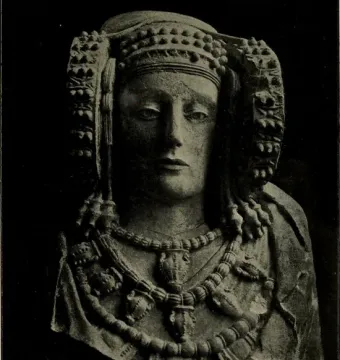
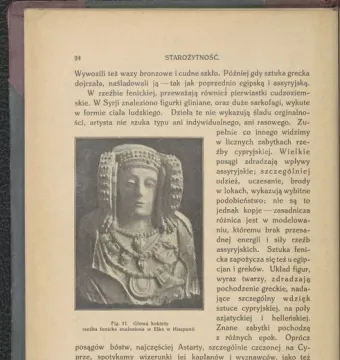
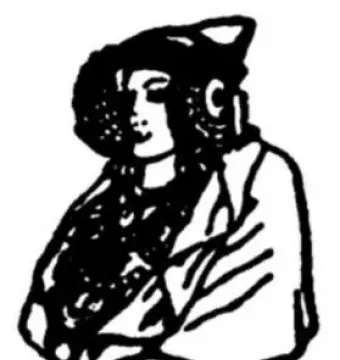
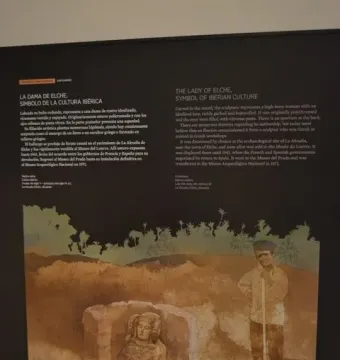
Lady of Elche is an Iberian limestone sculpture, a 56 cm-high bust with idealized facial features and rich adornment. It shows a woman wearing a headdress made of a tiara, veil, diadem, and side rosettes, along with necklaces, pendants, earrings, and a fibula fastening the tunic. The back includes a hollow cavity, suggesting it may have served as a funerary urn, a conclusion supported by later analyses of human cremated remains found inside. Discovered accidentally in 1897 at La Alcudia in Elche, Alicante, it was later acquired by the Louvre, returned to Spain in 1941, and has been part of the National Archaeological Museum of Spain in Madrid since 1971.
1900 © Geffroy, Gustave, 1855-1926 · No restrictions
© Charles Bayet · Public domain
1922 © Q136474262 · Public domain
May 2017 © Emilio J. Rodríguez Posada · CC BY-SA 2.0
April 2013 © James Tissot · Public domain
Identification | |
| Title | Lady of Elche |
| Type | Iberian limestone bust |
| Original name | La Dama de Elche |
| Alternative names | Dama de Elx; Dama de Elche |
Historical context | |
| Period | Iberian period, 5th–4th centuries BC (disputed; also proposed as 4th century BC or 5th/early 4th century BC) |
| Culture | Iberian culture |
Creator | |
| Artist | Unknown; possibly an Iberian workshop in Elche |
Discovery and provenance | |
| Removed to | France |
| Inventory numbers | Prado: E433; National Archaeological Museum of Spain: 1971/10/1 |
| Museum locations | Displayed at the Louvre in 1897; deposited in the Museo del Prado in 1941; transferred to the National Archaeological Museum of Spain in Madrid in 1971 |
| Return route | From Elche to Alicante, then by ship to Marseille |
| Return to Spain | 1941, by exchange of artworks between Spain and France |
| Acquired by | Louvre Museum |
| Early local name | Reina mora ('Moorish queen') |
| Initial ownership after discovery | Bought shortly after discovery by Pierre Paris for the Louvre, with money advanced by Noël Bardac |
| Found by | Officially Antonio Maciá; another account says Manuel Campello Esclápez first uncovered the face and Antonio Maciá finished extracting it |
| Discovery circumstances | Found by chance during agricultural work, hidden in a stone-slab niche and supported against the slabs |
| Discovery place | La Alcudia archaeological site, Elche, Alicante, Spain |
| Discovery date | 4 August 1897 |
| Concealment reason | Probably placed there in connection with some danger |
Physical characteristics | |
| Circumference | 115 cm |
| Back cavity | Deliberately made almost spherical opening in the back, 18 cm wide and 16 cm deep |
| Height | 56 cm |
| Form | Bust |
Materials | |
| Primary material | Limestone |
| Surface treatment | Originally polychromed; eyes filled with vitreous paste |
| Preserved traces | Red traces on the lips and clothing elements |
Technique | |
| Technique | Sculpted with Greek sculptural techniques |
Appearance | |
| Clothing | Tunic closed with a fibula, with mantle or wrap over the shoulders and back; raised, slightly forward-curved shoulders |
| Comparative style | Greek-influenced with possible Carthaginian prototypes for the jewelry; Iberian style in dress |
| Decoration colors | Red, white, and blue |
| Portrait character | Portrait-like characteristics |
| Jewelry | Three necklaces with small amphora-shaped pendants and amulet containers; plaque earrings; ínfulas at the sides of the face |
| Headgear | Elaborate headdress with a tiara covered by a veil, a diadem on the forehead, and large wheel-like side rodetes |
| Facial treatment | Idealized but realistic face with delicate features, half-closed eyes, and slight asymmetry |
| Depicted figure | A richly dressed woman, probably a young aristocratic woman |
Iconography and meaning | |
| Back cavity function | Unknown; probably used to store relics, sacred objects, or ashes of the dead |
| Funerary interpretation | Possibly used as a funerary urn |
| Religious interpretation | Some scholars associated it with Tanit |
Location and ownership | |
| Current location | National Archaeological Museum of Spain, Madrid |
| Current collection | National Archaeological Museum of Spain |
History and restoration | |
| 2011 analysis | Microparticles from the back cavity were analyzed by electron microscopy and energy-dispersive X-ray spectrometry, and identified as human bone ash |
| 2011 interpretation | The piece was concluded to have been used as a cinerary urn in Iberian times |
| Modern loan/return to Elche | Returned temporarily to Elche in 1965 and again in 2006; in 2006 it inaugurated the Archaeological and History Museum of Elche in the Altamira Palace |
Significance | |
| Art historical significance | Considered one of the most outstanding achievements of Iberian art |
| Cultural significance | Best-known and most important archaeological remain of Iberian culture; became a symbol of Iberian culture |