
Giants of Mont'e Prama
Giants of Mont'e Prama are ancient Nuragic sculptures discovered by chance in March 1974 at Mont'e Prama in the Sinis of Cabras, western Sardinia. Each figure was carved in the round from a single block of local calcarenite and stands about two to two and a half metres tall. They depict archers, warriors, and boxers, alongside models of nuraghi and other ritual stone objects. After restoration, the complex consists of 38 sculptures: five archers, four warriors, sixteen boxers, and thirteen nuraghe models. The fragments were found in connection with a large necropolis, and dating evidence places the site within the Nuragic Bronze Age, making it one of the oldest and most numerous sculpture groups in Europe and the western Mediterranean.
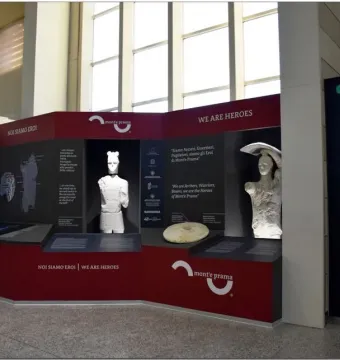
October 2019 © János Korom Dr. >17 Million views · CC BY-SA 2.0
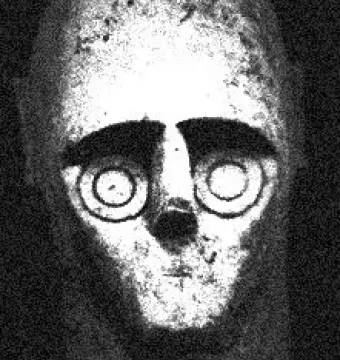
© Xoil · CC BY-SA 3.0
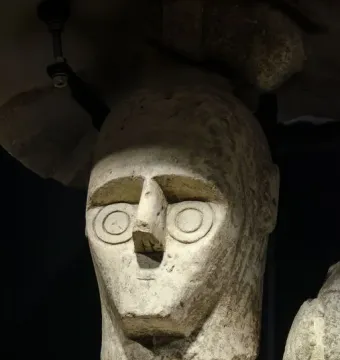
August 2022 © Ángel M. Felicísimo · CC BY 2.0
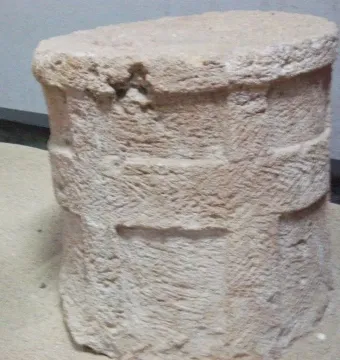
January 2009 © DedaloNur · CC BY-SA 3.0
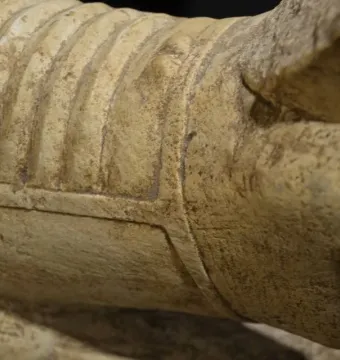
April 2015 © DedaloNur · CC BY-SA 4.0
Identification | |
| Title | Giants of Mont'e Prama |
| Original name | Sos gigantes de Mont’e Prama |
| Type | Ancient stone sculptures |
Historical context | |
| Burial posture | Burials were seated |
| Buried individuals | Young individuals, almost all male, with very developed musculature |
| Interpretation of buried individuals | Scholars suggest they belonged to the warrior class or the aristocracy |
| Dating evidence | Human remains, ceramics, and in one case an Egyptian scarab of Ramesside age |
| Dating method | Carbon-14 dating |
| Archaeological context | A large necropolis with about 150 burials as of 2021 |
| Current dating of necropolis initial phase | Recent Nuragic Bronze Age (12th century BC–13th century BC) |
| Latest Nuragic burial date | 4th century BC, around the time of the Carthaginian conquest of Sardinia |
| Later disturbances | Punic ceramics and tombs are linked to the destruction and dumping of the statues |
| Site context | Surrounded by Nuragic remains such as villages and nuraghi; may be the surface manifestation of a larger settlement |
| Geophysical survey findings | Ground-penetrating radar identified numerous other tombs, probably other statue deposits, and temple structures, not yet investigated as of 2021 |
| 2014 excavations | Excavations resumed in 2014 by the Universities of Sassari and Cagliari and uncovered new tombs and statues |
| 2014 betyl find | A new betyl specimen with a human face and Nuragic-helmet crest was discovered in 2014 and compared with examples from Ossi and Viddalba |
| Proposed dating | Hypotheses range from the 13th century BC to the 9th century BC, with some proposals as late as the 11th to 8th century BC |
| Burial type | Pit tombs |
| Culture | Nuragic civilization |
| Associated site | Mont'e Prama necropolis |
Discovery and provenance | |
| Restoration organization | Restoration was carried out by the Centro di conservazione archeologica di Roma under the coordination of the Superintendence for Archaeological Heritage for the provinces of Sassari and Nuoro |
| Initial display | Some of the first fragments were exhibited in a wing of the Archaeological Museum of Cagliari |
| Discovery date | March 1974 |
| Discovery location | Mont'e Prama, Sinis di Cabras, province of Oristano, Sardinia, Italy |
| Discovery circumstances | Discovered by chance by farmer Sisinnio Poddi; the first find was a statue head |
| Condition at discovery | Found broken into numerous fragments |
| Initial excavators | Giovanni Lilliu and Enrico Atzeni |
| Archaeological excavations | Four campaigns between 1975 and 1979 |
| Fragments found | About 5,000 stone fragments were recovered |
| Fragment inventory | 15 heads, 22 torsos, 176 arm fragments, 143 leg fragments, and 784 shield fragments |
| Associated finds | Nuraghe models and numerous betyls of the oragiana type |
| Initial storage | Repositories of the National Archaeological Museum of Cagliari |
| Early reception | The discovery was neglected for decades |
| Restoration location | Centro di restauro e conservazione dei beni culturali in Sassari / Li Punti, Sassari |
| Restoration funding | Funds were allocated in 2005 by the Ministry for Cultural Heritage and Activities and the Region of Sardinia |
| Planned final location | Cabras, in a future museum extension intended to house all the figures |
| Current exhibition status | As of May 2026, none of the giants are exhibited in Cagliari |
| Public exhibition | Since 2009, 25 restored statues have been exhibited at special events; permanent public access began in November 2011 |
| Restoration period | 2007–2012 |
Physical characteristics | |
| Finds from later excavations | Additional statues, Nuragic models, and a long wall were found |
| Depicted figures | Archers, warriors, and boxers |
| Most recent estimate of original number of statues | 44 statues |
| Reconstructed complex | 38 sculptures in total: 5 archers, 4 warriors, 16 boxers, and 13 nuraghe models |
| Height | Between 2 and 2.6 meters |
Materials | |
| Stone source | Quarries about 16 km away in a straight line |
| Material | Local calcarenite / sandstone |
Technique | |
| Tool marks | Traces of a tool similar to a gradina were found |
| Carving method | Carved in the round from a single block |
Appearance | |
| Stylistic comparison | Comparable to Nuragic bronzetti and bronze figurines from Abini, Serri, and Teti |
| Facial features | Deep-set eyes made of concentric circles, large noses, and mouths represented by a line |
| Life-size scale | Their life-size scale is considered unique for the time and for Sardinia |
| Helmet features | Horned Nuragic helmets, sometimes described as crestated and horned |
| Clothing style | Oriental-style clothing with a broad belt and short kilt |
| Hairstyle | Some figures have Celtic-like hairstyles |
| Shield features | Shields are elaborately worked |
Iconography and meaning | |
| Facial significance | Among the earliest representations of the human face in Nuragic Sardinia |
| Related symbolism | Linked to funerary cults of the warrior elite and to changing social and political conditions |
| Depicted warrior type | Warriors with typical Nuragic helmets |
| Interpretation of depicted figures | Initially regarded as Punic or Roman sculptures, later interpreted as Nuragic warriors |
| Alternative name used by Giovanni Lilliu | Kolóssoi / Kolossoi |
| Interpretation | Evidence for a proto-statuary tradition in Nuragic culture |
| Evolutionary hypothesis | Seen as the final outcome of a line of development from oragiana betyls to anthropomorphic statues |
| Stylistic relationship | Connected to statue-menhirs, statue-betyls, and bronzetti through shared features such as pectoral plates, diagonal weapons, possible masks, and facial representation |
Significance | |
| Historical significance | Possibly the oldest and most numerous complex of free-standing sculptures in Europe and the western Mediterranean |
| Art-historical comparison | If the dating is confirmed, they would be the most ancient anthropomorphic sculptures in the Mediterranean after Egyptian statues and before the kouroi of ancient Greece |
| Comparative chronology | Earlier than the kouroi of ancient Greece and second only to Egyptian sculpture |
| Distinctive significance | The life-size scale makes them unique for their period and for the island |