
Jockey of Artemision
Jockey of Artemision is a Greek bronze sculpture from the Hellenistic period, now held in the National Archaeological Museum in Athens (inventory no. Χ 15177). It was recovered in parts from a shipwreck off Cape Artemision on northern Euboea in 1928 and 1937, then assembled. Some elements were missing, including the reins and whip once held by the rider, and parts of the horse’s tail and belly were reconstructed during restoration. The sculpture measures 2.10 m in height and 2.90 m in length. It depicts a young boy, probably African, riding a galloping horse. The horse is rendered with strong dynamism and realism, while the rider wears sandals and a chiton and has a fierce expression.
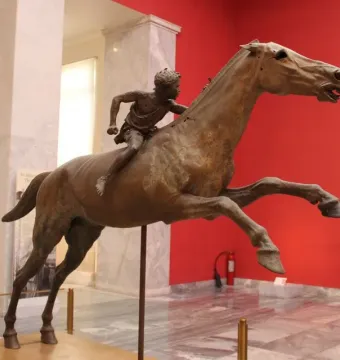
July 2016 © Gary Todd · CC0
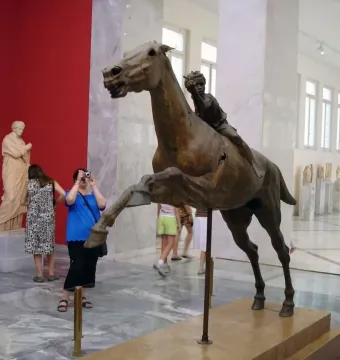
© Славен Косановић · CC BY-SA 3.0
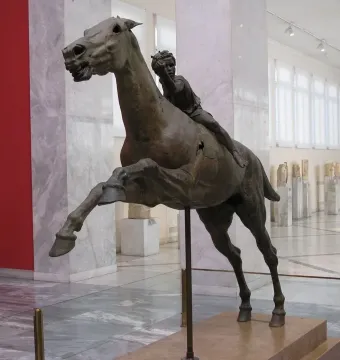
January 2009 © Tilemahos Efthimiadis · CC BY 2.0
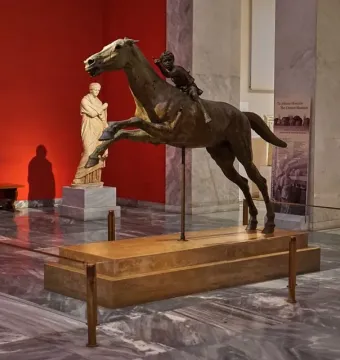
September 2018 © George E. Koronaios · CC BY-SA 4.0
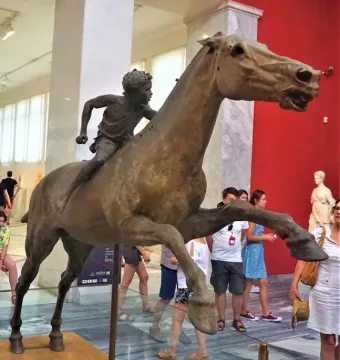
August 2018 © Joyofmuseums · CC BY-SA 4.0
Identification | |
| Title | Jockey of Artemision |
| Alternative name | The Cavalier or Jockey of Artemision; Jockey from Cape Artemision; Horseman from Cape Artemision; Reiter von Artemision |
| Original-language title | Jeździec z Artemizjon; El jinete de Artemisión; Вершник з мису Артемісіон |
| Type | Hellenistic bronze equestrian sculpture group |
Historical context | |
| Date | c. 150–140 BC |
| Period | Hellenistic period |
Creator | |
| Artist | Unknown |
Discovery and provenance | |
| Possible original provenance | Sean Hemingway proposed that it may originally have stood in Corinth, been looted by Lucius Mummius in 146 BC, transferred to Attalus II, and lost in a shipwreck en route to Pergamon; this is hypothetical |
| Additional recovery | Further fragments were recovered in 1928 and in 1936/1937 |
| Discovery context | Recovered from a Roman shipwreck; found by sponge divers among bronze fragments, together with the Poseidon of Cape Artemision |
| Discovery location | Off Cape Artemision, northern Euboea, Greece |
| Discovery date | 1926 |
Location and ownership | |
| Current location | National Archaeological Museum, Athens |
| Inventory number | Χ 15177 |
Physical characteristics | |
| Scale | Approximately life-size |
| Height | 2.10 m |
| Length | 2.90 m |
| Condition | Preserved almost intact except for the reins, bridle, and whip; later reassembled after recovery |
Materials | |
| Material | Bronze |
| Restored or inserted materials | Some missing sections, including part of the horse's tail and belly/body, were restored during conservation; the horse's eyes and Nike emblem were made of a different material and are now lost |
Technique | |
| Construction | Cast in multiple parts and later assembled |
Appearance | |
| Depicted subject | A young boy jockey riding a galloping horse |
| Rider expression | Fierce, angry expression |
| Horse pose | The horse is shown in a leaping or full-gallop pose with forelegs stretched forward and hind hooves on the ground |
| Rider pose | The rider leans forward on the horse's back |
| Objects held | Originally a bridle in one hand and a whip or riding crop in the other |
| Decoration | A Nike figure with a wreath was engraved or attached on the horse's right thigh |
| Relative scale | The rider is very small in comparison with the horse |
| Surface details | The rider and the horse's hooves are somewhat darker than the horse's body; the eyes were originally inlaid and are mostly lost |
| Rider appearance | The boy is probably of African, likely Ethiopian, origin; he wears a short chiton and sandals and has a Greek hairstyle |
Iconography and meaning | |
| Meaning | It is often read as emphasizing movement, vivid realism, and the relationship between human beings and forces greater than themselves |
| Race type | Probably a single-horse race (keles) |
| Interpretation | The sculpture may commemorate a victorious rider or horse-racing victory, possibly as a dedication to the gods by a wealthy patron |
Significance | |
| Rarity | One of the rare surviving original bronze sculptures from ancient Greece; a rare surviving example of a racehorse in Greek sculpture |
| Historical significance | Important as one of the most original surviving sculptures of the Hellenistic period |
| Related works | The Boxer of Quirinal, the Charioteer of Delphi, the Poseidon of Cape Artemision, the Riace bronzes, the Thermen ruler, and the fragment of the Chatsworth Apollo |
History and restoration | |
| Restoration history | Recovered in parts, restored, and reassembled after 1928/1937 recoveries; a reconstruction attempt was made in 1972 |
| Missing parts | The reins, bridle, and whip are missing |
| Reconstruction issues | A 1972 reconstruction noted difficulties with the horse's right foreleg, the tail, and the rider's seating position |
Other | |
| Source of survival | It survived because it was lost in antiquity in a shipwreck, whereas most ancient bronzes were later melted down for their metal |