
Athlete from Ephesus
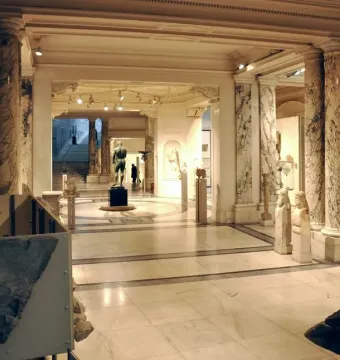
Athlete from Ephesus, also known as the Apoxyomenos of Ephesus, is an Ancient Greek bronze sculpture representing an athlete cleaning his body with a curved scraper called a strigil after physical exertion. The work belongs to the antiquities collection of the Museum of Art History in Vienna and is preserved in the Ephesus Museum in the Imperial Palace of Hofburg. The statue was gifted to Emperor Franz Joseph I by Sultan Abdul Hamid II and later reconstructed in Vienna from 234 elements attached with brass links and 1,800 screws on an iron frame. Mortar was used to stabilize it, but after later display in Vienna’s Volksgarten, deterioration and corrosion affected the sculpture.
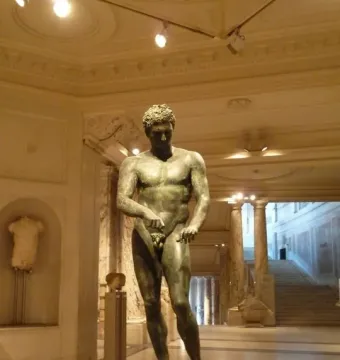
February 2013 © Deror Avi · CC BY-SA 3.0
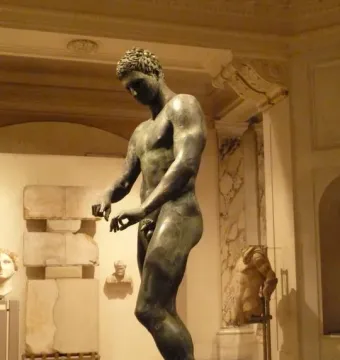
February 2013 © Deror Avi · CC BY-SA 3.0
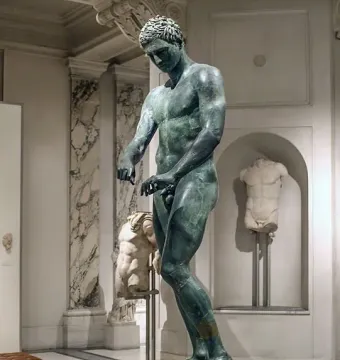
October 2007 © Tsui · CC BY-SA 3.0
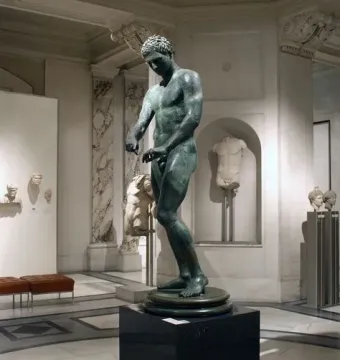
October 2007 © Tsui · CC BY-SA 3.0
October 2010 © Photo: Andreas Praefcke · Public domain
Identification | |
| Title | Athlete from Ephesus |
| Alternative title | Apoxyomenos of Ephesus |
| Type | Bronze statue |
| Cultural origin | Ancient Greece |
Historical context | |
| Historical note about Ephesus | Ephesus was destroyed by the Goths in 263 and by an earthquake in 614 |
| Original statue date | Around 330 BC |
| Date | Not specified in the fragment |
Creator | |
| Possible original artist | Daidalos of Sicyon, but this attribution is hypothetical |
| Original artist | Not attributable to any ancient Greek artist |
Discovery and provenance | |
| Expedition | An Austrian expedition |
| Condition when gifted | In fragments |
| Gifted by | Sultan Abdul Hamid II |
| Gifted to | Emperor Franz Joseph I |
| Excavation leader | Rudolf Heberdey (1864–1936) |
| Discovery condition | Found as several hundred fragments |
| Excavation area | The palaestra area of Ephesus |
| Discovery date | 1896 |
| Findspot | Ephesus, near modern-day Selçuk, on the western coast of Anatolia, Turkey |
Physical characteristics | |
| Height | 192 cm |
Materials | |
| Primary material | Bronze |
Appearance | |
| Subject | A young nude athlete cleaning himself with a strigil |
Iconography and meaning | |
| Action depicted | The athlete is cleaning himself with a recently used strigil held between the thumb and index finger of his left hand |
| Cultural practice depicted | Athletes and wrestlers traditionally cleaned their bodies in this way to remove oil and dust |
| Strigil status | The strigil itself has not survived |
Location and ownership | |
| Inventory number | VI 3168 |
| Later display location | Temple of Theseus in Volksgarten park, Vienna |
| Preserved at | Ephesus Museum in the Imperial Palace of Hofburg |
| Collection | Antiquities collection of the Kunsthistorisches Museum Vienna |
History and restoration | |
| Reconstruction place | Vienna |
| Cause of damage | Climate conditions and acidic vapors from an old wine cellar below |
| Reconstruction basis | 234 elements |
| Condition at reconstruction | In many fragments |
| Examination period | Two years before the 2015 exhibition |
| Transport assessment | Considered able to travel |
| Damage after display | The mortar began to dissolve, and efflorescence appeared on the bronze |
| Inventoried after reconstruction | 1911 |
| Stabilization method | Filled with mortar |
| Assembly method | Fixed on brass links or brackets with screws and mounted on an iron frame |
| Scientific analyses | Chemical analyses, endoscopic examinations of the filling mortar, and X-ray examinations of the structure |
Significance | |
| Original status | Lost statue |
| Known copies | Numerous Roman copies survive in marble, plain stone, and clay |
| Historical significance | The many Roman copies indicate that the original was very popular |
| Related sculpture | Another athlete statue found in the sea near the Croatian islands of Lošinj and Vele Orjule, recovered from almost 50 m depth |
| Exhibition | Shown together with the related statue in a traveling exhibition organized with the J. Paul Getty Museum in 2015 |
| Exhibition venues | Vienna, Florence, Los Angeles, and Washington, D.C. |
Other | |
| Categories | Sculpture of Greece of the 1st century BC; Collections of the Kunsthistorisches Museum, Vienna; Bronze sculptures of Ancient Greece |