
Portrait of the Four Tetrarchs
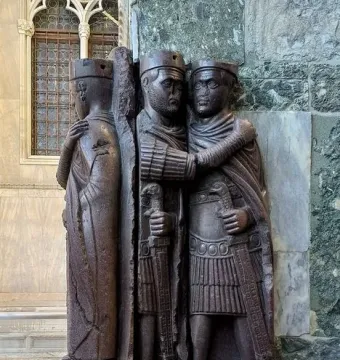
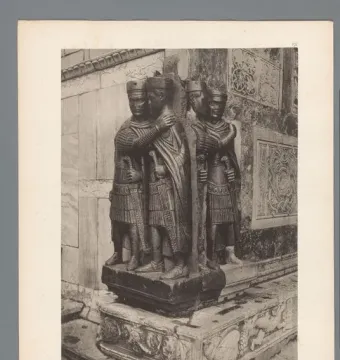
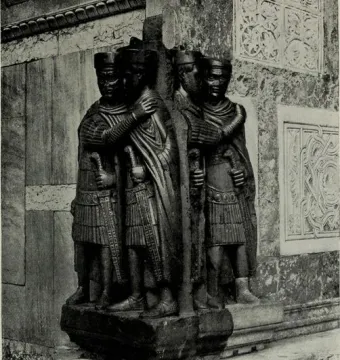
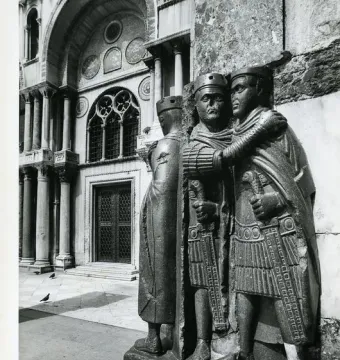
Portrait of the Four Tetrarchs is a porphyry sculptural group of four Roman emperors dating to around 300 CE. It is one of the most characteristic artworks of the Late Roman Empire. The sculpture has been fixed to a corner of the façade of St. Mark’s Basilica in Venice, Italy since the Middle Ages, and was probably originally part of the decorations of the Philadelphion in Constantinople before being moved to Venice in 1204 or soon after. The work was originally designed as two separate sculptures, each showing a pair of late Roman emperors in armor embracing. There is debate about the identities of the figures and their arrangement, but they are generally linked to the first Tetrarchy established by Diocletian.
October 2023 © Ondřej Žváček · CC BY 4.0
© Rijksmuseum · CC0
1903 © Internet Archive Book Images · No restrictions
© Paolo Monti · CC BY-SA 4.0
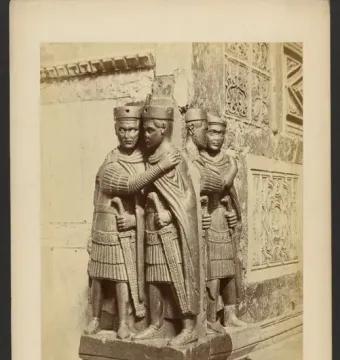
© Carlo Ponti · Public domain
Identification | |
| Title | Portrait of the Four Tetrarchs |
| Alternative names | The Four Tetrarchs; The Tetrarchs; Monument to the Tetrarchs; Statue of the Four Tetrarchs |
| Type | Sculptural group |
| Subject | Four Roman emperors of the Tetrarchy |
Historical context | |
| Date | around 300 CE |
| Period | Late Roman Empire |
| Historical context | Associated with the Roman Tetrarchy created by Diocletian |
Creator | |
| Art-historical attribution | Eastern school of Roman art |
Discovery and provenance | |
| Probable original location | The Philadelphion in Constantinople, probably as part of the decoration of the Capitolium |
| Original installation | Unknown; probably transported to Constantinople from Diocletian's palace in Nicomedia |
| Removal to Venice | Taken to Venice in 1204 or shortly after, likely as spoils of the Fourth Crusade |
Location and ownership | |
| Current location | Fixed to a corner of the facade of St. Mark's Basilica in Venice, Italy |
| Location since | Since the Middle Ages |
Physical characteristics | |
| Number of figures | Four |
| Number of statues | Two paired statues |
| Scale | Slightly smaller than life-size |
| Height | about 1.30 meters |
Materials | |
| Material | Porphyry |
| Material origin | Egypt |
Technique | |
| Technique | Carved from porphyry and attached to columns; the figures are almost fully sculptural in high relief, with their backs merging into the columns |
Appearance | |
| Beards | Two figures have beards; two are clean-shaven |
| Support | The statues stand on plinths supported by consoles of the same stone |
| Decoration | Shoes and sword scabbards are decorated with gemstones; one pair also has jeweled belts |
| Composition | Two pairs of nearly identically dressed men embracing each other |
| Facial style | Rigid, non-individualized faces |
| Clothing and equipment | Military dress with muscle cuirass, paludamentum, long-sleeved tunic with skirt reinforced by leather strips, pteruges, Pannonian cap, campagi, and spathae with jeweled scabbards |
| Pose | Each figure embraces the other with one hand and rests the other on a spatha |
| Headgear | Pilleus Pannonicus |
Condition | |
| Condition | Largely preserved, but with major losses and repairs |
| Damage | The original columns no longer exist; one pair is missing part of the pedestal and one foot, one statue pair is vertically cut and missing much of the right-hand emperor's right side, and another vertical cut separates the two figures and cuts off an arm; all portraits are missing their noses |
| Recovered fragment | The missing foot fragment was found in Istanbul in the 1960s and is now in the Istanbul Archaeological Museum |
History and restoration | |
| Restoration | The missing pedestal and foot were reconstructed by local craftsmen |
Iconography and meaning | |
| Alternative identification | An older theory identified the group as a dynastic group of the Constantinian dynasty; another interpretation proposed the Second Tetrarchy with Galerius, Constantius Chlorus, Severus, and Maximinus Daia |
| Symbolism | The embrace symbolizes unity, solidarity, and stability of the Tetrarchy and the Roman Empire |
| Depicted rulers | Diocletian, Maximian, Galerius, and Constantius I Chlorus |
| Arrangement theory | The eastern rulers may form one pair and the western rulers the other |
| Interpretation | Probably the First Tetrarchy, arranged in two pairs of an older Augustus and a younger Caesar; a less likely alternative is that the two Augusti are shown together and the two Caesars together |
| Political relation | Diocletian named Maximian as co-Augustus and appointed Galerius and Constantius I Chlorus as Caesars |
Significance | |
| Style significance | One of the most characteristic works of art of the Late Roman Empire |
| Interpretive function | A public imperial image meant to emphasize collective power, dynastic unity, and the tetrarchs' ability to reward loyalty and punish rebellion |
Other | |
| Material significance | Porphyry was rare, expensive, difficult to obtain in large quantities, and associated with imperial honor and permanence |