
The Deposition by Michelangelo
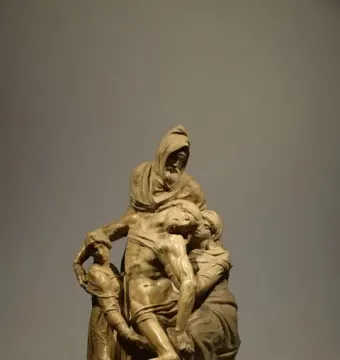
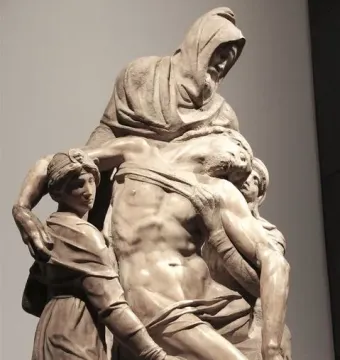
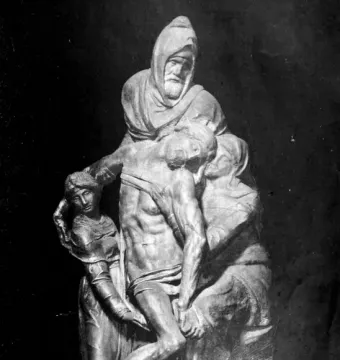
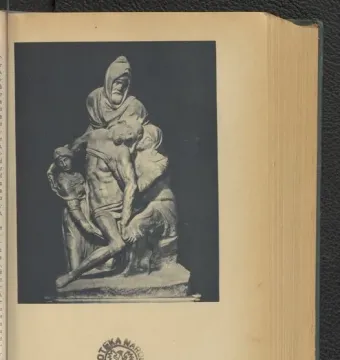
The Deposition, also known as the Florentine Pietà or Bandini Pietà, is one of Michelangelo Buonarroti’s late works. Carved in marble between 1547 and 1555, the group is 226 cm high and is now kept in the Museum of the Works of the Cathedral in Florence. Unlike traditional Pietà compositions, Christ’s lifeless body is supported from both sides by the Virgin Mary and Mary Magdalene, with Saint Nicodemus rising behind them. The sculpture is notable for its powerful vertical design, dramatic spiritual expression, and unfinished condition. Michelangelo left the work incomplete, and it later passed through several locations before reaching Florence in 1674.
June 2019 © George M. Groutas · CC BY 2.0
September 2016 © Milafirenze · CC BY-SA 4.0
1912 © Michelangelo · Public domain
© Jacob Burckhardt · Public domain
May 2009 © sailko · CC BY 2.5
Identification | |
| Title | The Deposition |
| Type | marble sculptural group; Pietà |
| Alternative names | Florentine Pietà; Bandini Pietà; Pietà of the Four Figures; The Lamentation over the Dead Christ; Pietà with Nicodemus; Pietà florencka |
Historical context | |
| Art period | High Renaissance |
| Series | one of Michelangelo's last two Pietàs |
| Subject | The deposition of Christ from the Cross, with Pietà and burial imagery |
| Iconographic tradition | Western European Pietà iconography |
| Religious theme | Meditation on Redemption, the Sacrifice of Christ, and Salvation |
| Meaning in Michelangelo's life | a late, largely personal devotional work intended for his own tomb |
Creator | |
| Creation period | 1547–1555 |
| Artist age at creation | about 72 at the beginning; 80 by the end |
| Artist style or status | late Renaissance master of sculpture |
| Artist nationality | Italian |
| Artist | Michelangelo Buonarroti |
Discovery and provenance | |
| Sale price | 200 scudi |
| Current location since 1981 | Museo dell'Opera del Duomo, Florence |
| Relocation in 1933 | first chapel on the right of the north transept |
| Relocation in 1722 | moved to Santa Maria del Fiore (Florence Cathedral) |
| Florence location in 1674 | Church of San Lorenzo, in the Medici crypt |
| Transfer to Florence | brought to Florence in 1674 through the intervention of Grand Duke Cosimo III de' Medici |
| Reception in Rome | admired by Gian Lorenzo Bernini |
| Later Roman location | the Bandini vineyard on the Quirinal (Montecavallo) |
| First post-sale location | Bandini's gardens near Piazza Monte Cavallo in Rome |
| Sale intermediary | Tiberio Calcagni |
| Cathedral placement | behind the high altar |
| Buyer | Francesco Bandini |
| Original purpose of marble block | probably intended for a portrait of Pope Julius II emerging from the tomb supported by four angels |
| Sale date | 1561 |
| Commission status | not made to commission |
| Intended function | probably made for Michelangelo's own tomb |
| Intended burial location | Basilica of Santa Maria Maggiore, Rome |
| Probable source of marble block | one of the blocks remaining for the tomb of Pope Julius II |
| Completion status | unfinished; Michelangelo never finished the work himself |
| Dating uncertainty | some sources suggest an earlier date of 1534–1535 and a planned connection with the tomb of Pope Julius II |
| Working conditions | Michelangelo worked into the night by candlelight and under difficult conditions with an extremely hard, impurity-filled marble block |
| Motivation for beginning the work | to amuse his mind, keep his body healthy, and occupy his final years |
| Working state in 1553 | still in progress and under construction |
| Work duration | about 8 years |
Physical characteristics | |
| Height | 226 cm |
| Number of figures | four |
Materials | |
| Material | marble |
Appearance | |
| Virgin Mary | pained and suffering |
| Mary Magdalene | cold and distant |
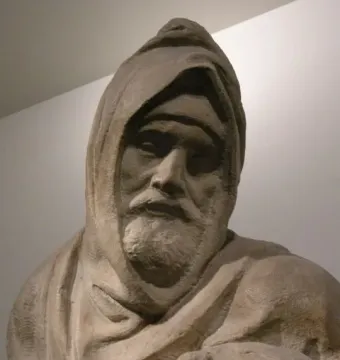
| Hooded figure | an unidentified hooded figure supporting Christ's body |
| Christ figure | the dead body of Christ is shown in a serpentine, heavily slumping pose after being taken down from the Cross |
| Figure arrangement | Christ's body lies in the arms of the other figures; the Virgin Mary is shown in mourning; Mary Magdalene stands to one side; the hooded figure supports Christ's body |
| Figure identities | the hooded figure is generally identified as Nicodemus, but some sources identify him as Joseph of Arimathea or both simultaneously |
| Composition | an unusual vertical composition with an S-curve linking the figures |
| Depicted figures | Jesus Christ; the Virgin Mary; Mary Magdalene; Nicodemus, possibly Joseph of Arimathea |
Iconography and meaning | |
| Alternative figure identification | the hooded figure may be Joseph of Arimathea rather than Nicodemus |
| Self-portrait interpretation | according to Vasari and some researchers, the face of Nicodemus is a self-portrait of Michelangelo |
| Entombment reading | suggested by Mary Magdalene and Joseph of Arimathea, though disputed |
| Deposition reading | supported by the presence of Joseph of Arimathea and Nicodemus and the arrangement of Christ descending into his mother's arms |
| Pietà reading | supported by Michelangelo's long interest in Pietà subjects and the emphasis on the Virgin's suffering |
| Narrative reading | if circumnavigated from the viewer's right to left, it can be read as a three-step sequence of deposition, Pietà, and entombment |
| Interpretation | the work may be read as a Pietà, a Deposition from the Cross, an Entombment, or a combination of these scenes |
History and restoration | |
| Completion attempt | Tiberio Calcagni tried to restore and complete the sculpture, especially the female figure on the left and the figure of Mary Magdalene |
| Interpretive note | a change in viewpoint significantly alters the perception of the work, so it should be displayed with a wall as a backdrop |
| Exhibition history | the sculpture was once mounted on an incorrectly made pedestal, and the old plinth was arbitrarily cut when installed in Florence Cathedral, affecting the viewing angle |
| Earlier version and reproductions | a copy by Lorenzo Sabatini exists in the sacristy of St. Peter's Basilica; other drawings, engravings, wax replicas, marble copies, and plaster casts are also known |
| Later restoration figure | Mary Magdalene added by Calcagni is disproportionate and executed differently from the rest of the work |
| Damage | Christ's left arm was broken above the elbow, the left leg was broken off and is missing, and there are cracks and minor damage in several places |
| Reason work remained unfinished | partly because of a flaw in the marble and mainly because Michelangelo was dissatisfied with the solution |
| Damage prevented by | Michelangelo's servant Antonio |
| Missing fragment history | the missing left-leg fragment was kept in Daniele da Volterra's workshop and is listed in his inventory as a marble knee by Michelangelo |
| Damage marks | breakage remains on Christ's elbow, chest, shoulder, and Mary's hand |
| Destruction attempt | around 1555 Michelangelo partially smashed the sculpture with a hammer after a marble vein caused a change in Christ's legs to break |
| Condition | unfinished and left in a damaged state |
Significance | |
| Importance | one of Michelangelo's last sculptures and one of his last two Pietàs |