
Palestrina Pietà
Palestrina Pietà is a large sculptural group attributed to Michelangelo, now on display in the Gallery of the Academy of Florence, near the David and other works by the artist. The group shows Christ, the Virgin Mary, and Mary Magdalene, and measures about two and a half meters high. Its authorship is disputed, since it is not documented in contemporary sources, and some scholars reject the attribution outright. The work was first mentioned in 1756 in connection with the funerary chapel of Cardinal Antonio Barberini in Palestrina, and the Italian state purchased it in 1939 for Florence. It is carved from a large Roman imperial marble block and shows a frontal, relief-like composition with unfinished secondary figures.
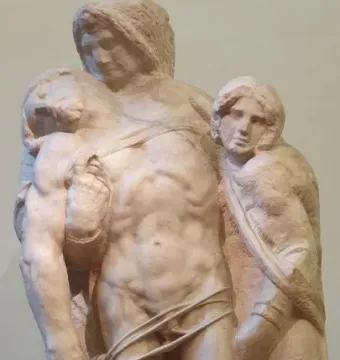
April 2019 © Yair Haklai · CC BY-SA 4.0
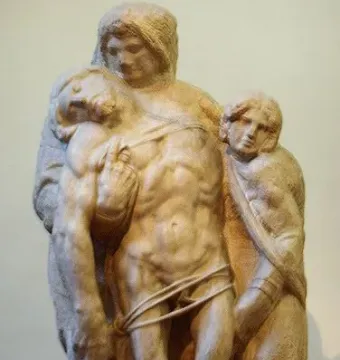
2008 © User:Tetraktys · CC BY-SA 3.0
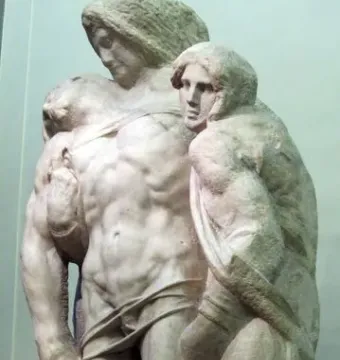
January 2014 © Francesco Bini · CC BY-SA 4.0
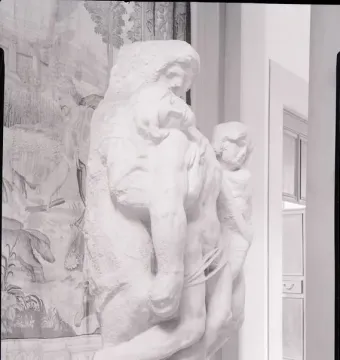
© Paolo Monti · CC BY-SA 4.0
© Sailko · CC BY 3.0
Identification | |
| Title | Palestrina Pietà |
| Art period | High Renaissance |
| Alternative name | Pietà of Palestrina |
| Type | Marble sculpture |
| Original-language name | Pietà di Palestrina |
Historical context | |
| Date | c. 1555; some sources date it to 1556, and proposed dates generally range from 1550 to 1559 |
Creator | |
| Evidence for attribution | Supporters cite stylistic affinities with Michelangelo, including the treatment of Christ's legs, a Herculean conception of the nude, some facial features, and contrasts between finished and unfinished areas |
| Attribution history | First attributed to Michelangelo in the first half of the 18th century; Leonardo Cecconi described it in 1756 as an abbozzo/bozzetto by the famous Buonarroti |
| Evidence against attribution | Skeptics point to the disproportion of Christ's legs, heaviness, a squarish or rectangular group outline, unusual softness of modeling, and the lack of contemporary documentary mention |
| Authorship uncertainty | Several scholars argue it was completed by an assistant, pupil, imitator, or other unknown hand rather than by Michelangelo himself |
| Alternative makers proposed | Niccolò Menghini, Gian Lorenzo Bernini, Francesco da Sangallo |
| Attribution | Traditionally attributed to Michelangelo, but the attribution is disputed |
Discovery and provenance | |
| First recorded description | Described as a sketch by Michelangelo in the funerary chapel of Cardinal Antonio Barberini in the church of Santa Rosalia in Palestrina |
| Original location | Unknown |
| Former location | A room beside the Church of Santa Rosalia in Palestrina |
| Name origin | Named after Palestrina, where it was formerly located |
| Provenance hypotheses | Romanelli linked its presence in Palestrina to Michelangelo's friendship with Vittoria Colonna and her family ownership of Palestrina; Granier/Grenier suggested it arrived through the Farnese family; some scholars connect it with a reported 17th-century Michelangelesque Pietà found in Rome and later said to end up in Palestrina |
| Historical silence | No earlier discussion of the work is known, and Suaresius did not mention it in 1655 |
| First recorded mention | 1756, in Leonardo Cecconi's Storia di Palestrina |
Physical characteristics | |
| Surface and modeling | The carving combines more finished and less finished areas with unusually soft modeling and a flattened relief effect |
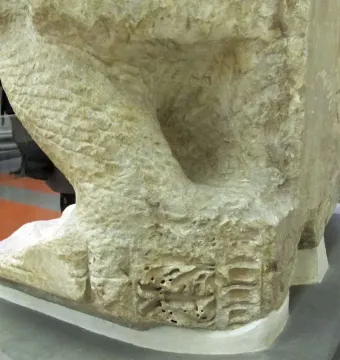
| Back surface | The reverse preserves acanthus-leaf decoration from an ancient architectural element |
| Number of figures | Three |
| Form | The figures barely detach from the background, giving the work a relief-like appearance |
| Viewpoint | Primarily frontal |
| Height | About 2.5 metres |
Materials | |
| Material | Marble |
| Stone source | A large ancient Roman marble block, possibly part of an entablature or architrave |
| Visible earlier decoration | Part of the earlier decoration remains visible on the back, including acanthus-leaf ornament |
Technique | |
| Carving technique | Carved from an ancient reused block |
| Workshop involvement | Differences between parts of the work have been attributed to a workshop member or student working under Michelangelo's direction or supervision |
Appearance | |
| Comparative references | It has been compared with the Bandini Pietà, the Rondanini Pietà, and the drawing for the Pietà for Vittoria Colonna or the Deposition in Oxford |
| Stylistic affinities | The work is considered Michelangelesque in its treatment of Christ's legs, the nude body, and the contrast between finished and unfinished passages |
| Composition | A group of three figures with Christ supported by Mary and John the Evangelist; a smaller side figure may be Mary Magdalene |
Location and ownership | |
| Current location | Galleria dell'Accademia, Florence, Italy |
| Ownership history | Formerly owned by the Barberini family; acquired by the Italian state in 1939 |
| Acquisition details | Bought in 1939 through a donation and payment arranged by Gerolamo Gaslini; the Fascist regime blocked a planned sale to an American dealer and used the acquisition for propaganda |
| Museum display | Placed in the Galleria dell'Accademia in Florence, alongside the David and other Michelangelo works |
History and restoration | |
| Dating context | Often considered one of Michelangelo's last works, created in the 1550s and possibly intended for his own tomb in Rome, near the Basilica of Saint Mary Major |
| Creation hypothesis | Possibly made in Rome without commission for Michelangelo's own tomb; another hypothesis is that it was carved directly in a Carrara quarry while he was supplying marble for his works |
Significance | |
| Current attribution status | The attribution to Michelangelo remains controversial, and the work is often considered by modern scholars to have been completed by someone else |