
Sarcofago delle Amazzoni
Sarcofago delle Amazzoni is a painted Etruscan sarcophagus dating to the 4th century BC. It was discovered in 1869 at Tarquinia, then called Corneto, and is now in the Archaeological National Museum in Florence. The marble coffin and lid are decorated with reliefs and inscriptions, including the name of the deceased, Ramtha Huzcnai. Its painted scenes on a pink ground show battles between Amazons and Greeks, with figures rendered in tempera over a thin lead layer. The composition has long been debated in scholarship, with some scholars regarding the paintings as Greek work and others as Etruscan.
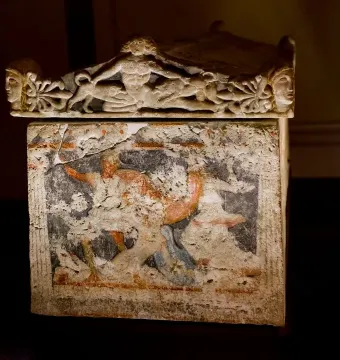
August 2016 © ArchaiOptix · CC BY-SA 4.0
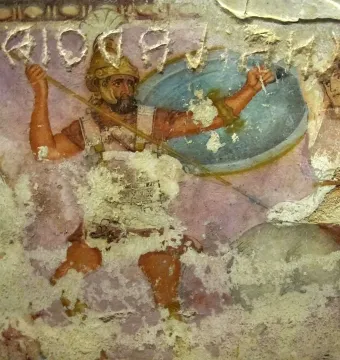
January 2014 © Sailko · CC BY-SA 3.0
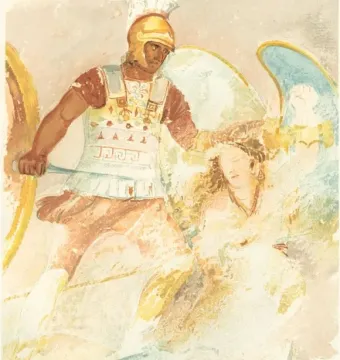
1883 © Charles Fairfax Murray ("These facsimiles have been prepared ... from drawings taken at my request by Mr. C. Fairfax Murray in 1881" — Colvin, p. 355) · Public domain
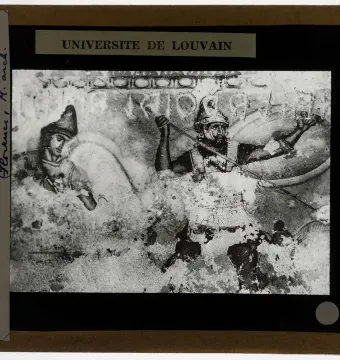
© Unknown authorUnknown author · Public domain
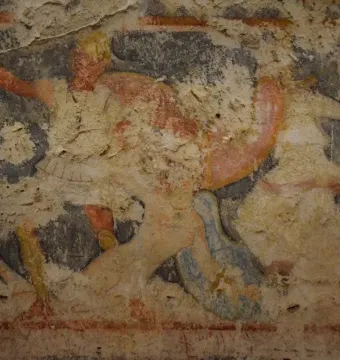
© Carole Raddato · CC BY-SA 2.0
Identification | |
| Title | Sarcofago delle Amazzoni (Sarcophagus of the Amazons) |
| Object type | Architectural sarcophagus in the form of a small temple (tempietto) |
| Type | Etruscan painted sarcophagus |
Historical context | |
| Date | 4th century BC, probably mid-4th century BC; one source specifies the third quarter of the 4th century BC |
Discovery and provenance | |
| Discovered | 1869 |
| Discovery location | Tarquinia (then Corneto) |
| Associated find | A second similar sarcophagus was found with it, but without figurative paintings; it is now lost |
| Transfer to Florence | Transferred to Florence in 1872 by the Savoy government |
Location and ownership | |
| Current location | National Archaeological Museum of Florence |
| Inventory number | 5811 |
| Original ownership context | A burial monument for Ramtha Huzcnai |
Physical characteristics | |
| Base form | Simple base, hollowed out from a single block |
| Lid form | Modeled like a gabled roof; architectural form with pediments and pillars |
| Form | Simple rectangular coffin with a sloping lid |
| Dimensions | 71 cm × 194 cm × 62 cm |
Materials | |
| Coffin material | White calcite alabaster stone, often described as marble or alabaster |
| Lid material | White calcite alabaster stone, often described as marble or alabaster |
| Material provenance | The stone does not occur in Etruria; it is probably from Greece or Asia Minor, and may have been shipped to Italy in semi-finished form |
Technique | |
| Carving technique | Carved from a single block |
| Painting technique | Tempera applied over a thin layer of lead mixed with white pigments |
| Preparatory technique | Figure outlines were incised into the stone and then drawn in dark red or brown |
| Shading technique | Hatched lines and fluid chiaroscuro were used to model the figures |
Appearance | |
| Long-side inscriptions | Longer inscriptions are incised into the paintings on the long sides |
| Short-side background | Dark background on the short sides |
| Surface treatment | Painted exterior walls |
| Framing | Each side is framed by a painted border with Doric pilasters at the corners on a continuous crepis, with Doric kyma, Lesbian kyma, and an ovolo frieze |
| Figure colors | Women are shown with light skin and men in a reddish-brown tone |
| Color palette | Pink to reddish-wine background with bright, vivid colors |
Iconography and meaning | |
| Burial relation | Ramtha Huzcnai was the mother or grandmother of the official Larth Apaiatru (zileteraias) |
| Inscription language | Etruscan |
| Buried person | Ramtha Huzcnai |
| Inscriptions | Two Etruscan inscriptions naming Ramtha Huzcnai (TLE² 122) |
| Lid decoration | Reliefs of Actaeon being torn apart by his dogs on the short sides; female heads at the four corners; central head-shaped acroterion with human protomes at the lateral acroteria |
| Depicted figures | Amazons appear on foot, on horseback, and in chariots |
| Head end scene | A kneeling Greek attacked by two Amazons |
| Foot end scene | Three figures: one Amazon attacked by a Greek, with another Amazon coming to her aid |
| Back side composition | Two larger groups: on the right, two Amazons in a four-horse chariot attack two Greeks defending on foot; on the left, a corresponding group |
| Front side composition | Five groups: a central Amazon fighting two Greeks; on both sides, pairs in which a Greek kills a fallen Amazon; at the ends, an Amazon on horseback fighting a Greek on foot |
| Iconographic note | Some scenes do not fit known mythological narratives, so the work may depict battles in general rather than a single specific myth |
| Subject | Amazonomachy, the battle between Amazons and Greeks |
History and restoration | |
| Restoration | Restored in 2007 |
| Condition | Noted for extraordinary freshness, in part thanks to the 2007 restorations |
Significance | |
| Artistic significance | A very rare example of ancient painting with very high pictorial quality, remarkable in Etruscan art |