
Stele of the Vultures
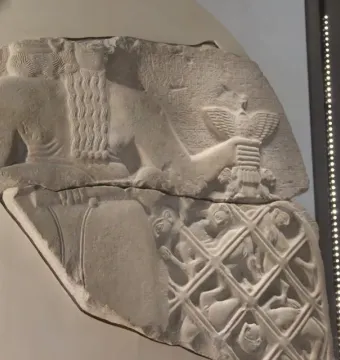
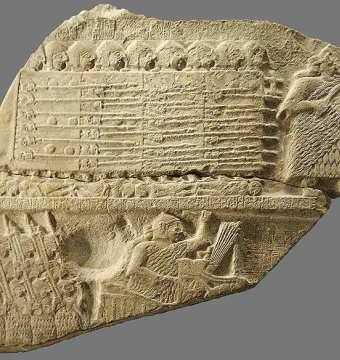
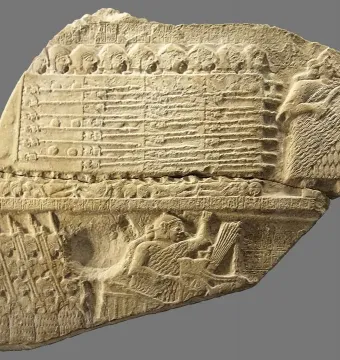
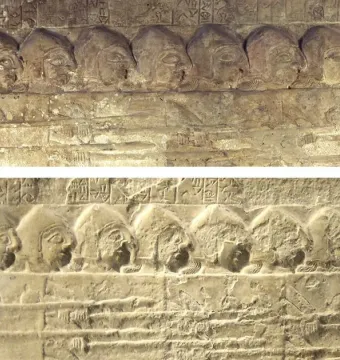
The Stele of the Vultures is a Sumerian commemorative relief carved in limestone around 2450 BCE, at the end of the Early Dynastic period. It celebrates the victory of Eannatum, king of Lagash, over Umma. The work is a narrative bas-relief organized in horizontal registers, with the king and the gods shown in dominant positions. One side depicts marching soldiers and fallen enemies, while the reverse shows the god Ningirsu holding a net of prisoners as a symbol of divine punishment. Cuneiform inscriptions recount the conflict between Lagash and Umma and the treaties established afterward. The stele is considered an early example of political propaganda and a key work of Sumerian art.
July 2016 © Gary Todd · CC0
April 2011 © User:Sting · Public domain
© Unknown artistUnknown artist · CC BY-SA 3.0
April 2020 © User:Sting · CC BY-SA 4.0
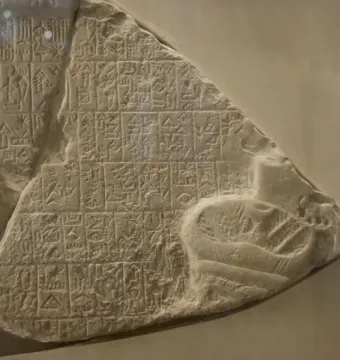
December 2015 © Kikuyu3 · CC BY-SA 4.0
Identification | |
| Title | Stele of the Vultures |
| Original language title | Estela de los buitres |
| Original language title | Stele degli avvoltoi |
| Original language title | Estela dos Abutres |
| Type | Monumental stele |
| Alternative title | Vulture Stele |
Historical context | |
| Culture | Sumerian |
| Period | Early Dynastic III period |
| Date | c. 2450 BC |
| Historical context | Mesopotamian monument commemorating the conflict between Lagash and Umma, during a period of rivalry and repeated wars between the two city-states |
| Related conflict | Lagash-Umma War |
| Commemorated event | Victory of Lagash over Umma |
Creator | |
| Associated ruler | Eannatum, king of Lagash |
| Commissioned by | Eannatum |
Discovery and provenance | |
| Seventh fragment | Bought by the British Museum on the antiquities market in 1898, then transferred to the Louvre in 1932 |
| Current location | Louvre Museum, Paris |
| Surviving remains | Seven fragments |
| Later fragment discovery | Three additional fragments were discovered during excavations in 1888–1889 |
| Discoverer | Ernest de Sarzec |
| Discovery date | 1881 |
| Discovery site | Tello (ancient Girsu), southern Iraq |
Physical characteristics | |
| Material | Limestone |
| Original form | Single limestone slab with a rounded top |
| Dimensions | About 180 cm high, 130 cm wide, and 11 cm thick |
Technique | |
| Technique | Carved relief on both sides |
| Relief type | Low relief (bas-relief) |
| Composition | Organized in horizontal registers |
Appearance | |
| Depicted scenes | Battle scenes, religious scenes, and mythological scenes |
| Depicted figures | Eannatum, the king of Umma, Ningirsu, soldiers of Lagash, defeated enemies, prisoners, vultures, and a female figure identified as Ninhursag |
| Pigmentation | No pigments survive; the stele is presumed to have originally been polychromed |
| Condition | Highly fragmentary and eroded, though many details remain visible |
Iconography and meaning | |
| Subject and meaning | Victory of Eannatum and divine favor, presented as a political and didactic monument rather than decoration |
| Name origin | Named after the vultures shown in one of the scenes carrying off human remains |
| Inscription | Sumerian inscription of about 830 lines on both sides, written in the first person in the name of Eannatum and recounting the conflict and victory |
| Iconography | One side shows Ningirsu trapping and striking enemies with a net and mace; the other side shows Eannatum leading troops, fallen enemies, burial preparations, and vultures tearing at the dead |
| Stylistic significance | A historied narrative stele in traditional Sumerian register composition |
Location and ownership | |
| Current ownership | Louvre Museum |
History and restoration | |
| Preservation history | Recovered in fragments, later reconstructed in the Louvre from seven parts |
Significance | |
| Historical significance | Considered the earliest known war monument and among the oldest historical documents, and one of the first known works to depict a historical event and glorify a victorious ruler |
| Art-historical significance | A key work of ancient art and an early example of political propaganda |
| Influence | Comparable to later Mesopotamian victory monuments such as the Stele of Naram-Sin and the Stele of Hammurabi |