
Daniel and the Lion
Daniel and the Lion is a sculpture by Gian Lorenzo Bernini, made approximately between 1655 and 1657. It is placed inside a niche in the Chigi Chapel in the Basilica of Santa Maria del Popolo in Rome, where it shows the prophet Daniel in the lions' den. Together with the statue of Habakkuk and the Angel, set diagonally opposite, it forms part of a larger compositional scheme. Bernini’s work on the chapel began in 1652 for Fabio Chigi, later Pope Alexander VII. The sculpture was inspired by the Laocoön group, and a terracotta preparatory model survives in the Vatican Museums.
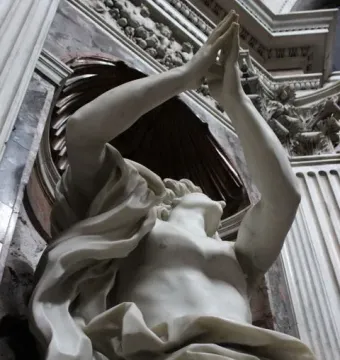
March 2014 © Miguel Hermoso Cuesta · CC BY-SA 3.0
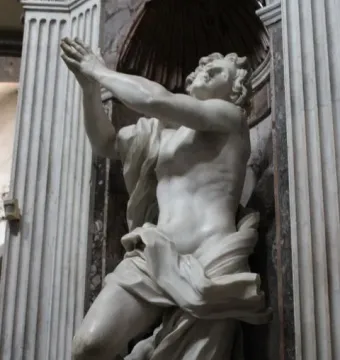
March 2014 © Miguel Hermoso Cuesta · CC BY-SA 3.0
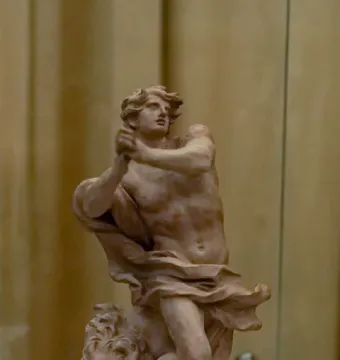
December 2022 © Fabrizio Garrisi · CC0
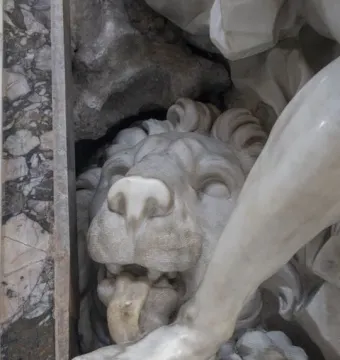
September 2019 © Nicholas Hartmann · CC BY-SA 4.0
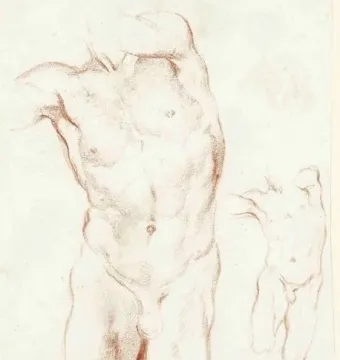
February 2017 © Gian Lorenzo Bernini · Public domain
Identification | |
| Title | Daniel and the Lion |
| Type | Sculpture |
| Original title | Daniele e il leone |
Creator | |
| Artist | Gian Lorenzo Bernini |
| Artist name variant | Le Bernin |
Historical context | |
| Work began | 1652 |
| Stylistic period | Bernini's late style |
| Artistic method | Bernini studied classical models and reworked them in a Baroque style |
| Inspiration | The Laocoön group |
| Patron became pope | 1655, as Alexander VII |
| Initial plan | Bernini first considered moving Raphael-designed statues of Jonah and Elijah to the empty niches beside the altar, but later changed the plan |
| Context | Made for the restoration of the Chigi funerary chapel in the basilica |
| Commissioned by | Fabio Chigi, cardinal priest of the basilica, later Pope Alexander VII |
| Date | circa 1655–1657 |
Location and ownership | |
| Part of ensemble | Forms part of a larger chapel composition with Habakkuk and the Angel, placed diagonally opposite |
| Location | Niche to the left of the entrance in the Chigi Chapel, Basilica of Santa Maria del Popolo, Rome |
| Other statues in chapel | Jonah and Elijah, by Lorenzetto after designs by Raphael |
| Position in ensemble | Diagonally opposite Habakkuk and the Angel, facing it |
| Related sculpture | Habakkuk and the Angel |
Iconography and meaning | |
| Subject | The prophet Daniel in the lions' den |
| Thematic parallel | Parallels Lorenzetto's Jonah; both figures symbolize victory over death by God's grace |
| Classical model for Jonah's face | The ancient statue of Antinous |
| Classical model for Daniel's face | Alexander the Great |
| Interaction with animal | The lion licks Daniel's right foot |
| Gaze direction | Daniel looks upward toward God the Father |
| Divine figure | God the Father is represented in the dome mosaic |
| Characterization of prophets | They are portrayed as youthful, athletic heroes, closer to ancient gods than to the bearded figures of the Old Testament |
| Threat motif | Death threatens both prophets through a dangerous beast: a lion for Daniel and a whale for Jonah |
History and restoration | |
| Payment | 26 June 1657, 1000 scudi; the statue was already in place |
Discovery and provenance | |
| Evidence for attribution | The terracotta model bears Bernini's fingerprints |
| Model attribution | Formerly thought to be by an assistant; after restoration and cleaning in the 1980s it was attributed to Bernini himself |
| Preparatory model | A terracotta preparatory model survives in the Vatican Museums |
| Preparatory drawings | Four studies survive in the Museum der bildenden Künste, Leipzig |
Physical characteristics | |
| Pose | Kneeling and leaning to the right |
| Drapery | Flowing drapery in angular folds from the shoulders across the loincloth and to the sides of the base |
| Body proportion | Characteristic elongated body |
| Animal | A tame lion |
| Gesture | Praying fervently and stretching his hand to the right |
| Figure depicted | The young prophet Daniel |
Other | |
| Other artist mentioned | Lorenzetto |